Showing posts with label ID. Show all posts

Friday, 24 October 2014

False alternatives in creationism and Darwin-plagiarism-theories

A curious similarity exists between creationists and ID-ologists on the one hand and Darwin-conspiracy theorists on the other. The former are unable or unwilling to consider the gradual evolution of organisms or traits from predecessors. The latter are equally unable or unwilling to consider the gradual evolution of Darwinian ideas from predecessors. 

The creationists and ID-ologists claim that it is impossible for complex organisms or traits to evolve by mere chance. Their examples are something like the impossibility of an airplane assembling from a storm in a junkyard or the ostensible irreducibility of complex traits. The Darwin-conspiracy theorists claim the impossibility that the full blown theory of evolution by means of natural selection precipitated independently and from scratch in the minds of Matthew, Wallace and Darwin around the same time. They, too, ignore the predecessors and assume an impossible event that was not necessary for the outcome.

Their false alternatives have no bite
What both have in common is the logic fallacy of false alternatives. Either emergence through mere coincidence or creation, these are the false alternatives of creationists. Either independent discovery from scratch or plagiarism, these are the false alternatives of Darwin-conspiracy theorists.

Where the former see the whole of nature as a big conspiracy pointing towards a creator, the latter see the convergence of ideas as a conspiracy of Darwinists against Wallace, Matthew, or Blyth alternatively.

If we consider the predecessors, however, it is clear that natural selection was not a yet undiscovered idea. On the contrary, it existed in many different contexts (see here, here, here, here and here). Ironically, before Matthew (1831), natural selection was thought to keep the species fixed. We'd now say, they only considered stabilising selection and failed to see the possibility of directional selection.

T.R. Malthus (WikimediaCommons)
In particular, Matthew, Wallace and Darwin all admitted that Thomas R. Malthus (1798. An Essay on the Principle of Population ) was a major source of inspiration for their insight into the importance of natural selection.

Let's see, then, whether anything in Malthus's essay comes so close, that we can comprehend the independent emergence of the idea of evolution through natural selection. (Six times between 1813 and 1858 by Wells 1813/1818, Adams 1814, Matthew 1831, Spencer 1852, Wallace 1858 and Darwin 1858.)

Malthus (1798, p. 11) starts from two simple postulates:
"I think I may fairly make two postulata.
First, That food is necessary to the existence of man.
Secondly, That the passion between the sexes is necessary and will remain nearly in its present state."
From these postulates he deduces a law of nature (Malthus 1798, p. 13f):
"Assuming then my postulata as granted, I say, that the power of population is indefinitely greater than the power in the earth to produce subsistence for man.
Population, when unchecked, increases in a geometrical ratio. Subsistence increases only in an arithmetical ratio. A slight acquaintance with numbers will shew the immensity of the first power in comparison of the second.
By that law of our nature which makes food necessary to the life of man, the effects of these two unequal powers must be kept equal.
And he illustrates the effect of that law of nature (Malthus 1798, p. 15):
"The race of plants and the race of animals shrink under this great restrictive law. And the race of man cannot, by any efforts of reason, escape from it. Among plants and animals its effects are waste of seed, sickness, and premature death. Among mankind, misery and vice."
Malthus's law of nature can justly be called by its current name, which is natural selection. The only thing that is still missing, is the idea of heritable variation acting in concert with this natural selection. That a lot of variation is heritable, however, was a triviality for plant and animal breeders of all stripes. Is it then not comprehensible, how various scholars independently combined these explanatory parts into similar or even identical theories of evolution through natural selection?

Friday, 10 May 2013

The Mousetrap Paradox

It might be useful to reformulate Behe's mouse trap ruse as a paradox, in order to reveal the absurdity of his conclusion. Remember, a paradox is an argument that seems to be correct but leads to an absurd conclusion.


1. Premise:
The flat snap mouse trap consists of five parts, each carrying a function that is necessary for the trap to catch mice: platform, striker (hammer), spring, holding bar (holds the striker in set position), catch (arrests the holding bar in set position and carries the bait).
Figure 2-2 from Behe (Darwin's Black Box, p. 46)
2. Premise:
If any of these parts is missing, the trap will not function as a trap (irreducibly complex). So far the argument is correct. 

3. Conclusion (absurd because it contradicts the historical evidence):
Hence the trap cannot have a precursor working with one part less.

4. Contrary evidence:
The direct precursor of current flat snap traps (the patent from which they all derived) had one part less and was working perfectly (catching mice, economic success story etc).

5. Resolution:

Thursday, 20 December 2012

The Heath Robinson test for evolved complexity

William Heath Robinson (31 May 1872 - 13 Sept. 1944) was a British cartoonist and illustrator and got famous (before Rube Goldberg) for his drawings of contraptions, whose complexity was absurdly out of proportion to their trivial use. If you compare the contraption depicted in a poster commissioned by Procter Bros. with the Little Nipper mouse trap advertised in it, you can clearly see the discrepancy between botched and professional design.


You can use this Heath Robinson test as a non-rigorous check of your own intuitions. If you go "OMG, what an eccentric contraption!" and feel reminded of a Heath Robinson (Rube Goldberg for Americans), it will probably be evolved and not designed - unless it will be art.

Now, that's what biologists regularly think, when studying eyes, hearts, entangled seminal and ureal ducts, etc. Hence these traits all pass the Heath Robinson test for evolved design.

Wednesday, 4 July 2012

Encore: Behe's mousetrap nemesis


Behe simply did not do his homework and check patents before making claims about mousetraps (Behe 1996, p. 39-42). Behe observed that a mousetrap does not work if any of its parts is lacking and therefore cannot have had a precursor made up of one part less.
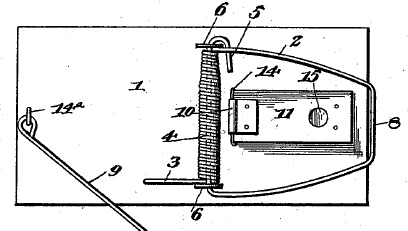
Figure from US patent 528,671 by William C. Hooker
   A search for "animal trap" with a patents search engine can prove the opposite. The seminal patent (Hooker 1894), on which all current flat snap mousetrap designs are based, happened to have one part less—easily. The striker and spring of these traps were formed of one wire part. The figure on the right is from Hooker (1894), a top view on the platform with all the other parts mounted on it.  
    We are interested in the wire part that starts at #3, coils (#4), then runs into the striker (#2 and #8), runs through the coil, and ends at #5 behind the striker. Numbers 6 are fixtures. #14 with the strange exponent is the fixture for the holding bar (#9). Numbers 10, 11, 14, and 15 all belong to the catch with a notch for the bait. 

Behe (1996, p. 43) depicted the following mouse trap and observed:

Friday, 24 February 2012

Gods fail as intelligent designers

The most direct evidence for Gods is scripture.

ID proponents suggested irreducible complexity (Behe) and independently specified information (Dembski) as criteria for identifying intelligent design. That is, if something is irreducibly complex or contains independently specified information, then it must be designed.

However, the Bible, for example, is neither irreducibly complex nor does it contain independently specified information. Concerning irreducible complexity, the whole New Testament could be deleted and it would still work as a holy book - it actually does for jews. Independently specified information, on the other hand, would require that the scribes were non-believers, whereas the opposite is true.

Hence either the criteria of ID proponents are bonk or Gods fail as intelligent designers (at least of their own scripture).

Tuesday, 6 December 2011

Nothing in biology makes sense ... [updated]

Quote mining Theodosius Dobzhansky's Nothing in Biology Makes Sense Except in the Light of Evolution (1973, p. 125) a tiny wee deeper than the standard quotation of the title only, it turns out that he opened this essay as follows:
>>As recently as 1966, sheik Abd el Aziz bin Baz asked the king of Saudi Arabia to suppress a heresy that was spreading in his land. Wrote the sheik:
   "The holy Koran, the Prophet's teachings, the majority of islamic scientists, and the actual facts all prove that the sun is running its orbit ... and that the earth is fixed and stable, spread out by God for his mankind. ... Anyone who professed otherwise would utter a charge of falsehood toward God, the Koran, and the Prophet."
    The good sheik evidently holds the Copernican theory to be a "mere theory," not a "fact". In this he is technically correct. A theory can be verified by a mass of facts, but it becomes a proven theory, not a fact."<<
Fourty years later, creationists and IDologists have employed the false dilemma between "mere theory" and "fact" so successfully that some evolutionary biologists no longer apply the traditional distinction expressed by Dobzhansky, because it plays into the hands of anti-Darwinians. Jerry Coyne (2009, p. xiii), for example, states:
>>But evolution is far more than a "theory," let alone a theory in crisis. Evolution is a fact.<<
See also Larry Moran's Evolution is a fact and a theory at Sandwalk.

UPDATE 03.06.2012: The solution I have now reached concerning this issue is that creationists seem to mistake facts with data. Facts are not data. Mere data without a theory to make sense of them remain noise. A fact is made by a theory's predictions (derived hypotheses) and data collected in order to test them.
Philosophers of science would probably say that facts are theory laden: 

fact = data + theory. 
Creationists seem to think that they can miraculously get the meaning of data directly without any theory mediating it to them. Hece the best way to take their false dilemma of 'theory vs. fact' rhetoric from them seems to point out that they jump from their own theory (creation) to the facts they wish for ignoring the data, or they jump from the data to the facts they wish for ignoring scientific theories. Anyway, it's a false dilemma. 


References
  • Coyne J. Why evolution is true. Viking Penguin, New York.
  • Dobzhansky T. Nothing in biology makes sense except in the light of evolution. The American Biology Teacher, March 1973.

Wednesday, 26 October 2011

Intelligent Design predictions

Over at Panda's Thumb, Jack Scanlan posted a comment showing an inconsistency in intelligent design arguments. In short, if ID proponents immunize their arguments against the criticism from bad design, they cannot predict anymore what intelligent design should look like.

I've found the solution:

Firstly, intelligent design involves intelligence and hence Trial & Error (Ashby 1960). Secondly, intelligent design involves design and hence Variation & Selection.
“Think of the design process as involving first the generation of alternatives and then the testing of these alternatives against a whole array of requirements and constraints.” (Simon 1981)
Consequently ID predicts that intelligent design should just look as though it was evolved. Therefore any evidence for evolution is in fact evidence for ID!

References
  • Ashby WR (1960) Design for a brain, 2nd edition. Chapman and Hall.
  • Simon HA (1981) The sciences of the artificial, 2nd edition, MIT Press.

Wednesday, 27 July 2011

Michael Behe's negligence

In his book The Edge of Evolution (2007, Free Press), Michael Behe features as his figure 6.1 fitness landscapes taken from Sergey Gavrilets (2004, Fitness landscapes and the Origin of Species, Princeton Univ Press). The figure shows a simple and rugged landscape with several adaptive peaks similar to the following one. 

Behe makes a lot of the impossibility of a species getting from a local peak to the global peak, because of valleys between the peaks., if natural selection was the only force driving evolution.
   Gavrilets (2004), however, only shows these images at the very beginning of his book, in order to prove them wrong. As fitness landscapes are multidimensional (not 3 dimensional), there are many connections between peaks. As a mental picture imagine bridges between the peaks bridging valleys. Therefore Gavrilets concludes that fitness landscapes are very different from ordinary landscapes and that populations form networks within them, where much of the variation is neutral in terms of fitness. Nevertheless Behe presents the rugged landscape as if it was the state of art in research and makes a lot of fuss about the impossibility of a population crossing valleys in the landscape.
   How is that to be judged? In my eyes, it is either gross negligence or dishonesty. If Behe took the images from Gavrilets without taking even a superficial look at the context and what Gavrilets was showing, it would be gross negligence. If, however, he knew what Gavrilets was about, it would be dishonest.
   Given that on page 114, Behe falsely credits Fisher (not Wright) with conceiving the idea of a fitness landscape, I conclude that he is only negligent or just ignorant. Otherwise he would have known that Wright already proposed drift in small sub-populations as a means of crossing valleys that requires no ID.