Showing posts with label traps. Show all posts

Saturday, 6 March 2021

Heinrich Schacht (ca. 1584 to 1654), a catholic missionary disguised as a mousetrap peddler

The Jesuit monk Henricus Schachtius went on an undercover mission in protestant Sweden, in the guise of a mousetrap maker and peddler. The image below shows him with some classical mousetraps. There's a dome-shaped cage trap at the near edge of the table, an unfinished double box-trap at its left edge, and a planchette or "dragin trappe with a great wyar" behind the dome cage (see here for dragin traps). There are also some tools, pieces of wood and wire on the table. A double box-trap with unset trap doors is standing in the niche behind Schacht.


From Mathias Tanner (1694, Societas Jesu Apostolorum Imitatrix... pp. 794-796)

Giovanni Battista Veraldi, a protestant Italian musician serving at the Royal Court in Stockholm betrayed Heinrich Schacht together with Swedish catholics, Zacharias Anthelius and Georg Bähr. Veraldi had jealously reported them to the authorities in 1624, because Bähr had had a love affair with Veraldi's wife. In his defense, Bähr claimed at trial that the musician had been impotent for eight years. The trial involved further Swedes. Zacharias Anthelius, Georg Bähr Ursinus, Nicolaus Campanius, Henricus Schachtius and Arnold Johan Messenius were sentenced to death. As a foreigner, however, Schacht was pardoned and he returned to Hamburg. The juvenile Messenius was exiled to a fortress in Finland, where he died in 1636.

References

Sture Lagercrantz, 1987. The Jesuit priest Heinrich Schacht and his mousetraps.
Förutvarande Institutionen för Allmän och Jämförande Etnografi vid Uppsala Universitet. Occasional Papers XII, Varia III: pp. 20–29
.

A blog entry by Tommy Hansson with information on the trial in Sweden.

German edition of the Sociatas Jesu Apostolorum Imitatrix (entry on Schachtius: pp. 895-6).

Tuesday, 13 May 2014

Priority issues with mousetrap patents

Leaving cage traps and other designs aside, the flat snap trap with a spring loaded bar or striker has a long history. But neither all its historical changes have been patented nor all of its predecessors were made for mice.

1. Using one patent for advertising a different device
An early patent that has later been claimed to be incorporated in a flat rat trap with a spring loaded bar seems to have been Job Johnson's patent on a fish hook  (US patent no. 5,256 by Johnson 1847).
Rat trap marked: "JOB JOHNSON, BROOKLYN NY, PATENTED 1847"
(via BioImplement by courtesy of Rick Cicciarelli)
Though the imprint on the wooden base suggests that this trap incorporates Johnson's patent for a spring loaded fish hook, this was probably a gig for advertising its reliability to farmers, who have already been in the habit of using Johnson's fish hook as a rat trap instead (see here).

If you compare the above rat trap with the below drawings of the fish hook patent, you will see that they are quite different.
Drawings from US patent no. 5,256 (Johnson 1847) rotated for clarity.
As you can see, the fish hook has a spring, d, powering the trap by tension whereas the rat trap above has a spring working by torsion. The set/release mechanism of the fish hook is way more sophisticated than in the rat trap. In the rat trap the wire that serves as bait hook at one end runs through the wooden base. The other end engages directly with the striker, that is, it functions as the set/release mechanism itself. In the fish hook, however, the bait hook, f, is linked to a trigger beam or lever, e. The other end of lever e has a hole at x engaging with a cock-pin, 8, at the movable dart hook, b.

The part of the rat trap resembling a plain fish hook was not patent-worthy, as claimed by Johnson (1847, p. 1) himself: 
"I do not claim to have invented the common fish-hook, as that is well known and in general use; but [...]" 
That what has been patented in the fish hook is not incorporated in the rat trap, again, as Johnson's (1847, p. 1) claim continues: 
"[...]; but I do claim as new and of my own invention and desire to secure by Letters Patent of the United States: l. The original application of the stock or frame piece a, the original application of the helical contractile spring d, together with the original constructive arrangement of these parts for these purposes, conjointly with a crooked and barbed dart, b, acting, through the cock-pin 8, trigger-lever e, and contractile helical spring d to strike the fish or animal by disengaging the dart b from the trigger d [sic, must be e] through the combined action of the change able hook f with and upon the foregoing parts, the whole constructively arranged and combined to strike the fish or animal with the dart b at the instant of the fish or animal biting at or touching the bait on the hook f"
In conclusion, the above rat trap is an early flat trap with a spring-loaded striker, but it is not the first such trap to have been patented. The patent that is advertised on the trap is not incorporated in the trap.


2. Parallel patents granted in different nations
This and the next issue is with William C. Hooker's patent of 1894 (US patent no. 528,671). Though this is clearly a patent given for a flat snap trap with spring loaded bar, priority is often given falsely to James Henry Atkinson or John M. Mast.

James Henry Atkinson was a British inventor, who patented a flat snap trap with spring loaded bar called the Little Nipper in 1899 (GB patent no. 27,488). It is still being produced by Procter Bros. and sold with its initial name. It may therefore hold the record for the longest marketed product name of a brand mousetrap. Formulations meant to explain the provenance of current Little Nippers such as "the flat spring loaded mouse trap has been invented by Atkinson in  ..." may well have lead to the misunderstanding that this was the first such flat snap trap to receive a patent.
Current Little Nipper

Drawings from GB patent no. 27,488 by Atkinson (1899)
As you can see it has a treadle cut out of the whole width of the base and hinged to it. Atkinson (1988) claimed that this assures that the mouse releases the trap even if it only pass over the trap without being attracted to the bait as may be usual in bakeries and other places replete with food.

Another source of confusion is the way in which British and US patents differ in giving dates. On British patents the date of submission is featured prominently at the top, whereas the date of acceptance is given in the third line and in smaller font.


On US patents the date of acceptance is given in the heading line instead.


A third date for the invention of the Little Nipper, 1897, can also be found. For example, the company's website About Procter Machine Guarding says: "In 1897, a Leeds inventor called James Henry Atkinson invented a better mousetrap which he named “The Little Nipper”." Whether Atkinson invented his Little Nipper earlier or not, he received the patent no sooner than 1899.

A confusion of dates may also be the reason why Atkinson's Little Nipper patent (applied 1898, accepted 1899) is sometimes confused with another by Atkinson (GB patent no. 13277 filed in 1899 and accepted in 1900). The latter is a modification of Atkinson's earlier design that transformed the trap that was sprung by pressing a treadle into one that is sprung by pulling on a bait hook. It used to be marketed by Procter Bros. as the Alert, but is no longer produced.
Drawing from GB patent no. 13277 by Atkins (1899/1900)
The wooden base of the Alert did not need to be as thick as in that of the Little Nipper, and its general appearance is more similar with the patent by Hooker 1894.
Out O' Sight build according to Hooker's US patent 528,671 (1894) 


Entangled enterprises
Finally, a great source for confusion is the entanglement of the enterprises of the inventors William C. Hooker and John M. Mast. Both their patents and companies were closely related.

In 1899, John Mast of Lititz, Pennsylvania, filed US patent no. 744379 for an improvement of Hooker's design that can be "readily set or adjusted with absolute safety to the person attending thereto, avoiding the liability of having his fingers caught or injured by the striker when it is prematurely or accidentally freed or released." He obtained the patent at 17 November 1903.

After William Hooker had sold his interest in the Animal Trap Company of Abingdon, Illinois, and founded the new Abingdon Trap Company in 1899, the Animal Trap Company moved to Lititz, Pennsylvania, and fused with the J.M. Mast Manufacturing Company in 1905. The new and bigger company in Lititz, however, retained the name Animal Trap Company (see Drummond, Brandt & Koch (2002) at mousetrapbookscom). Compounding these different but related patents and companies may have contributed to the widespread misattribution of priority to Mast rather than Hooker.

P.S.: A remarkable 'coincidence' is the fact that the trap designs patented by Hooker (1894), Atkinson (1899 and 1900) and Mast (1903) all had the spring and striker formed of one piece of wire (see figures above). Job Johnson's rat trap, and many other traps for that matter, had spring and striker formed by separate parts.

Friday, 10 May 2013

The Mousetrap Paradox

It might be useful to reformulate Behe's mouse trap ruse as a paradox, in order to reveal the absurdity of his conclusion. Remember, a paradox is an argument that seems to be correct but leads to an absurd conclusion.


1. Premise:
The flat snap mouse trap consists of five parts, each carrying a function that is necessary for the trap to catch mice: platform, striker (hammer), spring, holding bar (holds the striker in set position), catch (arrests the holding bar in set position and carries the bait).
Figure 2-2 from Behe (Darwin's Black Box, p. 46)
2. Premise:
If any of these parts is missing, the trap will not function as a trap (irreducibly complex). So far the argument is correct. 

3. Conclusion (absurd because it contradicts the historical evidence):
Hence the trap cannot have a precursor working with one part less.

4. Contrary evidence:
The direct precursor of current flat snap traps (the patent from which they all derived) had one part less and was working perfectly (catching mice, economic success story etc).

5. Resolution:

Wednesday, 9 January 2013

Fish traps on shore leave


An interesting blog post of Christopher Hogue at BioImplement suggested that part of a spring loaded fish hook (patented by Job Johnson in 1847) took shore leave and became an integral part of a rat trap. The patented fish hook looks like this:
Figures from Patent US 5,256 (Johnson 1847)

The rat trap, however, looks like this:
Job Johnson's rat trap (linked from BioImplement)

Now, what do we have here?
A flat spring loaded rat trap with a bait hook reminiscent of a fish hook and a claim to embody US patent 5,256. Nevertheless, I have some caveats with the simple story that the patented fish hook has become integral part of the rat trap and, therefore, the latter carries the patent ad justly.

1.) The fish hook has a tension spring (contractile spring, d, in Johnson's usage) pulling the striker (dart b), whereas the rat trap has a torsion spring pushing the striker. 2.) The torsion spring runs around the pivot of the striker, while the tension spring runs around the handle (stock or frame a) of the fish hook, which is rectangular to the pivot. 3.) The bait hook of the rat trap runs through the wooden base and re-emerges at the top, where it holds the striker directly. That is, one part carries the function of bait hook at one end and of holding bar at the other. If the rat pulls the bait, the hook will be pulled down through the wooden base and thus release the striker at the other end. The set/release mechanism of the spring loaded fish hook is more complicated and indirect. There is an additional part between the hook and the striker -- the trigger-lever (see e in fig. 3 above) links arms with the cock-pin, 8, of the dart/striker. When the hook is pulled, the trigger-lever slips from the cock-pin thus releasing the dart.

Let's compare this with what Job Johnson claimed in his patent (letter in italics relate to parts given in the patent figures above):
"I do not claim to have invented the common fish-hook, as that is well known and in general use; but I do claim as new and of my own invention and desire to secure by Letters Patent of the United States--        1. The original application of the stock or frame piece a, the original application of the helical contractile spring d, together with the original constructive arrangement of these parts for the purpose, conjointly with a crooked and barbed dart, b, acting, through the cock-pin 8, trigger-lever e, and contractile helical spring d, to strike the fish or animal by disengaging the dart b from the trigger d [sic, must be e] through the combined action of the changeable hook f with and upon the foregoing parts, the whole constructively arranged and combined to strike the fish or animal with the dart b at the instant of the fish or animal biting at or touching the bait on the hook f, the whole effected without any action of the line or of the person holding the line, substantially as described and shown." (Johnson 1847, US patent 5,256)
Now that is some sentence. The last mention about no action on the line being necessary probably relates to fish hooks like the one patented by Stanton Pendelton the same day, 21 August 1847, as US patent no. 5,255. In it, the spring is missing and the power driving the striker down upon the fish is its own pulling at the line. The second claim of Johnson, which I did not quote above, relates to part 9 in the figures, which is a guard-ring protecting users from injury when setting the trap.

Basically, the long sentence quoted above claims that the whole arrangement including hook, tension spring, trigger-lever and striker is the patent. This patented mechanism, however, is different from the one operating the rat trap. The latter has no trigger lever and works with a torsion spring instead.

Strikingly, Johnson always mentioned "fish or animals" in his patent. It seems as if he did already have other ideas about its use. There is independent evidence in the form of a review of the patented fish hook in The Prairie Farmer concluding: "Those who wish to catch rats have got the right machine here." Todd Larson also wrote a book about fish hook history in which he details how farmers have been in the habit of using Johnson's fish hook for catching rats. (See BioImplement for source of quote and Larson's book.)

Maybe we can assume that Johnson had the idea of modifying his fish hook for catching rats and put the patent advert on the later rat trap in order to signal that it was of the proven quality the farmers already knew from his fish hook. The difference, however, was too large to claim embodiment of patent 5,256 in the rat trap.

In conclusion, the Johnson rat trap shows that traps for mice, rats and fish belong into one cluster of artifacts (traps) with rampant exchange (not of physical parts but of ideas) amongst them.

Thursday, 20 December 2012

The Heath Robinson test for evolved complexity

William Heath Robinson (31 May 1872 - 13 Sept. 1944) was a British cartoonist and illustrator and got famous (before Rube Goldberg) for his drawings of contraptions, whose complexity was absurdly out of proportion to their trivial use. If you compare the contraption depicted in a poster commissioned by Procter Bros. with the Little Nipper mouse trap advertised in it, you can clearly see the discrepancy between botched and professional design.


You can use this Heath Robinson test as a non-rigorous check of your own intuitions. If you go "OMG, what an eccentric contraption!" and feel reminded of a Heath Robinson (Rube Goldberg for Americans), it will probably be evolved and not designed - unless it will be art.

Now, that's what biologists regularly think, when studying eyes, hearts, entangled seminal and ureal ducts, etc. Hence these traits all pass the Heath Robinson test for evolved design.

Wednesday, 14 November 2012

Build a better mouse trap, and the world will beat a path to your door.

Ralph Waldo Emerson is often quoted as follows:
"Build a better mouse trap, and the world will beat a path to your door." (All over the net.)
However, the closest quote of him that has ever been published in print goes:
"If a man has good corn, or wood, or boards, or pigs, to sell, or can make better chairs or knives, crucibles or church organs, than anybody else, you will find a broad hard-beaten road to his house, though it be in the woods." (Journals of Ralph Waldo Emerson, vol 8, pp. 528-529. Constable & Co., London, 1909, available at archive.org.)
Where, then, does the saying come from? Burton Stevenson (1934. The mouse trap. The Colophon, Item 7, pt 19, vol 5, December 1934) has tracked it down to a compendium of aphorisms compiled by two ladies of the First Unitarian Church of Oakland, Sarah S. Beach Yule and Mary S. Keene. The compendium is called Borrowings: A compilation of helpful thoughts from great authors (1889, available at archive.org). It gives the following aphorism on page 38:
 "If a man can write a better book, preach a better sermon, or make a better mouse trap, than his neighbor, though he builds his house in the woods, the world will make a beaten path to his door.     --Emerson"
The ladies did not list references, they just listed a number of poems at the end, but no reference to Emerson. Being asked about the origin of the aphorism in 1912, Mrs. Yule remembered (my emphases):
"To the best of my knowledge and belief, I copied it in my handbook from an address delivered long ago, it being my custom to write everything there that I thought particularly good, if expressed in a concise form; and when we were compiling Borrowings, I drew on this old book freely." (Quoted in Raymond Adams 1947. Emerson's brother and the mousetrap. Modern Language Notes 63(7): 483-486.)
Both Stevenson and Adams trusted that the aphorism in Borrowings was a verbatim quote of what Sarah Yule had heard Emerson say in one of his lectures, but I wonder about the meaning of the passages emphasised  above:
"To the best of my knowledge and belief, ..."
"... that I thought particularly good, if expressed in a concise form, ..."
"... I drew on this old book feely."
There seems to be some scope for the possibility that Mrs. Yule had improved a little what she had heard. Or, as typical for history, we will never know what happened exactly.

Saturday, 3 November 2012

David Drummond goes fully online

Great news for all those who want to get a decent smattering of knowledge about historical mouse traps. David Drummond has now made his publications downloadable as PDFs at his web site mousetrapbooks.com.

Job's Hooker: of fish, birds, mice, and men

Christopher Hogue seems to have been travelling a parallel trajectory to mine concerning an interest in mouse trap history. We both embarked in 2006 on peculiar and parallel enquiries. Though I do not know the cause for this coincidence, I have a hunch. On December 20, 2005 Judge Jones ruled that teaching Intelligent Design in biology classes at US schools is unconstitutional. Possibly the media hype following on this prompted both of us to take a closer look at ID claims, such as Behe's claim that mouse traps cannot have precursors that worked with one part less, because a current trap cannot work with one part lacking. 

Thursday, 26 July 2012

Animal ecology and traps

A Whig history to justify my whacky interest

At the beginning was Charles Sutherland Elton, who established the Bureau of Animal Popultation and defined the field in 1927 with his classic book Animal Ecology. The picture below shows him in 1926 with a sack full of mouse traps setting off for Bagley Wood, the site of the first field study of voles and mice. Unfortunately, I do not know what type of traps he used. Anyone still alive to tell?
Charles Elton with a sack of mouse traps headed for a survey trip (I scanned this from Chitty 1996, p. xvi)

Wednesday, 4 July 2012

Encore: Behe's mousetrap nemesis


Behe simply did not do his homework and check patents before making claims about mousetraps (Behe 1996, p. 39-42). Behe observed that a mousetrap does not work if any of its parts is lacking and therefore cannot have had a precursor made up of one part less.
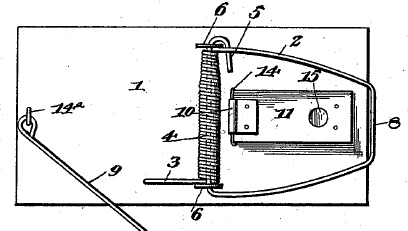
Figure from US patent 528,671 by William C. Hooker
   A search for "animal trap" with a patents search engine can prove the opposite. The seminal patent (Hooker 1894), on which all current flat snap mousetrap designs are based, happened to have one part less—easily. The striker and spring of these traps were formed of one wire part. The figure on the right is from Hooker (1894), a top view on the platform with all the other parts mounted on it.  
    We are interested in the wire part that starts at #3, coils (#4), then runs into the striker (#2 and #8), runs through the coil, and ends at #5 behind the striker. Numbers 6 are fixtures. #14 with the strange exponent is the fixture for the holding bar (#9). Numbers 10, 11, 14, and 15 all belong to the catch with a notch for the bait. 

Behe (1996, p. 43) depicted the following mouse trap and observed:

Sunday, 1 July 2012

Carnival of Evolution: catch 49

[note] Due to a late loss of the whole CoE49 post from my blog, I chose to structure the re-make economically. Hence the format of all entries is alike and as follows:
  • Author (Date) Post title (also links to blog post). Blog Name (no link to blog for clarity). Link to source article (when needed).
    My comment will follow in italics, if I have one.
P.S.: I did neither include submissions of posts from March or earlier nor submissions of posts that are only loosely about evolution as in 'evolution' of the solar system or climate. [/note]


Evolutionary studies are rich both in concepts and methods but not dis-integrated. As you will see, there is a common theme. Have fun.


Trees or Networks
Both figures from Gibson (1881). 


Tuesday, 22 May 2012

The Mérode mousetrap

[Update 12.01.2018: Shawn Woods from Mousetrap Monday has a knack for engineering these old traps from the auld sources and they work very well as he shows at his youtube channel.]

The Mérode altarpiece is an annunciation tryptich dating from 1427-32. It was made in the workshop of Robert Campin and is now in the Cloisters of the Metropolitan Museum of Arts in New York. The MET also has a high resolution picture of it online with zoom function. The right panel shows Joseph who has made two mouse traps. One is on display on a window sill that goes out on the market place. It is a trap of the kind where a block of wood falls vertically.1 The other sits on his workbench and looks like this:
Mérode mousetrap
To understand the mechanism of this trap, it is best to look at a replica complete with the missing stick that holds the striker up, when it is set. 

Thursday, 5 April 2012

"No more mouse traps!" (Drummond 1.4.2012)

"No more mouse traps!", David Drummond told me during a meeting in Neroth, which is a small village in the volcanic Eifel (Germany) with a particular history of mouse trap making and marketing in the 19th and 20th century and one of cultivating this heritage since. With this unique proposition among the villages of the Eifel Hinterland, Neroth attracts enough tourists to sustain two hotels, where otherwise probably one could hardly survive.
Neroth village at the foot of a volcanic plug called Nerother Kopf

David Drummond returned to this remote village, because he will retire from research into mouse trap history at the age of 84. One of his last deeds was the repatriation of a considerable amount of antique mouse traps to the mouse-trap-museum in Neroth.
David Drummond and the secretary of the Neroth heritage club discuss how 'Irish' mouse traps got their name because they've been shipped thither - not made there.

The traps had been bought by a German collector in the late 1970s and after his death the collection went to an American collector in Pennsylvania. Now that the American collector deceased, David took the chance to acquire the German traps and donate them to the museum in Neroth. As the Eifel is close to France, he also donated some French traps as well.

Whereas collectors are often greedy about their precious, David's generosity stems from an urge to spread the knowledge of mouse trap history. Therefore I suggested that he could link PDFs of his publications to his website. If he will do that, hopefully, the knowledge about mouse trap history will not fall into another dark age with inane ID/creationist seizures.

That doesn't mean we live in an entirely enlightened age. While David covered USA, Great Britain, France, and Germany pretty well, Slovakia, Italy, Spain, and many other countries are still black spots - at least for international audiences depending on English information. After David is finished with mouse traps no other mouse trap expert with a scientific training seems to remain, at least among English speaking academics. 

Irish trap (Drummond 2008, p. 11)
Addendum
This is the kind of trap known as an 'Irish' in England. As it turned out, however, these traps were never made in Ireland but in Germany and shipped to Great Britain. The mouse trap makers knew where their own produce came from and named them according to destination not origin. 

Looking at the right whole, you can see how these traps were set by means of a string running through tiny holes and binding the choker down. The mouse had to gnaw it through in order to reach the bait thus releasing the choker.
Souvenir tap from Neroth mouse trap museum

This kind of set-release mechanism was fiddly and improvements were invented. There's one woman left in Neroth, who still remembers how to produce an improved version from childhood. She produces them as souvenirs for tourists. Instead of tiny holes for the gnaw strings there are slits sawed into the back of the wooden block so that setting the trap with gnaw string is easier. 


Drummond D. (2008). British Mouse Traps and their Makers. Mouse Trap Books, Dorking, UK

Wednesday, 14 March 2012

Mouse trap master

I'm soon going to see David Drummond, the current world authority concerning mouse traps, on the occasion of repatriating mouse traps from a deceased collector. David studied at University Colledge, London, and Pennsylvania State University and became a professional zoologist doing world-wide research and advice on rodent control. Somewhere along the line he started to fancy mouse traps as objects of study in their own right. After retiring he turned this interest into his topic of publications.

Since the demise of Sture Lagercrantz, who was professor for ethnography at Uppsala University until 1976, no professional academic at any university is attending the history, sociology, or any other aspects of mouse traps and related artefacts anymore (as far as I know).

Academia has left this field of artefact culture to the street mob and is now facing a dire situation, where a scrub of urban legends is overgrown by inane claims of intelligent design advocates concerning the ostensible impossibility of precursors functioning with one part less than current traps.

For all those who'd like to get a smattering of the depth and width of mouse trap history, I recommend David's homepage. Read at least "William C Hooker's great American mouse trap" online there.

P.S.: David Drummond is a digital immigrant - not a digital native. 

'Little Giant' from Drummond (2009)


For the fun of it, a rat trap from Horace Tinker [sic] of Meadville, PA (US patent 265,802, 1882). Take note of the one wire forming both spring and striker. This is a precursor, where the spring and striker function are carried by one part in comparison with current flat snap traps, where spring and striker are separate wires. For the immediate precursor of current flat traps with one part less go here.


Drummond D (2009) Norway Rat, Erie Canal & and Little Giant. North American Trap Collectors Association, Galloway, OH

Thursday, 22 September 2011

Here be Dragon-traps

In 1590, Leonard Mascall recorded two traps, which he called “Dragin traps”. The following reproduction and replica are from David Drummond (1992 and 2005, for originals see appendix below).

The first one (see right) has two twisted cords as its power source and the striker board is inserted between the twisted cords. Mascall (1590) called it “Dragin trappe for Mice or Rattes”. Actually, the stiker board looks like a bat and the handle of the bat is inserted between the twisted cords. 

The second one (see left) has a wire forming both power source and striker. Mascall (1590) called it “Dragin trappe with a great wyar”. 

If material culture is evolving, one question is how to get from a trap with twisted cords as power source to one with a wire spring. Going one step at a time, you would have to replace the twisted cords by twisted wires, in order to be able to insert the striker board between the wires. In my opinion, twisted wires would be a poor power source. Apart from that, I do not see how to get from two twisted wires with a striker board inserted between to one wire with curved or coiled ends serving as power source and a middle loop serving as striker.

The only one-step-at-a-time solution would be to form the wire spring in such a way that it has a middle loop to which the striker board can be fixed. 

Searching for traps with this design I found two patents.

The first patent is from William Wrigh (1860), Philadelphia, PA. The figure at the left is taken from that patent. The side view (Fig. 3) shows the striker board e with spikes being pressed down by the wire a. The top view (Fig. 4) shows that the wire a is actually the middle loop of a spring being coiled at both ends. The trapy type is L-shaped, which once was a large group of traps with considerable variability in design.

The second patent is from Carl J. Erikson (1887), Rockford, IL. The figure at the right is taken from this patent. It looks complicated, but the relevant part is the striker board c, which is fixed to the middle loop of the spring wire B. 

As an aside, part H is a bait box, an odd feature of this particular patent. The inventor thought that the mouse would be attracted by the bait in this box walking around it to look through the windows in the bait box. As the windows were at the side of the striker and the tradle, the mouse would release the trap when looking through the windows. The round base seems to be a heritage from the older dragon-traps (why else should the base be round when actually a rectangular base would be far more practical for accommodating the bait box?

Admittedly, these trap patents are from a later period than the dragon-traps, but I suggest that they could represent a missing link in spring/striker design.

A striker board is fixed to the middle loop of the wire spring. But now the striker board is utterly redundant. The middle loop of the spring only needs to be formed in such a way that it can carry the striker function on its own. Et voilà, a Dragon-trap with spring/striker unit ‘evolved’.

There’s more to Dragon-traps. For example, the set-release mechanism changed from suspended to hinged striker.Therefore, a second missing link would have to look like the one above except for having a treadle and suspended striker instead of bait hook and hinged striker. 

P.S.: The younger history of mouse traps shows that they (and by implication other irreducibly complex systems) can have precursors with one part less and therefore can evolve (see Behe's mousetrap nemesis).

Appendix: Mascall's originals

The Dragin trappe for Mice or Rattes is described as follows:  

“This engine or trappe is made of wood like the stocke of a Bell, with two holes at the endes, and therein is put thorow [through] haire or corde double, and the lidde is put between, and so wreath the haire one way towarde the lidde uppon the under hoope, with sharp wyars [spikes] set round on the upper lidde, and a long badge under, falling within the neather hoope with a staffe set fast above on the stocke, to tie the string and clicket, which must holde up the lidde: the upper trappe lyes with the mouth towarde you, and the lower with the side towardes you.” (Mascall 1590, p. 71)

Actually, both are top views rather than a front and a top view. 

Mascall's drawing of the Dragin trappe with a great wyar (right) is better. For those who delight in old English, however, here is the explanation:

“This engine or trappe, is to take Mice and Rats, it is made of two bordes: the neather borde is made round at the one end, and broad at the other end, like a swallow tyle. Then is there an other bord set on edge in the middell thereof, which borde hath a great wyar bowed and nayled thereon, as ye may see: and the rounde bowght thereof must lie close on the round ende of the neather borde. Then is there two short square bordes nayled and spreading toward the great wyar. Also yee see at the toppe of the upsight borde, a long mortis, wherein the wyar that must holde the clicket and baite, must goe thorowe and there staye on another wyar, and the like is holden up with the upper ende thereof: which clicket, doe stay on the toppe of the middle or upright borde, and so tyde thereat with a threede which holdes up the great wyar, when that ye will set or tyle him: also the neather borde is set rounde with sharpe wyars [sprikes] to holde mouce or ratte, and they must stande all within the bowght of the great wyar, and it is done.” (Mascall 1590, p. 74-75)


References