Showing posts with label genetics. Show all posts

Saturday, 17 February 2018

G.C. Williams and J. Maynard Smith conceived the maintenance of sexual reproduction differently

[This blog post was a mere comment on Sandwalk first, because I thought someone there was confused about the different conceptions of the cost of sex. See this thread, particularly towards the end. The following expands the comment, there, into its own blog post, here. But it just explicates the differences between two historically important conceptions of the cost of sex and does not pretend to offer a resolution. There's also an article here, that also does not pretend to offer a resolution of the paradox of sexual reproduction. But it describes how, despite their different conceptions of the issue, Williams and Maynard Smith were able to communicate with each other fruitfully and amicably. In fact, I find that rather amazing. Often, such situations tend to escalate into a useless dispute with both parties at cross-purpose. None of that ever happened. On the contrary, Williams and Maynard SMith were able to understand each other despite their different assumptions and advance the issue in a dialectic way rather than the contrarian fashion.]


George C. Williams
George Williams conceptualized the maintenance of sexual reproduction as a problem of selection within one species or population. He began by considering organisms that include both sexual and asexual modes of reproduction within their complex life-cycles, for example, aphids & rotifers or strawberries & corals. He conceived the cost of sexual reproduction as the cost of meiosis, that is, the cost of reducing the relatedness with the own offspring from r = 1 to r = 0.5, when these organisms meet the time or conditions for switching from asexual to sexual reproduction. With this kin-selection conception he took the maintenance of sexual reproduction as a problem of selection within a population. Herein, he disagreed with Maynard Smith: 
“I think that the primary disadvantage of sexual reproduction in relation to asexual is most fruitfully formulated as a paradox of kin selection—an organism devotes resources to the production and care of a more distant (r = 0.5) rather than a close (r = 1) relative. This formulation provides a number of advantages. In its focus on genes identical by descent, kin selection is genetically explicit and relates directly to evolution. Maynard Smith’s economic argument (resources wasted on males) makes it easy to overlook the fundamental distinction between (1) the evolutionary problem of sexual and asexual reproduction as alternative character states in a population, and (2) the purely ecological question of competition between a clone and a Mendelian population.” (Williams 1978, ‘Mysteries of sex and recombination. A review of The Evolution of Sex by John Maynard Smith.’ Quarterly Review of Biology 53: 287–289. Page 298)
“I believe that understanding has been hampered by failure to distinguish the ecological from the evolutionary problem of sexuality. In important ways, insights gained from conceptual or experimental comparisons of sexual populations and competing clones (the ecological problem) may mislead in relation to sexual and clonal reproduction as alternative processes in a population (the evolutionary question with which I am concerned here).” (Williams 1980, ‘Kin selection and the paradox of sexuality.’ In Sociobiology: Beyond nature/nurture? Ed. by G.W. Barlow and J. Silverberg. Boulder, CO: Westview: 371–384. Page 372)
The fact that William and Maynard Smith cut the cake differently gets obvious from the way in which Williams treated the maintenance of recombination as not the problem he was at all concerned with:
“I assume that observed chromosome numbers and crossover rates reflect the optimum compromise between maximizing whatever benefits there are in recombination, and minimizing recombinational load. Tighter linkage must reduce recombinational load, but it does nothing to alleviate the cost of meiosis.” (Williams 1975, Sex and Evolution, Princeton Univ. Press, p. 108)
That is, reducing replication-rate by fusing gametes is not alleviated by assuming, for example, a species with a genome consisting of one homologous pair of a giant chromosome and no crossing-over between this homologous pair. [Felsenstein and Yokoyama (1976) modelled this problem.] That would exclude recombination through segregating heterologous chromosomes as well as through crossing-over between homologous chromosomes, but it would not pay the cost of reducing r from 1 to 0.5, or the cost of males, or the cost of fusing gametes, or whatever you conceive the cost of sex to be.

John Maynard Smith
John Maynard Smith conceived the maintenance of high recombination rates (not sex) as a problem of within-population selection between alleles that increase and others that decrease recombination rates. [This differs from Williams's within-population problem of a species with a complex life-cycle and both sexual and asexual modes of reproduction within it.] He accepted Williams's criticism of group-selection arguments for this issue (what he called the "balance argument" of Williams). He agreed that this problem requires an immediate individual-level explanation. But he also maintained that the competition between a sexual population and a genetically isolated asexual clone is a case of between-population selection. At this level, he did allow for long-term or group selection to play some (limited) role.

Anyway, his distinction begins in the preface already:
"I am under no illusion that I have solved all the problems which I raise. Indeed, on the most fundamental question - the nature of the forces responsible for the maintenance of sexual reproduction and genetic recombination - my mind is not made up. On sex, the relative importance of group and individual selection is not easy to decide. On recombination, group selection can hardly play a significant role, but it is not clear to me whether the short-term selective forces I discuss are sufficient to account for the facts, or whether models of a qualitatively different kind are needed." (Maynard Smith 1978, The Evolution of Sex, Cambridge Univ. Press, p. ix)
"It may help to classify the various theories; first, according to the time scale on which selection is supposed to act, and then according to the 'unit of selection' - population, individual, or gene." (Maynard Smith 1978, p. 1)
"I do not find it possible to give an unequivocal answer concerning the role of group selection in the maintenance of sexual reproduction. It has played some role, as evidenced by the taxonomic distribution of parthenogens; but it is not the only relevant force, as will be apparent from the review of the balance argument in Chapter 4, section E. But, whatever one may think of the role of group selection in the maintenance of sex, it cannot explain how it started, and it cannot explain the maintenance of high levels of genetic recombination within sexual populations." (Maynard Smith 1978, p. 6)

And so throughout the book. Maynard Smith consistently distinguishes the maintenance of sexual reproduction from that of recombination, the former being an issue of selection between isolated populations and clones, the latter being one of selection between alleles within one population.

Maynard Smith's support for "some role" of long-term or group selection in the maintenance of sex (not recombination) was also defending his earlier publication from 1958 (The Theory of Evolution, Penguin Books, pp. 138-139). It is often forgotten in potted histories about the paradox of sex, that Maynard Smith did already clearly state the cost of males in this early pop-science writing and also embraced the long-term group-selection explanation of the maintenance of sex.
"If the rate of increase of an animal population were limited by the number of eggs which each female could lay, which in turn depended on how much food a female could eat and transform into eggs, then a population consisting entirely of parthenogenetic females would increase twice as fast as would a population of equal numbers of males and females. From the point of view of reproduction, males are a waste of living material. (This argument does not hold for hermaphroditic organisms, or for those animals in which both parents help to feed the young.)      The compensating advantage of the sexual process is that it increases the range of potential variation in a population, and therefore, its evolutionary plasticity." (Maynard Smith 1958, p. 138)
"Thus the sexual process is a means of ensuring evolutionary plasticity at the expense of interfering with reproduction. [...] Now if the advantage of sexual reproduction is that it increases the range of potential variation in a population, then the advantage refers to the population as a whole, and not to any particular individual in it. It follows that sexual reproduction has been established as a rule, both in animals and plants, because selection has favoured some populations at the expense of others. This forms a contrast to the the examples discussed in the last chapter, in which the 'unit' selected was the individual and not the population." (Maynard Smith 1958, p. 139)

By the way, Ghiselin (1988, p. 16, in Michod & Levin (eds): The Evolution of Sex), reminisced an instance of Williams reviewing one of his papers and telling him about the twofold cost of sex and that he [Williams] had found it in a book by Maynard Smith (1966), which must have been the second edition of the above quoted Penguin book by Maynard Smith (see also Dagg 2016, On recognising the paradox of sex. Philosophy, Theory, and Practice in Biology. DOI: 10.3998/ptb.6959004.0008.003).

The fact that John Maynard Smith never changed his mind about his hedged support for some role of group (between-population) selection in the maintenance of sex is clear from an interview of Richard Dawkins with John Maynard Smith in 1997 (deposited at the Web of Stories in 2008).  

Tuesday, 7 April 2015

The Cider Crisis, the crab apple and the Golden Pippin

 [Update 28.08.2017: Golden Pippins where indeed so common a subject of consideration among horticulturists and naturalists that even Erasmus Darwin's Zoonomia (vol. 1, p. 417+420) has musings about it, and Charles Darwin's Notebook B is Headd "Zoonomia." Ht, Julian Derry.] 

The Golden Pippin was one of the most famous apple varieties of the country. But to suggest that Charles Darwin must have gotten his musings on Golden Pippins from Matthew (1829) is not convincing. What Matthew (1829) has sent to the Caledonian Horticultural Society (vol. 4, pp. 467-477) was a mere list of apple and pear varieties grown in Gurdie Hill with some additional remarks praising the qualities of a variety called Scarlet Golden Pippin, which Matthew believed to have been derived from THE Golden Pippin.

Now this is not convincing, because scientific literature on the status of the Golden Pippin as a variety of the wild crab apple, its incipient decay, and what could be done against it, was as important an issue in the 18th century as naval timber used to be. The sailors were fine with Rum, but the rest of the population needed its cider. The decay and degeneration of cider apple varieties was at least as severe a crisis as the lack of oak forest trees for naval timber.

This is a tale of the crab apple, the Golden Pippin, and what Darwin may actually have meant by his cryptic note: "They die; without they change; like Golden Pippens. it is a generation of species. Like generation of individuals."

Let's go straight for Thomas Knight (1801. A Treatise on the Culture of the Apple & Pear, and on manufacturing of Cider and Perry. 2nd Edition. London: Longman, Rees; and White). This book opens with a salvo: stating up front that animals and plants vary more strongly under domestication than in nature and that humans profit from this by artificial selection:
"The effects of cultivation on the animal and vegetable system are extremely similar. A change in form, in colour, and in size or stature, takes place in each; and in each those changes appear to arise from similar causes—from a more abundant and regular supply of nourishment than is afforded in a state of nature, with a favourable climate, or protection from the bad effects of an indifferent one. The offspring of every plant and animal, when unchanged by cultivation, bears a very close resemblance to it's parents; but amongst the cultivated kinds of each, it is extremely various; still, however, generally shewing some similarity to them. By taking advantage of incidental variations, and by propagating from those individuals which approach nearest to our ideas of perfection, improved varieties of fruit, as well as of animals, are obtained." (p. 3)
From there, he directly plunges into the topic of Apple cultivation.
"The Apple (on the culture of which I propose to offer some observations in the following pages) is not the natural produce of any soil, or climate; but owes its existence to human art and industry; and differs from the crab, which is a native of every part of England, only in the changes which cultivation has produced in it." (p. 5)
Alas, the best varieties of apples trees are in decay and degeneration.
"The Moil, and its successful rival the Redstreak, with the Musts and Golden Pippin, are in the last stages of the decay and the Stire and Foxwhelp are hastening rapidly after them." (p. 6f)
After pointing out the difference to animals, which cannot be propagated by vegetative (asexual) means, he advances an explanation that could, with anachronism, be called one of cloning the trees through grafting.
"The art of the planter readily divides a single tree into almost any number that he wishes; but the character of the new trees, thus raise, is very essentially different from that of a young seedling plant; they possess a preter-natural maturity, and retain the habits and diseases of the tree of which they naturally formed a part." (p. 8)
The cure, of course, is breeding afresh from seeds and crossing breeds (p. 37). Astonishingly, Knight also provides a qualitative observation that is strikingly reminiscent of Mendel's later quantitative proof of segregation:
"If the male and female be taken from two permanent varieties of different characters, the immediate offspring will present a mixture of both characters, in nearly an equal proportion; but the progeny of this offspring will be extremely various. Some will take nearly the form of their male, and others of their female ancestry, and it will be long before a new permanent character is acquired." (p. 88f)
Let's leave Thomas Knight, here, and see how Sir Humphry Davy (1815. Elements of Agricultural Chemistry. New York: Eastburn, Kirk & Co.) picked up the ball and ran with it. After recapitulating the experiments and findings of Knight (1801), he continues with the selection that is necessary after crossing breeds:
"The power of the horticulturist extends only to the multiplying excellent varieties by grafting. They cannot be rendered permanent; and the good fruits at present in our gardens, are the produce of a few seedlings, selected probably from hundred of thousands; the result of great labour and industry, and multiplied experiments.
Given all this, what could Charles Darwin have been thinking about, when he wrote in his notebook about Golden Pippens that die without change and the generation of species being like generation of individuals?

The answer should be clear now. Thomas Andrew Knight (1801) claimed that apple varieties that were propagated by grafting were nothing more than parts of the trees they stemmed from. Nothing rejuvenated them and they died from old age ("they die, without they change"), no matter on what youthful stock they were grafted. What Knight (1801) had argued quite forcefully was that they were not to be counted as two generations but merely as one individual having been divided by horticulturists ("It is a generation of species. Like generation of individuals"). What does that mean? It means that Charles Darwin has read Thomas Knight's Treatise shortly before he made his cryptic note. 

Thursday, 2 October 2014

Yet another anticipation of natural selection (Adams 1814)

Kenneth M. Weiss (2008. "Joseph Adams in the judgement of Paris" Evolutionary Anthropology 17: 245-249) has drawn attention to yet another anticipation of natural selection. Darwin did not mention it in his Historical Sketch and historians of science usually overlook it. It can be found in a book by Joseph Adams (1814. A Treatise on Hereditary Disease. London: J. Callow). 


Adams wrote down the idea without the typical phrases one would type into a search engine. Mind that the context is a treatise about hereditary disease (Weiss 2008 even highlights various anticipations of insights of Mendelian genetics).

Adams (1814, p. 32f):
"In a state of nature the race of all gregarious animals is probably progressively improving, as far as is consistent with their capacity for improvement. The strongest male becomes the vir gregis, and consequently, the father of most of the offspring. In a ruder state of human society, or rather in its earliest formation, something of the same kind may prevail; but in a more advanced stage, sufficient provision is made by the preferences which health and intellect will for the most part produce in either sex.
Another provision arises out of climate; which we have seen is, in some cases, the only means of exciting a diseased susceptibility into action. Those constitutions, which are peculiarly susceptible of such diseases as are excited by climate, fall an early sacrifice; hence, the propagation from sources gradually lessens, and the disease would cease altogether, were it not that parents, free from such susceptibility, occasionally produce an offspring in whom the susceptibility originates.
Thus we see the natives of warm climates, when removed to colder, are peculiarly liable to scrofula; and it cannot be necessary to add, how much the natives of colder climates suffer under the Tropics, from causes which produce little or no effect on the offspring of the old inhabitants. By these means a race is gradually reared with constitutions best calculated for the climate: a law which, I suspect, has been too much overlooked, in our inquiries after the causes of the more marked varieties in the human species."
He continues with examples of artificial selection by breeders, especially the ill consequences of inbreeding, ruminates on eugenic laws against inbreeding, and so on. See for yourself or read the article by Weiss (2008), who also discussed other anticipations including Matthew's.

Tuesday, 20 May 2014

Prediction in evolutionary biology

Here's a quote of George C. Williams (1985. 'A defense of reductionism in evolutionary biology.' Oxford Surveys in Evolutionary Biology 2: 1-27) refuting the claim that evolutionary theory must predict future evolutionary events.

"From this [...] theory of adaptation comes a reductionist methodology [...]. Its practitioners imagine that they understand a studied organism well enough to recognize certain of its features as components of some special problem-solving machinery. If other postulated components are not yet known, it is predicted that an appropriate investigation will reveal their existence. This is the most frequent kind of prediction now being practised in evolutionary biology and it has immensely enriched our understanding of organisms. The idea that a theory of evolution must predict future evolutionary change is unrealistic, but it has been the basis of some prominent criticisms of evolutionary reductionism." (Williams 1985, p. 1, my emphasis)

Actually, I sanitized the quote from references to selfish-genes and the adaptationist programme, because that would only raise the ire of certain folks and thus distract from the content of the statement concerning prediction in evolutionary biology.

Here's the full quote with the formerly deleted words in bold:

"From this selfish-gene theory of adaptation comes a reductionist methodology known as the adaptationist programme. Its practitioners imagine that they understand a studied organism well enough to recognize certain of its features as components of some special problem-solving machinery. If other postulated components are not yet known, it is predicted that an appropriate investigation will reveal their existence. This is the most frequent kind of prediction now being practised in evolutionary biology and it has immensely enriched our understanding of organisms. The idea that a theory of evolution must predict future evolutionary change is unrealistic, but it has been the basis of some prominent criticisms of evolutionary reductionism."

Tuesday, 4 March 2014

The History and Social Influence of the Potato (excerpts from the preface)

Here are some entertaining excerpts, with an interesting connection to William Bateson, from the preface of Radcliffe N. Salaman's magnum opus of 1949:

The History and Social Influence of the Potato

"Now that, after many years, a record of my studies on the history and economic repercussions, consequent on the introduction of the potato, is near completion, it may not be inopportune to give some account of how my interest in this otherwise inoffensive vegetable came about. [...]

My career as a medical man and pathologist was brought by illness to a sudden close in 1903. [...]

In the following year, I retired to what promised to be a life of ease and leisure in the beautiful village of Barley, in north Herts. In less than a couple of years my health was completely restored and I was able, once more, to lead a physically active life. Thirty-two years of age, happily married, free from financial cares, and devoted to hunting, one was unconsciously graduating for the part of a Jane Austen character. But I discovered, as I believe her men also would have done, had not their careers invariably terminated with their capture and mental sterilization at the altar, that 'respectability', even with a corresponding income, is not enough. [...]

It was at this time that the study of heredity had taken on its new character and direction, following on the rediscovery of Mendel's epoch-making experiments. I was tempted to hope that within the field of the new science I might find an opportunity to satisfy my desire to do, as well as to learn.

In this connection, I was fortunate in knowing William Bateson, and it was at his suggestion that I enlisted as one of the small group of professionals and amateurs who, under his guidance, were building up the English school of Mendelian research.

With material supplied by Bateson, I set to work: in succession on butterflies, hairless mice, guinea-pigs, and Breda combless poultry. In my hands, all these adventures, I regret to say, were more or less complete failures. Loth to trespass further on Bateson's generosity and time, I decided that my next failure, if failure it was to be, should be in a field which, as far as I knew, had not been invaded by any of the new biologists.

Armed with this resolve, I confided to my gardener, Mr Evan Jones, that I felt it would be more becoming were I to confine my attention to some common kitchen-garden vegetable, and had he any suggestions to make? Jones was one of those men who, within the ambit of their own profession, feel themselves to be all but omniscient. His answer, prompt and to the point, remains fixed in my memory: 'If you want to spend your spare time on vegetables, then you had better choosen [sic] the potato, for I know more about the potato than any man living.' This seemed a promising beginning, though not without its dangers, seeing that Jones was an autocrat and I was instinctively opposed to dictation by others. However, I asked him to procure for me two distinct varieties, one bearing red, the other white tubers, and said I would 'try my luck'. With a sweep of the hand towards the kitchen garden, Jones informed me that all that one could wish for, in the matter of red and white potatoes, was already at my disposal, and introduced me to two plants: one, a white tubered variety, he said was 'Ringleader', and the other, a red one, was 'Flourball'. With these two, in the year 1906, I embarked on an enterprise which, after forty years, leaves more questions unsolved than were at that time thought to exist."
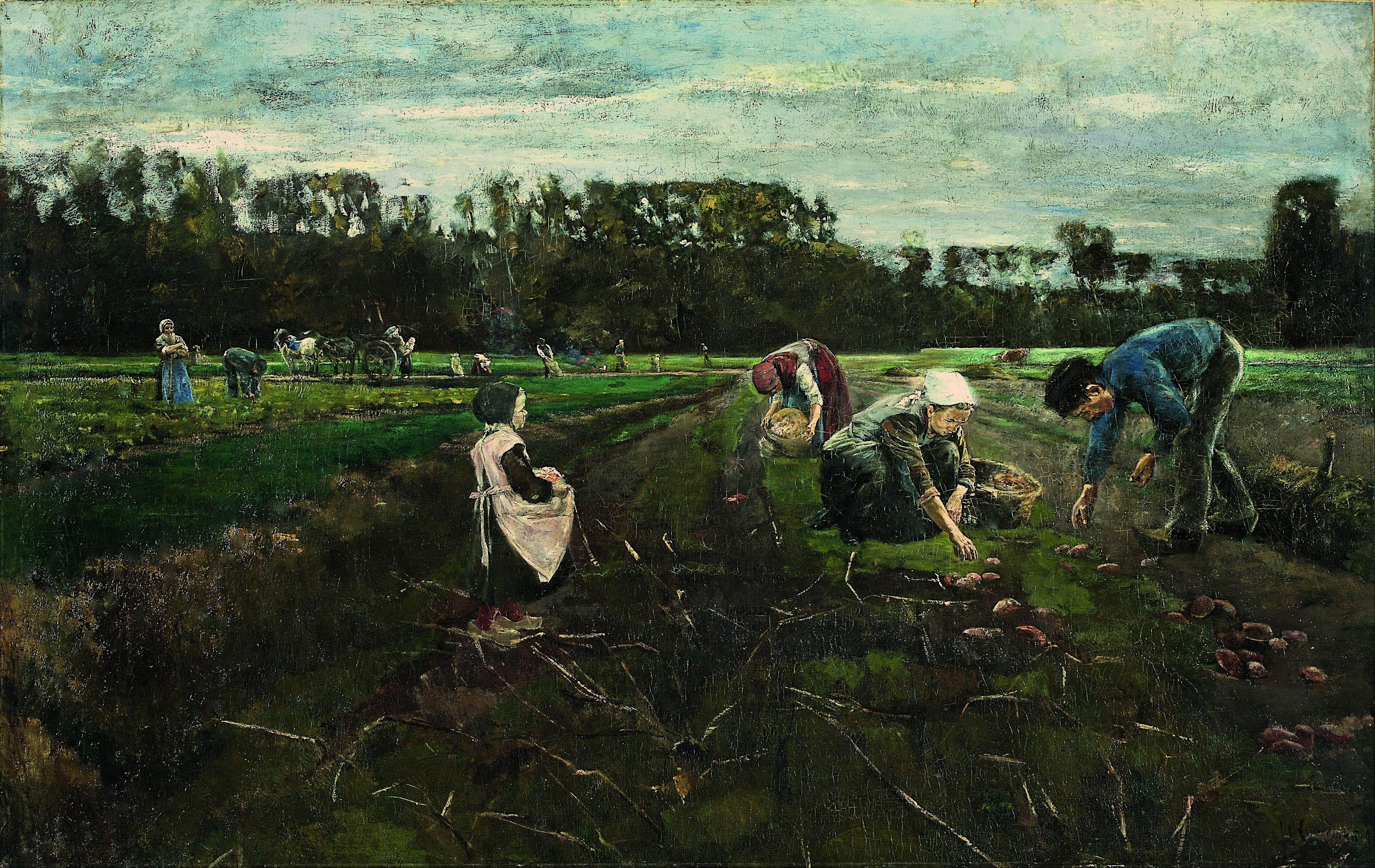
Max Liebermann: "Kartoffelernte" [Public domain], via Wikimedia Commons

Monday, 3 February 2014

Francis Galton's Kantsaywhere

Francis Galton, a cousin of Charles Darwin, coined the term eugenics. He did foundational work for genetics, but also wrote a novel at the end of his life explicating his eugenic "utopia." Writer and broadcaster Dr. Matthey Sweet introduces the novel as follows  at the Library Service site of the University College London:

"Francis Galton invented the weather map and revolutionised forensic science – but the reason why he is historically important is probably the reason why he is so little known today. Galton is the man who coined the word “eugenics” – a body of thought that we now regard as irremediably toxic; reject as a pseudoscience that was once used to naturalise racism and justify the view that some humans are less human than others. It remains one of the dirtiest words in the lexicon of western thought.

[...]

The Eugenic College of Kantsaywhere is a science fiction novel set in a country dedicated to the improvement of the human species by manipulating the sex lives of its inhabitants. “In Kantsaywhere,” we’re told, “they think more of the race than of the individual.” Here, prospective parents are required to undergo physical and psychometric tests before being pronounced fit to reproduce – and those found unfit are banished from the state. People denied the privilege of parenthood become the responsibility of a government agency that ships them to labour colonies where “sharp severity” is promised if they are sufficiently unwise to break a pledge of celibacy.

It is a plot that feels familiar, thanks to its echoes in twentieth-century science fiction: Aldous Huxley’s Brave New World (1932) in which babies are spawned in bottles and conditioned to suit the purposes of a consumerist state; John Wyndham’s The Chrysalids (1955), where the character of Sophie knows her sixth toe is evidence that she is one of the genetic mutations so feared and despised by her community; Andrew Niccol’s film Gattaca (1997)in which those judged genetically imperfect connive to pass DNA tests by submitting the samples of their chromosomal betters, purchased on a black market in bodily fluids. These, of course, are examples of dystopian fiction. What is striking about Kantsaywhere is that it is a place in which Francis Galton clearly wanted to live. A later version of a similar story might have depicted the outcasts in the labour colonies reclaiming their right to sex and reproduction. Such an idea, however, would have been anathema to Galton. Kantsaywhere offers a design for living in a eugenic state, one sufficiently detailed that it might have been used as a starting point for anyone daring enough to try."


The full novel can also be downloaded at the the UCL site

Thursday, 19 December 2013

Lewontin (1985) on population ecology

"Theoretical population ecology is almost entirely the elaboration of a single underlying model, the logistic equation of population growth, for which there is virtually no empirical justification. At its most general, population ecological modelling does not take the logistic seriously, but supposes an unspecified multispecies interaction model which is then expanded in a Taylor's series, yielding, to the second term - the logistic model! Virtually all of observational ecology, on the other hand, is phenomenological. Do species interact? How? Can predation, competition, weather be shown to be causally efficacious or not in the determination of numbers of coexistence?" Lewontin RC (1985, 3). Population genetics. In: Greenwood PJ, Harvey PH, Slatkin M (eds). Evolution. Essays in honour of John Maynards Smith. pp. 3-18. Cambridge University Press.

Sunday, 8 December 2013

Lewontin (1974) on population genetic theory

Here's a nice metaphor for the theory of population genetics by Richard Lewontin (1974. The Genetic Basis of Evolutionary Change, Columbia University Press, New York, p. 189):

“For many years population genetics was an immensely rich and powerful theory with virtually no suitable facts on which to operate. It was like a complex and exquisite machine, designed to process a raw material that no one had succeeded in mining. Occasionally some unusually clever or lucky prospector would come upon a natural outcrop of high-grade ore, and part of the machinery would be started up to prove to its backers that it really would work. But for the most part the machine was left to the engineers, forever tinkering, forever making improvements, in anticipation of the day when it would be called upon to carry out full production.
     Quite suddenly the situation has changed. The mother-lode has been tapped and facts in profusion have been poured into the hoppers of this theory machine. And from the other end has issued–nothing. It is not that the machine does not work, for a great clashing of gears is clearly audible, if not deafening, but it somehow cannot transform into a finished product the great volume of raw material that has been provided.”