Mike Sutton (Fear and Loathing in Science, @ldk50074280),
the crank who keeps claiming that Darwin plagiarised Matthew, contradicts himself by admitting that ideas might have been floating around freely without proper attachment of references:

Mike Sutton (Fear and Loathing in Science, @ldk50074280),
the crank who keeps claiming that Darwin plagiarised Matthew, contradicts himself by admitting that ideas might have been floating around freely without proper attachment of references:

This article is a vaccine against BS claiming that Patrick Matthew's (1831) mechanism of evolution was identical with Charles Darwin's. We find differences large enough to set Matthew apart from Darwin and Wallace. For example, catastrophes knocked out competition and hence competitive natural selection in Matthew's scheme, so that speciation (during his phase of ramification after catastrophes) took place in the absence of natural selection. However, Matthew is interesting in his own right as an intermediate source between Cuvierian catastrophism & species fixity on the one hand and species transformism (as of Buffon, Lamarck, Erasmus Darwin) on the other.
P.S.: The above link should get you through the paywall.
Intention or gross negligence leading to fabrication of the scientific message or a false credit or emphasis given to a scientist. (Nylenna 1999, 58)
Misrepresentation of data, such as by suppression of relevant findings, or knowingly, recklessly or by gross negligence presenting a flawed data interpretation (Types of misconduct in research 2020, item 5.i)
Misrepresentation of data and/or interests and/or involvement (Code of Practice for Research 2019, p. 11, item 9.2.3)
Misrepresentation, defined as a deliberate attempt to misrepresent falsely or unfairly the ideas or work of others, whether or not for personal gain or enhancement. (Procedure for Investigating Alleged Research Misconduct 2015-16, p. 4, item xvi)
In his own book on British forest trees, several times Selby adapted Matthew’s apparently unique phrase "greater power of occupancy" to "great power of occupancy" and was apparently first to be second once with Matthew's full original version (Selby 1842, p. 391), where he cited Matthew (1831) and revealed his apparent lack of understanding of one of Matthew's key concept of natural selection. (Sutton 2017, p. 43; see also Sutton 2014, p. 114f)
The soil upon which most of the Abietinae prevail, is usually of a dry and cool quality; thus, the débris of granitic and other primitive rocks, and barren sandy districts, are very commonly occupied by Pine and fir forests, sometimes of enormous extent; the thick and close manner in which they grow, and the dense shade they produce, effectually preventing the vegetation of other species. Matthew, however, in his able treatise on naval timber seems to think that its indigenous location in such districts arises not so much from preference of soils of the nature above-mentioned, as from its having more power of occupancy in such soils than any other plant of the country; and this opinion he endeavours to support by stating that the Pinus sylvestris, planted in a good or rich soil, attains larger dimensions and its best timber properties, and that it is only driven from this superior soil by the greater power of occupancy possessed by the oak and other deciduous trees, an opinion in which we cannot altogether acquiesce, as we see no reason why the fir, if it grows with such additional vigour in a richer soil, as Mr. Matthew asserts, should, at the same time, be unable to maintain a contest with the oak or other trees. (Selby 1842, 391)
Given Selby’s obvious enthusiasm for NTA [short for Matthew’s book: On Naval Timber and Arboriculture], repeatedly evidenced in his citations of Matthew’s natural selection concept of "greater power of occupancy" and his obvious respect for its author’s knowledge of arboriculture, it seems highly unlikely that he would not have discussed NTA, at the very least with other connected gentlemen of science. (Sutton 2017, p. 50; see also Sutton 2014, p. 122)
Here then we see an example of exactly what Secord (2000) is talking about in terms of a gentleman scientist of the 1840s keeping himself on safe ground by politely critizising Matthew on a point of botanical and arboricultural expertise. By so doing, Selby has managed to critizise one important element of Matthew's natural process of selection without mentioning it outside of the practical issue of Selby’s apparent failure to understand why there might be a multi-factored natural process of selection in nature. (Sutton 2017, 59; see also 2014, 140)
In this book I prove that other naturalists did read NTA, and this new knowledge is 100 percent veracious because those naturalists actually cited Matthew's book in the published literature. That three naturalists who cited NTA pre-1858—Loudon (1832), Chambers (1844) and Selby (1842)—were right at the epicenter of influence and facilitation of Darwin's and Wallace's published, so-called independent, discoveries of natural selection is a unique and new discovery about the greatest scientific discovery ever made. (Sutton 2014, p. 14)
We can be absolutely 100 percent certain of the fact that Wallace and Darwin were indirectly influenced by Matthew via Loudon, who edited and published Blyth's 1835 and 1836 papers on evolution; the naturalist and editor, Robert Chambers, who famously published on the same subject in many editions of his influential and bestselling Vestiges of Creation; and Selby, who edited and published Wallace's 1855 Sarawak paper on natural selection. (Sutton 2014, p. 14-15)
Wallace's (1855) Sarawak paper’s editor and publisher, Prideaux John Selby (1842), read and cited NTA thirteen years earlier. Moreover, the naturalist William Jardine, co-editor of Wallace’s Sarawak paper, had the book in his possession for some time because he purchased Selby's copy (see Jackson 1992). (Sutton 2014, p. 72)
For a start, the fact that William Jardine purchased for Selby a copy of NTA (Jackson 1992), that Selby then cited it and that the two of them later jointly published Wallace's 1855 Sarawak paper, which is his first paper on evolution, creates massive doubt that Wallace arrived at his ideas independently, because this newly discovered fact brings Wallace, most incriminatingly, right into the center of Matthew's orbit, albeit via Wallace's immediate scientific associates who so greatly facilitated his career as an evolutionist. (Sutton 2014, 78-79; see also Sutton 2014, 185-187)
With regard to the conduct [...], it did not strike me that any difficulty would arise in adjusting our shares of responsibility [...] Whatever might be sent by yourself & your co-operators (who I am glad to learn are disposed to assist), or by Sir W. Hooker [J. D. Hooker’s father, former editor of another journal fused in Taylor’s] in his department, would be inserted, of course, in such quantities as our space in each number wd admit; but though I should in all doubtful cases be glad to avail myself of the opinion of such able advisers, yet I am likely also to receive contributions from friends here of such undoubted eminence, that you wd not think it necessary that I should forward them to you. (Taylor to Jardine, 6 June 1839, quoted in Brock and Meadows 1998, 124)


"in many cases it is most difficult to" (Darwin 1859) vsThe green words are the ones that have been bridged and the red words constitute the 6-word match. However, the immediate context of this match is completely different in both books:
"in cases where it is difficult to" (Matthew 1831).
"Although in many cases it is most difficult to Conjecture by what transitions an organ could have arrived at its present state yet, considering that the proportion of living and known forms to the extinct and unknown is very small, I have been astonished how rarely an organ can be named, towards which no transitional grade is known to lead." (Darwin 1859)One actually needs to reduce the string-length down to 4 words, in order to get to the point, where the phrase that Mike Sutton, criminologist of Nottingham Trent University, takes to signify that Darwin plagiarized Matthew:
"Forests of Ficus sylvestris are sometimes destroyed by insects under the bark, in cases where it is difficult to decide whether external circumstances, such as a dry warm season, has been promotive of the increase of the insect itself, or has induced some disorder in the plant, rendering the juices more suitable aliment to the worm." (Matthew 1831)
"this process of natural selection" (Darwin 1859) vsThe immediate contexts:
"this natural process of selection" (Matthew 1831).
"Therefore, I can see no difficulty, more especially under changing conditions of life, inIt is true, both contexts are evolutionary, but does that prove plagiarism by Darwin of Matthew? The perfect matches amount to 2% of Darwin's book and 4% of Matthew's, most of it the trivial stuff that is clearly coincidental. And allowing for the bridging of words and only 80% matching words in phrases did not change this for the overall matches.
the continued preservation of individuals with fuller and fuller flank-membranes, each modification being useful, each being propagated, until by the accumulated effects
of this process of natural selection, a perfect so-called flying squirrel was produced." (Darwin 1859, p. 181)
"Mans interference, by preventing this natural process of selection among plants,
independent of the wider range of circumstances to which he introduces them, has increased the difference in varieties, particularly in the more domesticated kinds and even in man himself, the greater uniformity, and more general vigour among savage tribes, is referrible to nearly similar selecting law the weaker individual sinking under the ill treatment of the stronger, or under the common hardship."(Matthew 1831, p. 308)


"but it seems somehow" (Douglas 1898, p. 11) vsInstead, Wilde's sentence is matched with another of Douglas, because of a three-word match that required no bridging:
"but somehow it seems" (Wilde 1890, p. 14).
"Now, it seems to me I never could learn French." (Douglas 1898, p. 99)
"It is a silly habit, I daresay, but somehow it seems to bring great deal of romance into one's life." (Wilde 1890, 14)Obviously, neither the perfect three-word match nor the four-word-shuffled match has any significance concerning plagiarism. Apparently, four-word-shuffled matches do occur by mere coincidence at times. One should, therefore, take the occurrence of such a match between Darwin (1859) and Matthew (1831) with a grain of salt.
"Program music will generally be found easier to grasp than absolute music, and this is again a natural process of selection." (Spaeth 1829, p. 638)
"He [Patrick Matthew] was educated at Perth Academy and at Edinburgh University, but his stay at the latter cannot have been of long duration, for, on his father's death, he undertook, at the age of seventeen, the management of the estate of Gourdiehill, near Errol." (Calman 1912a, p. 452)3---
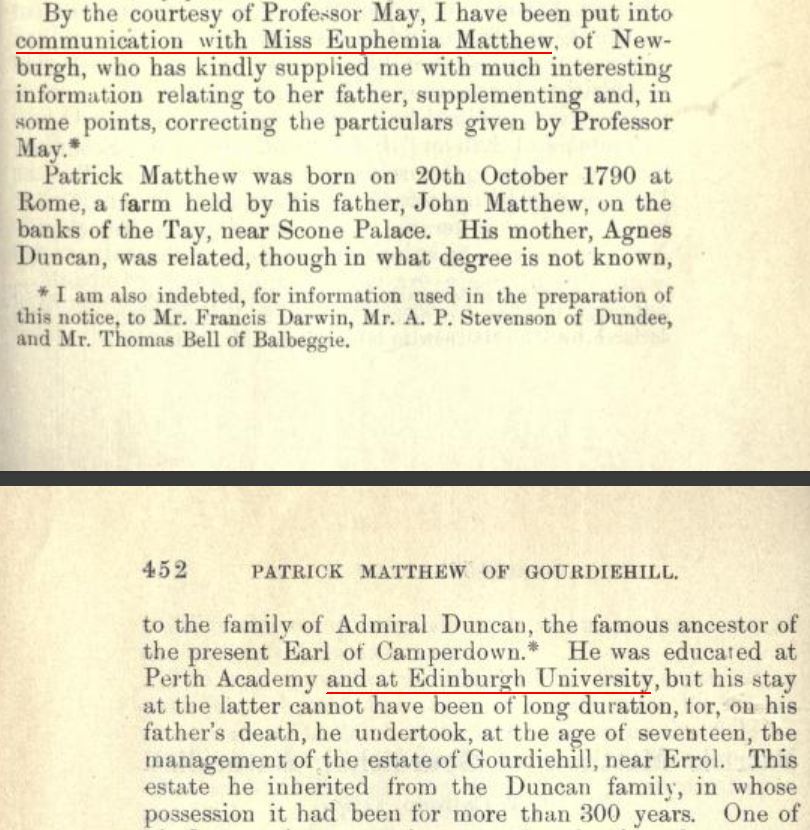 |
| Excerpt from Calman (1912a). The correcting of "particulars given by Professor May" concerns the claim that the Matthew family was related to Robert Bruce via a sister of him. |
" * The family tradition alluded to by Professor May, according to which the Matthews are descended from a sister of Robert Bruce, is declared by Miss [Euphemia] Matthew to be quite without foundation."However, Mike Weale found evidence that Euphemia Matthew owned genealogies that show that the Matthews descended from Robert Bruce in direct line—not via a sister (see section headed "Patrick Matthew's ancient family tree" at this page). And she gave them to A.H. Millar for his book the Historical Castles and Mansions of Scotland (1890). At page 128, it mentions a document in the possession of Miss E. Matthew, Errol Park Cottage, and reprints it as: The Genealogie of the Lords Oliphant as it was written in the Castell of Duplin. That is, Euphemia trusted in the correctness of the genealogy. Regardless of the question whether these genealogies were really correct or not, there remains the oddity that Calman claims Euphemia to have declared the family lore about the family link "quite without foundation," when she should only have denied that the link to Robert Bruce went via a sister. This suggests poor understanding between Euphemia Matthew and William Calman.
"According to the records in the Department of Rare Books and Manuscripts, Edinburgh University Library, the name of Patrick Matthew appears in the Matriculation Index in 1804-05 and again in 1808-09. His name is on the class list of Professor Gregory who held the chair of medicine. The subjects studied were anatomy, surgery, chemistry, medical practice. In 1808 Patrick Matthew attended Professor Hope's classes in chemistry. There is no evidence that Patrick Matthew graduated from Edinburgh and he appears never to have mentioned in his writings that he had attended Edinburgh University, where his studies were interrupted when he seventeen years old by the death of his father." (Dempster 1996, p. 1, my emphasis)Meanwhile, the University of Edinburgh has put its records of historical alumni online (see image below). This online record seems to suggest that the Patrick Matthew in question ran a regular course of studies in medicine and was training abroad, at the Indian Medical Service, from 1807 to 1808. However, it is rather a compound record of two namesakes as will become clear in the following.


"For the first time, [...] the splendid portals of the University of Edinburgh were thrown open to the fair sex [...]. On that memorable day Dr. Hope, the Professor of Chemistry, commenced a popular course of that fascinating subject. That learned lecturer has been long celebrated for his oral instruction, but still more famous for his showy experiments exhibited to the grown-up children of the male sex [...]." (Dr. Hope and his lecture to the Ladies of Edinburgh, The Lancet 6(145): 336-363, 1826)After toiling with the management of the family estate for 10 months, Patrick Matthew of Gourdiehill may either have needed a distraction or an educational leave for improving his farm management skills. What he did not need was a full-time course of studies for a job, as if he had none yet. He either visited only one of Prof. Hope's edutainment lectures for grown-up children or his stint at the university amounted to several weeks. As he does not occur in any records of 1809 or later, however, the season holidays around 20 December 1808 would probably mark the end of any stint longer than one day at the university. Personally, I do not believe that Matthew attended more than one fun lecture by Prof. Hope, because of the chores of managing the family estate and looking after his five sisters and widowed mother. By his own account in the Gardeners' Chronicle and Agricultural Gazette, he managed orchards from 1807, the year his father died, onward. In 1865, he corrected a claim made in the the Gardeners' Chronicle, that the climate of Scotland does not allow the cultivation of fruit trees, in a letter to the editors as follows:
"I have managed orchards for 58 years; have planted orchards—many thousand Apple and Pear trees in Scotland, Germany, and a small one in Spain; [...]" (Matthew 1865, Gardeners' Chronicle and Agricultural Gazette 25, 16 December 1865, p. 1179)


 |
| Again, the full record is paywalled. |


"Mr Patrick Matthew, as we understand, is a small landowner on Gourdie hill, near Errol, in Perthshire, an inconsiderable orchardist, if we may so speak, who has a house, with a garden and shrubbery, where he makes experiments on fruit-trees. Having been engaged, in his youth, in a seafaring line of life, probably as surgeon's mate to a man-of-war, he has acquired some acquaintance with the form and structure of a ship, with a quantum sufficit of naval slang. At one time or another also, it is possible that he may have been under-forester to some nobleman or gentleman in the neighbourhood. At all events, he has now amassed a little wealth; is owner of a couple of sea vessels that trade from Perth or Dundee to the Baltic; and, in a word, he considers himself as fully competent to enlighten the world on “Naval Architecture and Arboriculture.” "It is true that Patrick Matthew of Gourdiehill owned land with an orchard (big at that) and, later in life, was co-owner of two sloops trading with the Baltic (ht Anne Carroll). He also grew timber on some leased patches, but the stuff about a seafaring youth as a surgeon's mate is probably the first mix-up of the surgeon from Newbigging with the orchadist from Gourdiehill.
"Hate speech is a form of hate crime, and, speech can take the form of written or spoken word6.
6 In the UK, hate speech can be criminal if it falls within the definition of inciting racial hatred. However the law is quite complex in this area and there are several defences available." (Mann, Sutton and Tuffin 2003, p.4)In other words, as long as his hate speech is not inciting racial hatred, Sutton will be on the safe side. And since he knows so well, now, he puts his expertise to good use against Charles Darwin, Alfred Wallace, and evolutionary biologists.
>>On page 78 of the 1844 trial essay on the road to the Origin [a sketch that has been published after Charles Darwin's death by his son Francis] occurs the following observation: "In the case of forest trees raised in nurseries, which vary more than the same trees do in their aboriginal forests, the cause would seem to lie in their not having to struggle against other trees and weeds, which in their natural state doubtless would limit the conditions of their existence." When one turns to the Origin itself one finds that this statement has vanished. In Patrick Matthews' [sic] book on Naval Timber and Arboriculture, which contains a full anticipation of natural selection, occurs, however, this intriguing remark: "Man's interference, by preventing this naturalAnd here's what Hugh Dower made of Eiseley's claims, again, without hate speech:
process of selection among plants, independent of the wider range of circumstances to which he introduces them, has increased the difference in varieties particularly in the more domesticated kinds." [Matthew, 1831, On Naval Timber and Arboriculture, p. 308] Darwin's comment, in other words, sounds as though based on Matthew at least I am unaware of any other convenient source.<< (Eiseley 1959, p. 110)
"For 150 years, the world has been led to believe that Charles Darwin was the originator of the theory of evolution by natural selection. Though evolution scholars have always known that to be technically inaccurate (in the sense that he wasn't the first), I have recently discovered that it is completely untrue (in the sense that he wasn't even an originator). I shall show, beyond reasonable doubt, that Darwin was strongly influenced by, among many others, a Scottish estate owner, Patrick Matthew (1790-1874), who had hit upon exactly the same theory, and Darwin subsequently lied about his knowledge of Matthew. To begin with, for the benefit of the many people who have never heard of Matthew, I shall tell the story as it appeared in public print."Mike Sutton, the hate-speaker


The long-refuted claim that Darwin's Origin of Species was causal in the Holocaust gets an absurd twist, because Sutton exempts the far more jingoistic and racist Patrick Matthew from the same charge and maintains that Matthew would not even have played the causal role that Darwin allegedly did, even if he'd been more widely recognized (https://archive.is/Jj9Ih).

