Showing posts with label Patrick Matthew. Show all posts

Thursday, 31 December 2020

The Origin of Specious: misunderstandings about Patrick Matthew’s evolutionary thinking

by J.F. Derry & Joachim L. Dagg. Biological Journal of the Linnean Society, Volume 131, Issue 3, November 2020, Pages 706–715.

This article is a vaccine against BS claiming that Patrick Matthew's (1831) mechanism of evolution was identical with Charles Darwin's. We find differences large enough to set Matthew apart from Darwin and Wallace. For example, catastrophes knocked out competition and hence competitive natural selection in Matthew's scheme, so that speciation (during his phase of ramification after catastrophes) took place in the absence of natural selection. However, Matthew is interesting in his own right as an intermediate source between Cuvierian catastrophism & species fixity on the one hand and species transformism (as of Buffon, Lamarck, Erasmus Darwin) on the other.

P.S.: The above link should get you through the paywall.


Saturday, 22 June 2019

"Darwin in the Mirror of my Life." (Walther May 1903-04)

Walther May (1868-1926) was an assistant professor (no tenure) for forest zoology in Karlsruhe, Germany, who also wrote historical publications concerning the science of Goethe, Humboldt, Darwin, Haeckel and others. Given the recent revival of interest in Humboldt and the question what Darwin owed to the romantics, May's publications may merit a look. (I don't know them yet. Judging from the article translated below, they May be a bit pathetic.)

As I am generally more interested in what happened at the fringes rather than in the mainstream of science, my interest in May arose from his publication dealing with Patrick Matthew (1790-1874), the guy who published an apt formulation of the principle of natural selection in an appendix to a book On Naval Timber and Arboriculture in 1831. The article by May (1911. Darwin und Patrick Matthew. Zoologische Annalen 4: 280-295) was the first to give any biographical information about Matthew.

As it happened, Walther May's life also skated along the fringes of a German mainstream, and it was quite interesting and a little bit tragic. Alas, the only literature that can tell us anything about it are his own accounts and an article by Gaston Mayer (1913-2008):
May, Walther (1903-04). Darwin im Spiegel meines Lebens. Verhandlungen des Naturwissenschaftlichen Vereins in Karlsruhe 17: 3-32.
May, Walther (1914). Was Ernst Haeckel in meinem Leben bedeutet. In H. Schmidt (Hrsg. im Auftrag des deutschen Monistenbundes), Was wir Ernst Haeckel verdanken. Ein Buch der Verehrung und Dankbarkeit (pp. 273-286). Leipzig: Unesma GmbH.
Mayer, Gaston (1987). Walther May (1868-1926), Freidenker, Sozialist, Zoologe und Historiker des Darwinismus. Mitteilungen des Badischen Landesverbands für Naturkunde und Naturschutz, N.S. 14(2): 483-495.
[For translations of the second and third article click on "Walther May" in the menu of lables shown above the posts of this blog.]

Mayer is dead and so are the witnesses that he could still ask. For a start, I will translate the above articles into English. Those will be very long posts. Therefore, an abstract first:

May's Life Abridged
May's youth was guided by radical and romantic views, first Haeckel's and monism rather than Darwin's and naturalism, then Engles's and socialism rather than Marx's original writings. As a student, he was an active member of the free-thinker union, called Humboldt, in Leipzig. His talks during associations about monism, socialism and all that earned him an incarceration for four days by the University of Leipzig and a ban to talk at such meetings ever again. He did not care and was consequently sacked by the university and relegated forever from any German university.
    As a free man, he traveled Saxony from town to town and gave talks. Eventually, he became an editor for the journal Die Presse in Chemnitz in November 1891. A Christmas article for that journal, in December 1891, got him into conflict with the draconian Prussian press law. The harmless article merely justified the stealing out of poverty and need during the Christmas festivities. By 4th of March 1892, however, he got imprisoned for 1 year and 10 months in Zwickau for the 'crimes' of profanity, blasphemy, and calling for civil disobedience.
   Almost two years in prison for writing an article that sounds as if it would fit to the spirit of a Charles Dickens novel! He read Goethe during his time in jail and, for some odd reason, the scientific publications of the great romantic steered May away from his social romanticism. He wanted to become as 'objective' as Goethe. He also wrote a letter to the socialist party, while in prison, cancelling his membership.    After his release in January 1894 he began working as a corrector in the printing business of his uncle in Berlin. This was not a happy time, the only relief being his traveling to Tegel in the North of Berlin in order to visit the haunts of Alexander Humboldt. Finally, when he already showed first symptoms of lead poisoning, a private talk given before the family of his uncle moved the latter to write to Ernst Haeckel and beg him to help. And Haeckel helped! He visited the family in September 1894, listened to the young man, found his crimes most trifling, saw that the relegation of Leipzig university could not bind the one of Jena legally, and he helped May to get a stipend.
    Thus, in October 1895, began the happiest time in Walther May's life. Jena became his Shangri-La. He followed the traces that Goethe, Schiller, Humboldt, Döbereiner (chemist) and others had left in Jena and studied under Stahl, Kükenthal, Verworn, Johannes Walther and, foremost, the old but still active dean Haeckel. Paradoxically, again, the lectures of the great monist moved May away from radical monism and closer towards scientific research, but that was not due to an alienation between May and Haeckel.

If you got the impression of a hopelessly romantic young man, who did not study the originals in his youth and instead got indoctrinated by secondary ideologues, that was my impression too. However, beginning with his studies of Goethe during his prison sentence, he did study the originals, listen to the originals, and also started to read Darwin's original publications. And that, in his own words, turned him from a ideological fighter into a skeptical researcher. I will leave the abridgement at this happy point in May's life and leave the tragic sequel to the translation of Gaston Mayer's article in a later post. 

Translation of Walther May (1903-04):
-----------------------------------------------------------------------------------------------------------------------
Verhandlungen des Naturwissenschaftlichen Vereins in Karlsruhe    [vol. 17, p. 3]

Darwin im Spiegel meines Lebens.
By Dr. Walther May. [1868-1926]

When I leaf through the book of my life, I feel the Darwinian spirit whiff through it from early on. As a five year old boy [1873], with a silver Groschen in my pocket, I walked to the fair [market] in order to buy a toy, for the first time in my life at my own choice. I can still see myself standing in front of the colorful things of the ten-penny-booth [10 penny = 1 Groschen] on the Casseler Meßplatz yearning for a small wooden monkey with a red Röckchen [in old German literature, the word Rock does not necessarily mean a skirt for females but can also stand for uniforms or smart dress. The diminution Röckchen, here, did probably not mean a tutu but only that the monkey was small and hence its Rock was so too] on a yellow pole, not daring to ask for it. Finally, I overcome my inborn shyness, purchase the monkey and bring it home beaming with joy.

Monday, 1 April 2019

Mike Sutton is a malicious Fraud

Misrepresentation as a type of research misconduct
Nylenna et al. (1999) reviewed rules on research misconduct listing the following Danish definition:
Intention or gross negligence leading to fabrication of the scientific message or a false credit or emphasis given to a scientist. (Nylenna 1999, 58)
The University of Leicester lists types of research misconduct including:
Misrepresentation of data, such as by suppression of relevant findings, or knowingly, recklessly or by gross negligence presenting a flawed data interpretation (Types of misconduct in research 2020, item 5.i)
Nottingham Trent University, the former employer of Mike Sutton, also lists misrepresentation as a type of research misconduct in both its Code of Practice for Research and its Procedure for Investigating Alleged Research Misconduct.
Misrepresentation of data and/or interests and/or involvement (Code of Practice for Research 2019, p. 11, item 9.2.3)
Misrepresentation, defined as a deliberate attempt to misrepresent falsely or unfairly the ideas or work of others, whether or not for personal gain or enhancement. (Procedure for Investigating Alleged Research Misconduct 2015-16, p. 4, item xvi)
That is, if someone deliberately biases the interpretation of data in such a way as to deceive the readers, it will be a case of research misconduct.

Sutton’s misrepresentation of Selby (1842)
Mike Sutton's treatment of evidence from Prideaux John Selby (1842) concerning the evolutionary ideas of Patrick Matthew (1831) fulfills this definition, because he negligently proceeds from a historical source (Selby 1842) to an interpretation that perverts the historical message of that source into its opposite. Sutton writes:
In his own book on British forest trees, several times Selby adapted Matthew’s apparently unique phrase "greater power of occupancy" to "great power of occupancy" and was apparently first to be second once with Matthew's full original version (Selby 1842, p. 391), where he cited Matthew (1831) and revealed his apparent lack of understanding of one of Matthew's key concept of natural selection. (Sutton 2017, p. 43; see also Sutton 2014, p. 114f)
Selby did not understand Matthew’s power of occupancy as a concept of the comparative competitive advantages with respect to different conditions, so that a species could have the largest stamina under conditions that were not optimal for its growth but still worse for the growth of competitors.
The soil upon which most of the Abietinae prevail, is usually of a dry and cool quality; thus, the débris of granitic and other primitive rocks, and barren sandy districts, are very commonly occupied by Pine and fir forests, sometimes of enormous extent; the thick and close manner in which they grow, and the dense shade they produce, effectually preventing the vegetation of other species. Matthew, however, in his able treatise on naval timber seems to think that its indigenous location in such districts arises not so much from preference of soils of the nature above-mentioned, as from its having more power of occupancy in such soils than any other plant of the country; and this opinion he endeavours to support by stating that the Pinus sylvestris, planted in a good or rich soil, attains larger dimensions and its best timber properties, and that it is only driven from this superior soil by the greater power of occupancy possessed by the oak and other deciduous trees, an opinion in which we cannot altogether acquiesce, as we see no reason why the fir, if it grows with such additional vigour in a richer soil, as Mr. Matthew asserts, should, at the same time, be unable to maintain a contest with the oak or other trees. (Selby 1842, 391)
Where Matthew (1831) understood that pines could grow much better on rich soils in warmer climate, if competitors were kept at bay, Selby (1842) believed that pines do prefer poor soils and cooler climate. He, therefore, lacked the prerequisite for understanding Matthew’s idea that, after a catastrophe, remnant species would readily spread into free niches that had been cleared of competitors. He thus could not understand how natural selection could have transformed species, after catastrophes, even if Matthew had made the connection clear in his appendix. Despite Sutton's insistence to the contrary, the main text of Matthew (1831) says nothing about species transmutation. The appendix is the only place where he juxtaposed the ideas of natural selection and species transformation, but the relation of the two remained under-determined (Dagg 2018).
     In fact, Selby simply assumed that a species forming extensive tracts, occurring in masses, or forming natural forests had not only the greatest power of occupancy, there, but also optimal conditions and, vice verse, species that did not form the main tree species did also prefer other conditions of soil, climate etc. (see Selby 1842, 55, 101, 120, 299, 308f, 349, 364). For example, the oak did not exclude the pine from rich soils, but the pine preferred poor soils.
     This evidence suggests that Selby could not put the fragments of Matthew’s evolutionary aphorisms together, which were sprinkled over a text dealing mainly with practical matters of tree cultivation. Nevertheless, Sutton proceeds step by step to pervert his interpretation of this evidence into the opposite. He first turns Selby’s incomprehension of the prerequisite to understand Matthew’s idea of how catastrophes lead to species transformation into an “obvious enthusiasm” for the idea of natural selection:
Given Selby’s obvious enthusiasm for NTA [short for Matthew’s book: On Naval Timber and Arboriculture], repeatedly evidenced in his citations of Matthew’s natural selection concept of "greater power of occupancy" and his obvious respect for its author’s knowledge of arboriculture, it seems highly unlikely that he would not have discussed NTA, at the very least with other connected gentlemen of science. (Sutton 2017, p. 50; see also Sutton 2014, p. 122)
He then spin-doctors Selby’s rejection of Matthew's concept of competition into a purposeful but dishonest pose on Selby's part: 
Here then we see an example of exactly what Secord (2000) is talking about in terms of a gentleman scientist of the 1840s keeping himself on safe ground by politely critizising Matthew on a point of botanical and arboricultural expertise. By so doing, Selby has managed to critizise one important element of Matthew's natural process of selection without mentioning it outside of the practical issue of Selby’s apparent failure to understand why there might be a multi-factored natural process of selection in nature. (Sutton 2017, 59; see also 2014, 140)
The evidence suggests nothing of the kind. Instead, this evidence tells us that Selby did simply not understand those statements, scattered throughout the text and in the appendix, that were alien to the practical issues of arboriculture and could only be comprehended with a theory of evolution through natural selection already in mind (Dagg 2018). That is, Selby was not equipped to comprehend Matthew's evolutionary aphorisms, but Sutton claims the opposite.

Misrepresenting Selby’s role in the Annals and Magazine of Natural History
Alas, this is not the only misrepresentation by Sutton concerning Selby. For example, he puts Selby with other peripheral persons into “the epicentre of Darwin’s and Wallace’s” personal network, when that was clearly occupied by Joseph Dalton Hooker, Charles Lyell and others.
In this book I prove that other naturalists did read NTA, and this new knowledge is 100 percent veracious because those naturalists actually cited Matthew's book in the published literature. That three naturalists who cited NTA pre-1858—Loudon (1832), Chambers (1844) and Selby (1842)—were right at the epicenter of influence and facilitation of Darwin's and Wallace's published, so-called independent, discoveries of natural selection is a unique and new discovery about the greatest scientific discovery ever made. (Sutton 2014, p. 14)
For the record, Sutton has also dishonestly misrepresented the mentions of Matthew’s book by the others as well as the roles of the persons mentioning it, John Claudius Loudon and Robert Chambers in the above quote.
     Sutton also wrongly portrays John Selby and William Jardine as the chief editors of the journal in which the so-called Sarawak-law paper by Wallace (1855) occurred.
We can be absolutely 100 percent certain of the fact that Wallace and Darwin were indirectly influenced by Matthew via Loudon, who edited and published Blyth's 1835 and 1836 papers on evolution; the naturalist and editor, Robert Chambers, who famously published on the same subject in many editions of his influential and bestselling Vestiges of Creation; and Selby, who edited and published Wallace's 1855 Sarawak paper on natural selection. (Sutton 2014, p. 14-15)
Wallace's (1855) Sarawak paper’s editor and publisher, Prideaux John Selby (1842), read and cited NTA thirteen years earlier. Moreover, the naturalist William Jardine, co-editor of Wallace’s Sarawak paper, had the book in his possession for some time because he purchased Selby's copy (see Jackson 1992). (Sutton 2014, p. 72)
For a start, the fact that William Jardine purchased for Selby a copy of NTA (Jackson 1992), that Selby then cited it and that the two of them later jointly published Wallace's 1855 Sarawak paper, which is his first paper on evolution, creates massive doubt that Wallace arrived at his ideas independently, because this newly discovered fact brings Wallace, most incriminatingly, right into the center of Matthew's orbit, albeit via Wallace's immediate scientific associates who so greatly facilitated his career as an evolutionist. (Sutton 2014, 78-79; see also Sutton 2014, 185-187)
When Wallace (1855) published his Sarawak paper in the Annals and Magazine of Natural History, the roles of Jardine and Selby in that journal were rather limited. It is true that William Jardine had founded a journal called Magazine of Zoology and Botany in 1836 and jointly conducted it with Prideaux John Selby and George Johnston (see Brock and Meadows 2003, 123ff). The journal was a financial failure, however, and Jardine had to subsidise it heavily. By 1837, they decided to sell their journal to Richard Taylor, and so did William J. Hooker (father of Joseph D. Hooker) for his failing Companion to the Botanical Magazine. Taylor fused the two journals into one, which first appeared in March 1838 as: “Annals of Natural History; or, Magazine of Zoology, Botany, and Geology. (Being a continuation of the ‘Magazine of Zoology and Botany,’ and Sir W. J. Hooker’s ‘Botanical Companion.’)” Taylor also gave the names of the former editors of the failed journals as conductors together with his. Taylor also bought the Magazine of Natural History from Edward Charlesworth, in 1840, who had bought it from its founder John Claudius Loudon two years previously. Taylor’s journal thus became: “The Annals and Magazine of Natural history, including Zoology, Botany, and Geology.” Keeping the former editors of the failed journals as co-conductors on the title page had two advantages. They contributed material to its contents and probably kept some subscribers to the failed journals as subscribers to the successor journal.
     As Taylor financed this journal, however, he conducted it on his own authority and availed himself of the help of his illegitimate son William Francis. [Together they were the founders of Taylor & Francis (Sheets-Pyenson 1981; Brock & Meadows 1998).] Jardine, Johnston and Selby even lamented about their waning influence on the journal’s contents in their private correspondence (Sheets-Pyenson 1981a, 240). On 6 June 1837, Taylor made his editorial politics clear to Jardine:
With regard to the conduct [...], it did not strike me that any difficulty would arise in adjusting our shares of responsibility [...] Whatever might be sent by yourself & your co-operators (who I am glad to learn are disposed to assist), or by Sir W. Hooker [J. D. Hooker’s father, former editor of another journal fused in Taylor’s] in his department, would be inserted, of course, in such quantities as our space in each number wd admit; but though I should in all doubtful cases be glad to avail myself of the opinion of such able advisers, yet I am likely also to receive contributions from friends here of such undoubted eminence, that you wd not think it necessary that I should forward them to you. (Taylor to Jardine, 6 June 1839, quoted in Brock and Meadows 1998, 124)
That is, articles sent directly to Taylor and Francis in London were unlikely to get into the hands of Jardine or Selby, who were free to contribute their own articles or those of friends they deemed worthy, but they were not generally involved in the daily editorial chores at Taylor’s publishing house in London. [Of the three former editors of the Magazine of Zoology and Botany, William Jardine, John Selby, and George Johnston, the latter was diligent in contributing articles.]
     Despite the move to London, the absorption of competing journals and continuity with them, the Annals and Magazine of Natural History was not an immediate economic success (Sheets-Pyenson 1981; Brock and Meadows 1998). Taylor strove to save costs wherever possible. He even wanted to save the postage for sending proofs of the contributions by his sub-editors back north and do the proof-reading in-house (Sheets-Pyenson 1981a, 236; 1981b, 25). While Jardine could keep Taylor from this by suggesting a scheme to sent the proofs at a cheaper postage (Sheets-Pyenson 1981a, 236), Taylor would not have forwarded direct submissions to his London office northward, apart from exceptional cases that he, Francis, or his London staff could not handle themselves.
     Wallace’s mediator in London, Samuel Stevens, probably sent Wallace’s Sarawak paper directly to Taylor and Francis in London, and they probably edited and published it there without sequestering opinions from their Northern consultant naturalists. Jardine had retired by 1850, anyway, whereas Selby lingered on, on the title page of the journal, until 1860 (Brock and Meadows 1998,appendix 5). However, Selby loathed the chores of reviewing and proof-reading, even when he still was one of three chief-editors before Jardine sold their journal to Taylor (Sheets-Pyenson 1981a, 231). His contribution to Taylor’s successor journal remained below what was expected of him from its very beginning in 1838 (Sheets-Pyenson 1981a, 238; Jackson 1992, 10).

Conclusion
Sutton (2014; 2017) clearly stated that Selby (1842) did not comprehend Matthew’s conception of competition. Hence Sutton’s spin doctoring this into an allegedly deliberate move by Selby is a deliberate move by Sutton in turn. He dishonestly misrepresents Selby (1842) in order to mislead his readers. Again, Sutton (2014; 2017) cited Brock and Meadows (1998) as well as Jackson (1992). Hence, he was fully aware of the limited roles that Selby and Jardine played in Taylor’s Annals and Magazine of Natural History.
     He deliberately misleads his readers to regard them as connoisseurs of Matthew’s evolutionary ideas, as central figures in the publication of Darwin’s and Wallace’s works, and to assume a publishing process similar to today’s peer review with reviews, corrections and proofs being sent back and fro around the world with an inevitable correspondence between author (Wallace) and editor (allegedly Selby). Taken together, this is a clear case of research misconduct.

References
  • Brock, W.H. and Meadows, A.J. 1998. The Lamp of of Learning. Two Centuries of Publishing by Taylor & Francis. Taylor & Francis.
  • Code of Practice for Research. 2019. Nottingham Trent University. Accessed 01.02.2020: https://www.ntu.ac.uk/__data/assets/pdf_file/0031/796900/Code-of-Practice-for-Research-201819.pdf.
  • Dagg, J.L. 2018. Comparing the respective transmutation mechanisms of Patrick Matthew, Charles Darwin and Alfred Wallace. Biological Journal of the Linnean Society 123(4), 864-878.
  • Darwin, C. 1858. I. Extract from an unpublished work on Species, by C. Darwin Esq., consisting of a portion of a Chapter entitled 'On the variation of Organic Beings in a state of Nature; on the Natural Means of Selection; on the Comparison of Domestic Races and true Species.' II. Abstract of a Letter from C. Darwin, Esq., to Prof. Asa Gray, Boston, U.S., dated Down, September 5th, 1857. Journal of the Proceedings of the Linnean Society of London. Zoology 3(20 Aug): 46-53. [darwin-online.org.uk]
  • Darwin, C. 1859. On the origin of species by means of natural selection, or the preservation of favoured races in the struggle for life. John Murray.
  • Jackson, C.E. 1992. Prideaux John Selby: A Gentleman Naturalist. The Spredden Press.
  • Matthew, P. 1831. On Naval Timber and Arboriculture. Adam Black, Edinburgh; Longman, Rees, Orme, Brown & Green, London. [Hathi Trust: https://babel.hathitrust.org/cgi/pt?id=hvd.32044102888526&view=1up&seq=9]
  • Nylenna, M., Andersen, D., Dahlquist, G., Sarvas, M. & Aakvaag, A. 1999. Handling scientific dishonesty in the Nordic countries. The Lancet 354: 57-61.
  • Procedure for investigating alleged research misconduct. 2015-16. Nottingham Trent University. Accessed 01.02.2020: https://www.ntu.ac.uk/__data/assets/pdf_file/0009/204300/procedure-for-investigating-alleged-research-misconduct.pdf.
  • Selby, P.J. 1842. A history of British Forest-trees, indigenous and introduced. John van Voorst. [Internet Archive: https://archive.org/details/historyofbritish00selb/page/n10]
  • Sheets-Pyenson, S. 1981a. From the north to the Red Lion Court: the creation and early years of the Annals of Natural History. Archives of Natural History 10(2): 221-249.
  • Sheets-Pyenson, S. 1981b. A measure of success: The publication of Natural History journals in early Victorian Britain. Publishing History 9: 21-36.
  • Sutton, M. 2014. Nullius in Verba: Darwin's Greatest Secret. Thinker Media, Inc.
  • Sutton, M. 2017. Nullius in Verba: Darwin's Greatest Secret. CreateSpace, Independent Publishing Platform.
  • Types of misconduct in research. 2020. University of Leicester. Accessed 29.01.2020: www2.le.ac.uk/offices/researchsupport/integrity/code-of-conduct/6-research-misconduct/6-2-types-of-misconduct-in-research.
  • Wallace, A.R. 1858. On the Tendency of Varieties to depart indefinitely from the Original Type. Journal of the Proceedings of the Linnean Society of London. Zoology 3(20 Aug): 53-62. [http://darwin-online.org.uk]

Sunday, 6 January 2019

Patrick Matthew's evolutionary clock (1831)

Patrick Matthew is generally considered to be one of the predecessors of Charles Darwin concerning the integration of natural selection into an evolutionary scheme. Concerning the species problem, Matthew (1831. On Naval Timber and Arboriculture, p. 381) wrote:
"Throughout this volume, we have felt considerable inconvenience, from the adopted dogmatical classification of plants, and have all along been floundering between species and variety, which certainly under culture soften into each other. A particular conformity, each after its own kind, when in a state of nature, termed species, no doubt exists to a considerable degree. This conformity has existed during the last forty centuries. Geologists discover a like particular conformity—fossil species—through the deep deposition of each great epoch, but they also discover an almost complete difference to exist between the species or stamp of life, of one epoch from that of every other." (highlight added)
Here, Matthew was dealing with the problem of the stability of species, that is, why do species not disintegrate into one mêlé of amorphous variation without any clear species boundaries (gaps between species)? This problem had two sub-problems: 1. Why does spontaneous variation (sports) not lead to such a mess? 2. Why does hybridization not lead to such a mess? Matthew's answer was natural selection. Oddly, from our current perspective, he later referred to it as the problem of species fixity: 
"In my discovery of the fixity of species by natural competitive selection, I have overturned the only argument worth overturning brought forward by ancient superstition against the law of development. I have shown that we [farmers] can go ahead of college-bred, closet-taught naturalists, and leave them to follow in our wake at the distance of thirty years. This is nothing remarkable, as most of them are mere bundles of old-world prejudices. May I therefore hope for assistance from my brother-farmers, that we may keep ahead?" (Matthew 1861. Utility of change of place in seed, and still more in life continued by tubers or cuttings. The Farmer’s Magazine, Ser. 3, Vol. 19: 283-285, p. 285, highlight added)
Species fixity, here, did not mean that species were absolutely fixed in their morphology and physiology. The problem was to explain why species and varieties remained stable, despite the occurrence of sports and hybrids, but why demarcating species and varieties properly was so difficult at the same time. It starts out as a practical problem of classifying organisms, it then takes on a taxonomic dimension (how to define species and varieties), and it turns, in modern parlance, into a problem of the evolutionary maintenance of species (and varieties). In agreement with this, Matthew called himself the "solver of the problem of species" on the title page of the political pamphlet Schleswig Holstein (Matthew 1864) and not "discoverer of the principle of natural selection" as Charles Darwin (1865, 22 and 28 October. To J. D. Hooker. Darwin Correspondence Project, Letter no. 4921.) wrongly wrote to Joseph Hooker. 

Despite this stability of boundaries between species and varieties, Matthew thought they could still adaptation (lineage adaptation or anagenesis) to changing conditions, for example, in climate. The splitting of species (lineage splitting or cladogenesis), however, only occurred in short periods after global catastrophes had exterminated most species and thereby rendered an open field for the radiation of the surviving organisms into empty niches so to speak. Hence, Matthew's scheme is one of long periods of stability of species punctuated by short periods of quick radiation and lineage splitting. Naturally, the question arises how long Matthew thought that these periods of stability and radiation were. The only hint he ever gave us, however, are the forty centuries of conformity highlighted in the first quote from Matthew (1831, p. 381) given above. 

These 40 centuries only make sense in the context of chronologies being popular at that time, which told the history of the world along the lines of biblical events. Trying to align scientific findings from geology with the stories of the old testament was its own genre and was not regarded as unscientific (even Kepler and Newton engaged in it). The chronology of James Ussher, Archbishop Armagh and Primate of all Ireland, from 1650 was particularly popular. He dated the first day of creation to 23 October 4004 BC and the Noachian flood to 2349 BC.

The Noachian flood was thought to have occurred 4179 years before Matthew wrote his book in 1830, that is, roughly 42 centuries. Having no other numbers to go by than Matthew's 40 centuries of conformity, it would mean that the time for the evolutionary radiation after the last global catastrophe, the Noachian flood, were a mere 200 years after which lineage splitting (cladogenesis) stopped and the environments were fully stocked again. They could still change in response to changes in climate etc. (lineage adaptation) but no longer split. Species boundaries were then stable for 4000 years. This evolutionary scheme can be depicted in a pie chart with 200 years of radiation and 4000 years of stability.


The only other number from Matthew to go by is his statement: "millions of ages of regularity which appear to have followed between the epochs" (Matthew 1831, p. 383). Apparently, Matthew thought that the above depicted clock had turned millions of times. Make that 1 million and the age of Life on Earth would have been 4.2 billion years, which would be quite close to the current estimate of 3.9 billion years. 2 million revolutions or more would, of course, render Matthew's scheme out of whack with modern estimates.

Friday, 25 May 2018

Plagiarism software hardly finds significant overlap between Darwin (1859) and Matthew (1831)

[Update 26.5.2018: Now with control assay (blind sample) at the end, in order to render the conclusion valid.]

Some folks incessantly claim that that Charles Darwin (1859: On the Origin of Species) plagiarized Patrick Matthew (1831: On Naval Timber and Arboriculture) by touting similarities in usage in combination with findings that merely show that Victorian naturalists and publishers were connected by less than six degrees of separation. The latter is only to be expected, given that science was a much smaller endeavor back then. Mere connections leading from Matthew to Darwin via acquaintance or citation, along x degrees of separation, does not prove conscious plagiarism by Darwin. Here, I check both books with a plagiarism-detection software, in order to test the claim about similarities in usage proving plagiarism.

The software
WCopyfind is an easy to use software that compares text-files. In order to compare vintage books, like Darwin's On the Origin of Species (1859) and Matthew's On Naval Timber and Arboriculture (1831), you only need to download them as plain text from sites like archive.org, or Project Gutenberg and save them in a format that the program can process (e.g., .docx). The program is very lean, fast and easy to use. The download takes a mere second and getting started a mere half an hour. Just click on the link above and try it yourself.

The interface looks like this.


In the image shown above, the parameters are set to report matching strings with a length of four words or more ("Shortest Phrase to Match: 4 Words"). The parameter "Most Imperfections to Allow: 2" means that, here, the program will bridge up to two non-matching words within a phrase thus allowing for some editing. The parameter "Minimum % of Matching Words: 80%" also allows for editing in that only 80% of two passages or phrases need to be identical and will still be reported. "Fewest Matches to Report: 1 Words" actually means that even 1 matching 4-word phrase (not "1 words") will be reported. This is the lowest bar and one match can be expected by mere chance in book of such length.

Basic check
All the above parameter settings are as recommended by the maker of WCopyfind, except the string-length to be matched. Here, the maker recommends a string-length of 6 matching words for reporting. With this default setting, however, there will be 0% overlap between Darwin's and Matthew's book.


There must be some rounding involved in this reported 0% overlap, because some hits can still be found in viewing both texts side-by-side. But these are entirely fortuitous and would occur in any two texts of a certain length. They signify no plagiarism as the immediate context of the matching phrases shows.

For example, such a search yields matches of the following kind: "we have also seen in the," which Darwin continues with "second chapter" and Matthew with "moss of Balgowan."


Other matches require some more context, in order to get the fortuitous triviality of the match:
"in many cases it is most difficult to" (Darwin 1859) vs

"in cases where it is difficult to" (Matthew 1831).
The green words are the ones that have been bridged and the red words constitute the 6-word match. However, the immediate context of this match is completely different in both books:
"Although in many cases it is most difficult to Conjecture by what transitions an organ could have arrived at its present state yet, considering that the proportion of living and known forms to the extinct and unknown is very small, I have been astonished how rarely an organ can be named, towards which no transitional grade is known to lead." (Darwin 1859)

"Forests of Ficus sylvestris are sometimes destroyed by insects under the bark, in cases where it is difficult to decide whether external circumstances, such as a dry warm season, has been promotive of the increase of the insect itself, or has induced some disorder in the plant, rendering the juices more suitable aliment to the worm." (Matthew 1831)
One actually needs to reduce the string-length down to 4 words, in order to get to the point, where the phrase that Mike Sutton, criminologist of Nottingham Trent University, takes to signify that Darwin plagiarized Matthew:
"this process of natural selection" (Darwin 1859) vs

"this natural process of selection" (Matthew 1831).
The immediate contexts:
"Therefore, I can see no difficulty, more especially under changing conditions of life, in
the continued preservation of individuals with fuller and fuller flank-membranes, each modification being useful, each being propagated, until by the accumulated effects
of this process of natural selection, a perfect so-called flying squirrel was produced." (Darwin 1859, p. 181)

"Mans interference, by preventing this natural process of selection among plants,
independent of the wider range of circumstances to which he introduces them, has increased the difference in varieties, particularly in the more domesticated kinds and even in man himself, the greater uniformity, and more general vigour among savage tribes, is referrible to nearly similar selecting law the weaker individual sinking under the ill treatment of the stronger, or under the common hardship."(Matthew 1831, p. 308)
It is true, both contexts are evolutionary, but does that prove plagiarism by Darwin of Matthew? The perfect matches amount to 2% of Darwin's book and 4% of Matthew's, most of it the trivial stuff that is clearly coincidental. And allowing for the bridging of words and only 80% matching words in phrases did not change this for the overall matches.


Control assay (blind sample)
The problem with purely random word-salads is that they are not grammatical. That is, two word-salads will show less matches, by pure chance, than two independent texts, because grammar, rules, as well as an era's fashion of speech force language into similar strings of words at times. A blank sample or control assay must, therefore, compare two texts that are from the same time and culture, whose authors did not imitate each other. I assume (with no expertise in English literature on my part)* that Oscar Wilde's (1854-1900) tastes were sufficiently different from that of Amanda Minnie Douglas (1831-1916), author of juvenile fiction like the Little Girl... and Helen Grant... series, and that they did not copy each other. I compared their novels The Picture of Dorian Gray (1890) and A Little Girl in Old Boston (1898) using identical parameter settings as above.

-----
* I assumed that a homoerotic book by an openly homosexual author would have little in common with the girly romance novel of a spinster.
-----


Here, the perfect matches amount to 3% in Douglas's book and 4% in Wilde's and, respectively, the overall matches amount to 3% and 5%. This is slightly higher than in the comparison of Darwin's Origin with Matthew's Naval Timber (see above) suggesting that there is no more reason to assume that Darwin plagiarized Matthew than to assume that spinster Douglas plagiarized scandalous Wilde. Surely, the 2% and 4% overlap between Darwin's and Mathew's book, respectively, is within the range of what is to be expected from any pair of books of roughly the same age and culture.

A note of caution to those who are fond of relying on algorithms rather than reading and thinking themselves, the program missed a four-word-shuffle, because it found an overlapping perfect three-word match first. That is, the program overlooked the following matches:
"but it seems somehow" (Douglas 1898, p. 11) vs

"but somehow it seems" (Wilde 1890, p. 14).
Instead, Wilde's sentence is matched with another of Douglas, because of a three-word match that required no bridging:
"Now, it seems to me I never could learn French." (Douglas 1898, p. 99)
"It is a silly habit, I daresay, but somehow it seems to bring  great deal of romance into one's life." (Wilde 1890, 14)
Obviously, neither the perfect three-word match nor the four-word-shuffled match has any significance concerning plagiarism. Apparently, four-word-shuffled matches do occur by mere coincidence at times. One should, therefore, take the occurrence of such a match between Darwin (1859) and Matthew (1831) with a grain of salt.

Some readers might think that the string "natural process of selection" is charged with meaning in a way that "but somehow it seems" is not and, therefore, the former string carries biological significance in a way that the latter does not. However, the first time that the string "natural process of selection" has been used in publication (as far as the digitized record goes) was by Sigmund Spaeth (1829. The Encyclopedia Americana, Vol. 19, pp. 636-639). This entry in an encyclopedia, however, carries no significance concerning natural history. It is about music appreciation and contains the four words in a context that has nothing to do with biology:
"Program music will generally be found easier to grasp than absolute music, and this is again a natural process of selection." (Spaeth 1829, p. 638)

Tuesday, 17 April 2018

Darwin's "Questions & Experiments" notebook. One entry, many interpretations

Here's an entry from page 3 of Darwin's "Questions & Experiments" notebook (1839-46).


The poor performance
A naive and surprised reaction will be based on the fact that the only work on forest trees one usually ever heard of is Patrick Matthew's book On Naval Timber and Arboriculture, because it has some relation with natural selection. Thinking that Matthew was the only source for anything on forest trees will lead to an interpretation as follows:

First Interpretation: The fact that Darwin shows interest in forest-trees and their variability in nursery gardens proves that he had read Matthew (1831).

However, this is not the only possible interpretation, especially if you know something about the pertinent literature from around 1831.

Second Interpretation: There were others before Matthew (1831) writing about forest trees and their cultivation. An interest in the issue does neither prove nor disprove a knowledge of Matthew (1831).

Finally, having actually read and understood Matthew (1831) can even lead to the opposite of the first interpretation.

Third Interpretation: The question whether forest-trees sport more in nurseries than in nature as a consequence of the special conditions in nurseries, like manuring, indicates that Darwin had not read Matthew (1831) or else he would not have asked this. Matthew (1831, 308) had made it clear that the variability only appears to be increased under domestication, because of the lack of natural selection there. For Darwin to get there, it would still take years of studying barnacles and other organisms.
"Man's interference, by preventing this natural process of selection among plants, independent of the wider range of circumstances to which he introduces them, has increased the difference in varieties, particularly in the more domesticated kinds; and even in man himself, the greater uniformity, and more general vigour among savage tribes, is referrible to nearly similar selecting law—the weaker individual sinking under the ill treatment of the stronger, or under the common hardship." (Matthew 1831, p. 308)
One could, then, continue with a useless controversy about this entry and what it signifies about Darwin's knowledge or ignorance of Matthew (1831) or quip something like: "Had Darwin asked whether Forrest Gump sports much in nursery gardens, I'd surely know the answer." However, the entry also provides the chance to do something more interesting.

The historical performance
Let's first look at the context of Darwin's notebook entry. The very first question at page 3 about crossing two halfbred (we'd say heterozygous) animals and their offspring being uniform already shows that Darwin was on the track of hybridizers* in particular rather than on Matthew's general observations about the variability of trees in forests and nurseries.

* [By the way, Gregor Mendel was one of these hybridizers, and he would later answer Darwin's question with a resounding "No." He started from two strains of peas that differed in one trait (e.g., colour of the flowers), but were truebred (that is, homozygous) for that trait. Crossing this parental P-generation yielded a halfbred (that is, heterozygous) F1-generation, which was uniformly showing the dominant trait. But crossing these halfbred F1 plants with each other yielded an F2-offspring showing the parental traits in the ratio 3:1. Hence, the answer is "No!" to Darwin's first question at page 3: "If two halfbred animals exactly alike be inbred, will offspring be uniform?"]

Furthermore, Darwin's entries at page 21 of the same notebook show that he had a particular problem with trees and inbreeding. He believed that some degree of out-breeding was necessary for the health of organisms but could not understand how that should be possible in in mixed forests. Here, the scattering of trees of the same species should lead to close inbreeding between flowers of the same tree despite insects or wind.
     Darwin even wondered whether fruit trees can flower and their fruit ripen in Scotland—a question he'd never have jotted down had he been in the know of Matthew's writings.
"(2) History of fruit trees far north in Scotland — do they flower — do they live healthily, or does fruit merely not ripen. — The point to attend to is whether good & plenty of pollen is produced. & 2d if so, whether concepcion takes place, — the mere fact of seeds ripening has scarcely any no relation to hybrids." (Darwin's Q&E notebook, p. 21)
     At the same time, experiments by hybridizers, like William Herbert, had shown that hybridization can boost the variability of the offspring generally referred to as "sporting." If trees were inbred in mixed forests, and their out-breeding had similar effects as the hybridizing in experiments by hybridizers, the close proximity of trees of the same species in nurseries should lead to an increase of sporting in their offspring.
     Darwin's further question about the manuring of trees in nurseries ("are the is the ground much manured") hints at another doctrine, which had been well established among horticulturalists and animal breeders of Darwin's time, but has since been refuted. Horticulturalists and animal breeders, like Thomas Knight, believed that conditions of domestication or cultivation (such as an excess of food or shelter from harsh conditions) boost the variability of the offspring. And so did Darwin. Matthew (1831), however, did not subscribe to this doctrine. He did not explicitly refute it, but what he wrote was not in accord with it either. Concerning his personal experience with planting and growing trees he commented in the footnote that domestic trees vary no more than forest trees:
"In fairness, it may be proper to explain, that the greater part of the trees we have thus cultivated have been of Pyrus, although we commenced the practice with common forest trees—yet the pear and apple vary nothing from the oak and ash in the primary stage of life" (emphasis added, Matthew 1831, p. 215, footnote †)
That means, had Darwin read Matthew (1831), he might not have asked this question about the effects of domestic conditions on variability in the first place.

The analytical performance
The scan and the transcript provided by Darwin Online are not very good. Let's take a closer look at a better scan provided by the American Museum of Natural History.


The first thing to notice, here, is that the transcription (by David Kohn) has added a footnote "a" after "forest-trees." What does it say? It says: "aDo forest-trees] ‘No’ added over ‘Do’"
Apparently, we must look closer still!


What we see, now, is that Darwin has overwritten the first word, either "Do" with "No" or vice verse. Here are samples of Darwin's "D" and "N" from other pages in the same notebook as well as the Do/No overwrite at page 3 in large.


Taking the question mark at the end of the sentence as an indication that the original sentence must have been a question, the original first letter must have been a "D" in "Do forest-trees sport much in nursery gardens?" That means, Darwin has overwritten the "D" with an "N" and thus turned a question into an answer. He apparently concluded something about the effect of either out-breeding or manuring in nurseries. So here's an interesting project for an accomplished sleuth in trying to find out what this overwrite signifies.

Monday, 26 March 2018

Life of Patrick. A historic comedy of errors about two namesakes

Introduction
Patrick Matthew lived and died long ago (*1785, Newbigging near Errol, Scotland; †1830, Cawnpore, India). The traces of his existence have since been rotting in the archives as of no historical interest. Now, his existence gets linked to the live of his namesake, Patrick Matthew (*1790, Rome farm near Scone, Scotland; †1874, Gourdiehill near Errol, Scotland). Many will wonder who Patrick Matthew of Gourdiehill was, and some who heard of him will, nevertheless, claim his historical insignificance. However, the life of Patrick Matthew from Gourdiehill crossed the path of Charles Darwin, and his ideas crossed the history of the idea of natural selection. He is, therefore, of some interest to the history of biology.
     Patrick Matthew from Gourdiehill is often said to have anticipated the idea of species transmutation through natural selection in his book On Naval Timber and Arboriculture published in 1831 (e.g., Weale 2015. Patrick Matthew's law of natural selection. Biological Journal of the Linnean Society 115: 785-791). I personally disagree and think Matthew's evolutionary scheme only suggested species transmutation with natural selection in some lateral role, but not as the central force driving the transmutation process (Dagg 2018. Comparing the respective transmutation mechanisms of Patrick Matthew, Charles Darwin and Alfred Wallace. Biological Journal of the Linnean Society 123(4): 864-878).1 Julian Derry even disagrees with that and thinks that Matthew suggested two separate processes—species transmutation without natural selection and natural selection as a species fixing force without transmutation occurring while it is engaged. There you are, already having a hunch of the issues concerning Patrick Matthew's historical significance.
     Now, his namesake from Newbigging also gets significant in a comedy of mistaken identities concerning the (university) education of these two Patrick Matthews.2
---
1 If you'd like to know why I think that Patrick Matthew only suggested species transmutation with natural selection follow through the links here. The article linked, there, analyses Matthew's mechanism of species transmutation in detail and compares it with Darwin's and Wallace's.
2 While the following collects the historical facts that clarify these mistaken identities and their education at the University of Edinburgh, or educational leave for a few weeks, or visit of only one experimental fun lecture, respectively, I could never have done it on my own. It is due to a team effort by Anne Carroll, Julian Derry, Mike Weale, and me.
---

A family lore turned folklore
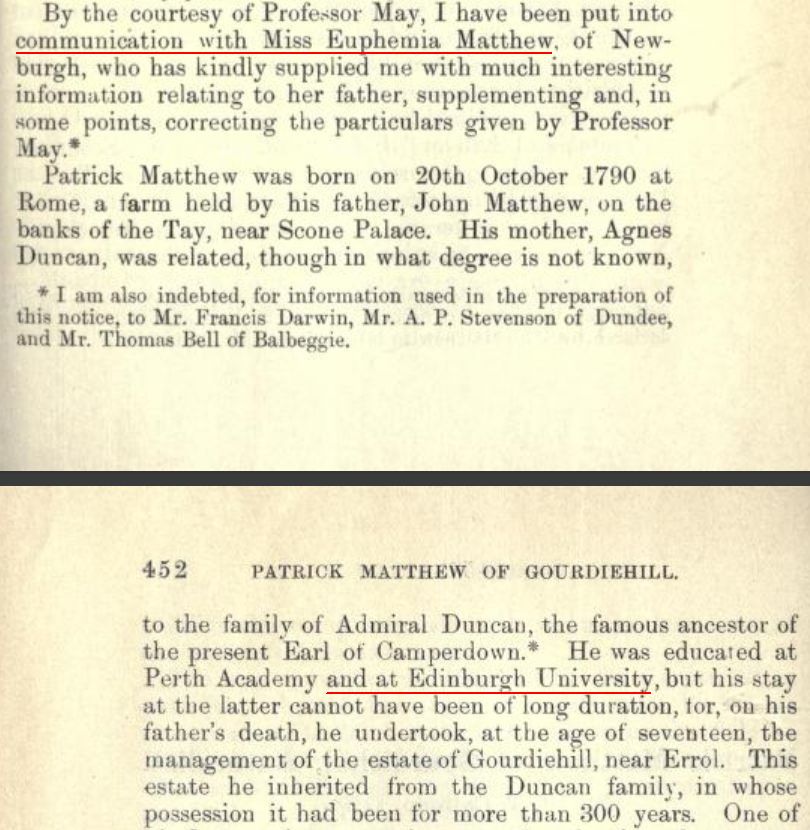
One enigma about this Patrick Matthew of Gourdiehill is his education. The only source we really have is William T. Calman (1912a, "Patrick Matthew of Gourdiehill." Handbook and Guide to Dundee and District, British Association for the Advancement of Science, pp. 451-457) stating:
"He [Patrick Matthew] was educated at Perth Academy and at Edinburgh University, but his stay at the latter cannot have been of long duration, for, on his father's death, he undertook, at the age of seventeen, the management of the estate of Gourdiehill, near Errol." (Calman 1912a, p. 452)3
---
3 He repeated roughly the same in a very similar article: Calman 1912b. Patrick Matthew (1790 – 1874). Journal of Botany, British and Foreign 50: 193-194.
---

Ever since, the above sentence about his education has been parroted by almost every publication ever written on Patrick Matthew (laudable exceptions being Mike Weale's and, thanks to him and Anne Carroll, mine). Matthew's university education is now often taken for granted, because this pseudo-replication created an appearance of corroboration that is not warranted.
     Calman (1912a, p. 451) only referred to communication with Miss Euphemia Matthew, Patrick Matthew's daughter, in general—a general nod at the memories of an 80 year old lady about a time, when she hadn't even been born, that is, family lore. But Calman did not refer to her as his particular source for the particular claim of Matthew's university education. Unless this communication was by letter and the letters have been preserved somewhere, we shall be unable to check Calman's words.

Excerpt from Calman (1912a). The correcting of "particulars given by Professor May" concerns the claim that the Matthew family was related to Robert Bruce via a sister of him.

Mike Weale from The Patrick Matthew Project found a first hint that sheds a doubt on the reliability of the communication between William Calman and Euphemia Matthew. The short version is that Pastor Benecke, a relative of the German branch of the Matthew family, told Walther May that the Matthews were descended from a sister of Robert the Bruce. May quoted Benecke on this in a German publication (May 1912. Darwin und Patrick Matthew. Zoologische Annalen 4: 280-311. See here for an English translation). Calman (1912a, p. 452), in turn, denied this in a footnote as follows:
"   * The family tradition alluded to by Professor May, according to which the Matthews are descended from a sister of Robert Bruce, is declared by Miss [Euphemia] Matthew to be quite without foundation."
However, Mike Weale found evidence that Euphemia Matthew owned genealogies that show that the Matthews descended from Robert Bruce in direct line—not via a sister (see section headed "Patrick Matthew's ancient family tree" at this page). And she gave them to A.H. Millar for his book the Historical Castles and Mansions of Scotland (1890). At page 128, it mentions a document in the possession of Miss E. Matthew, Errol Park Cottage, and reprints it as: The Genealogie of the Lords Oliphant as it was written in the Castell of Duplin. That is, Euphemia trusted in the correctness of the genealogy. Regardless of the question whether these genealogies were really correct or not, there remains the oddity that Calman claims Euphemia to have declared the family lore about the family link "quite without foundation," when she should only have denied that the link to Robert Bruce went via a sister. This suggests poor understanding between Euphemia Matthew and William Calman.

The misattributed matriculation record
William J. Dempster (1996, Evolutionary concepts in the nineteenth century. Natural selection and Patrick Matthew. Pentland Press) tried to verify Patrick Matthew's training at the University of Edinburgh by consulting its matriculation record. He wrote:
"According to the records in the Department of Rare Books and Manuscripts, Edinburgh University Library, the name of Patrick Matthew appears in the Matriculation Index in 1804-05 and again in 1808-09. His name is on the class list of Professor Gregory who held the chair of medicine. The subjects studied were anatomy, surgery, chemistry, medical practice. In 1808 Patrick Matthew attended Professor Hope's classes in chemistry. There is no evidence that Patrick Matthew graduated from Edinburgh and he appears never to have mentioned in his writings that he had attended Edinburgh University, where his studies were interrupted when he seventeen years old by the death of his father." (Dempster 1996, p. 1, my emphasis) 
Meanwhile, the University of Edinburgh has put its records of historical alumni online (see image below). This online record seems to suggest that the Patrick Matthew in question ran a regular course of studies in medicine and was training abroad, at the Indian Medical Service, from 1807 to 1808. However, it is rather a compound record of two namesakes as will become clear in the following.


A direct look at the records in the library of the university yielded entries for the sessions 1804-05, 1805-06 and 1808-09 (ht Julian Derry). Sessions were beginning 1st October of the first year, say 1804, and running through to summer of the next year, 1805. 
     Anyway, the above record does not fit to Patrick Matthew of Gourdiehill (Gourdiehill PM) for several reasons. First, Gourdiehill PM (1790-1874) would have been 14 in the year that the matriculation record first registered the enrollment. Second, Gourdiehill PM never was in India. Third, this Patrick Matthew (born 20 October 1790) would have been 17 or just turned 18, when visiting the university in the session 1808-09, which began at 1 Oct. 1808. However, the father of Gourdiehill PM died roughly one year earlier, at 1 November 1807.4 Though Patrick Matthew's uncle, yet another Patrick Matthew, was put up to manage the affairs of his deceased brother John Matthew (see here), it seems somewhat unlikely that Patrick Matthew jun. would have proceeded to start a course of academic studies at the university about one year later. He was the only son with five sisters (see section: "Patrick Matthew's immediate family tree" at The Patrick Matthew Project) and a widowed mother to look after. Even without the earlier death of his father, a course of studies including anatomy, surgery, and medical practice would have been a very odd choice.
-----
4 The church account of the Old Parish Register of Scone records a sum of money taken for forwarding a mort-cloth for a dead Mr. Matthew (no forename) at 8 November 1807.

-----

     A closer look at all university records (ht Julian Derry, his full data-set contains about 100 photographs of matriculation records, class lists etc. from the university archives), however, shows that the entries for 1804-05 and 1805-06 were by a medical student, whereas the matriculation in 1808 was only for chemistry. Furthermore, this non-medical Pat Matthew seems to have attended only one chemistry lecture of Prof. Thomas Charles Hope, given at 26 October 1808. The class list of that lecture shows that the "Pat. Matthew" attending this lecture indicated that he was not a medical student (see left column "Not med?" in the image below). Hence the above online record is not all of one medical student, but a compound of a medical student (1804-1806) and someone else who did not study medicine.


A day at the University—or a few months at most
That is, Patrick Matthew of Gourdiehill may have attended at least one of the chemistry lectures of Prof. Hope. These lectures were famous for their spectacular experiments and became so popular among the wider population, that was not studying and following a regular curriculum, that Hope, eventually, gave one for the ladies of Edinburgh at 15 Feb. 1826:
"For the first time, [...] the splendid portals of the University of Edinburgh were thrown open to the fair sex [...]. On that memorable day Dr. Hope, the Professor of Chemistry, commenced a popular course of that fascinating subject. That learned lecturer has been long celebrated for his oral instruction, but still more famous for his showy experiments exhibited to the grown-up children of the male sex [...]." (Dr. Hope and his lecture to the Ladies of Edinburgh, The Lancet 6(145): 336-363, 1826)
After toiling with the management of the family estate for 10 months, Patrick Matthew of Gourdiehill may either have needed a distraction or an educational leave for improving his farm management skills. What he did not need was a full-time course of studies for a job, as if he had none yet. He either visited only one of Prof. Hope's edutainment lectures for grown-up children or his stint at the university amounted to several weeks. As he does not occur in any records of 1809 or later, however, the season holidays around 20 December 1808 would probably mark the end of any stint longer than one day at the university. Personally, I do not believe that Matthew attended more than one fun lecture by Prof. Hope, because of the chores of managing the family estate and looking after his five sisters and widowed mother. By his own account in the Gardeners' Chronicle and Agricultural Gazette, he managed orchards from 1807, the year his father died, onward. In 1865, he corrected a claim made in the the Gardeners' Chronicle, that the climate of Scotland does not allow the cultivation of fruit trees, in a letter to the editors as follows:
"I have managed orchards for 58 years; have planted orchards—many thousand Apple and Pear trees in Scotland, Germany, and a small one in Spain; [...]" (Matthew 1865, Gardeners' Chronicle and Agricultural Gazette 25, 16 December 1865, p. 1179) 

     In conclusion, Calman's account is definitely false. It is chronologically impossible that the death of his father John Matthew in December 1807 forced Patrick to quit studying in Oct.-Dec. 1808. We already know that the communication between William Calman and Euphemia Matthew was unreliable (see Robert the Bruce above). Imagine Calman asking Euphemia a loaded question about her father's university education and Euphemia answering something to the effect that: yes, he did have his stint there in 1808 but, no, he couldn't pursue a full curricular course of studies because of his father's death in 1807...
Calman probably connected the wrong ends once more and construed a story about Patrick Matthew's full curricular course of studies terminated by the precipitous death of his father.

Let the mess begin
The above records for sessions 1804-05, 1805-06, the diploma from the Royal College of Surgeons in 1806, and the medical service in India in 1807 all refer to the other Patrick Matthew, a medical student from Newbigging. Before giving further details that illuminate the existence of this Patrick Matthew, however, a word on the above featured online record of historical alumni of the University of Edinburgh as well as on the habit of Scottish officials in treating fore- and surnames.
     First, the online record includes a typo and a rare expression. "Colleg" must simply be "College" and "Diplomate" was a standard expression for members of the Royal College of Surgeons with a diploma degree. Indeed, the medical student from Newbigging did earn a degree called diploma from the Royal College of Surgeons at 18 April 1806 (thanks to Aaron Fleming, Library and Archive Assistant, The Royal College of Surgeons of Edinburgh for that information).   
     Second, for some reason it was quite common among the Scots to treat the forenames Peter and Patrick as synonymous. Our medical student and his father from Newbigging as well as our orchard owner from Gourdiehill have all been referred to by either name in various documents. Likewise, the same person has variously been called by the surnames Matthew, Mathew, and Matthews in different documents. This is true, for example, for the diploma record of the Royal College of Surgeons, for it spells the medical student from Newbigging with only one "t" in Mathew. The military bureaucracy in India picked up that spelling with one "t" and never corrected it.  

Life of Patrick. Short story of the namesake from Newbigging
Traces of the existence of the other Patrick Matthew from Newbigging can be found in many independent documents. Before piling these historical records, here's the short version:
  • Patrick Matthew is baptised on 16 August 1785 in Errol, son of Peter/Patrick Matthew and Jean McCulloch of Newbigging, Errol. 
  • He studies medicine at Edinburgh University from 1804-05 (first year) to 1805-06 (second year). 
  • The British India Office of Medical Staff appoints him as Assistant Surgeon in 1805. 
  • At 18 April 1806, he earns a diploma from the Royal College of Surgeons and 
  • his appointment as Assistant Surgeon is promptly approved at 14 November 1806. 
  • The Caledonian Mercury, 13 December 1806, lists assistant surgeons P. Matthew and G. O. Gardner among the passenger of the ship General Stuart headed for Bengal.   
  • 16 April 1820, he gets promoted to surgeon. 13 years was quite the normal stretch for such a promotion in the army.
  • He eventually dies, aged 45, as Surgeon of the Hon. East India Company's Bengal Establishment, 15 August 1830, and is buried in Kacherie Cemetery in Cawnpore (Kanpur).
Before that, he marries Margaret McGowan and they have one daughter, also called Margaret. Mother Margaret was born in 1785/6—maybe in Ireland. After the death of her husband, she returns to Scotland with her daughter. She gets on a census record as living in Perth, 13 Marshall Place, from 1841 to 1871, where she also dies in 1873 (aged 87 or 88). Her daughter Margaret is born in Benares (Varanasi), India, on 9 November 1818. At the age of 20, 27 April 1837, she marries John Campbell, junr, Esq of Kinloch, of the Madras Army, in Perth. They return to India and have four sons, all but one born in India. Margaret Campbell (nee Matthew) dies in Jaulnah, Madras, and is buried on 18 July 1844 (aged 26).

Traces of Patrick. Evidence of the namesake's existence
1. Baptism
Here's a record from the ScotlandsPeople website showing that three Patrick Matthews have been born and baptized around the same time and close to each other in Scotland.


Okay, the guy from Udny near Aberdeen is a bit farther off, but the the guy baptized in Errol near Perth is our Newbigging P.M. (see record below), and the third guy baptized in Scone near Perth is our Gourdiehill P.M. known to have been born on Rome Farm near Scone.


2. Family background
The file GD316 of the National Records of Scotland has further information about the other Patrick Matthew's family. This Patrick was the grandson of a John Matthew from Clashbenny and the son of a Peter/Patrick Matthew from Newbigging. The following excerpt is from GD316_16_4, which gives the genealogies of Matthew families other than the one of Gourdiehill (put online by Mike Weale at The Patrick Matthew Project).


As you can see, Peter Matthew of "Newbigging" (red ellipse) was a son of John Matthew (of Clashbenny, this village is given on the next page, which is not shown above) and had a son called Patrick Matthew (third from left), who went to East India and married there. Here's the same excerpt rotated clockwise:


Inside the red ellipse, it says, in the right half (which is the top in the non-rotated version and hence the older half): "Patrick Matthew, went to East India, and married."
The left (younger) half says: "One daughter, married, name unknown." (We actually know that her name was Margaret Matthew and she married Captain John Campbell. See below.)
     Furthermore, the elder brother John Matthew (at the top of the rotated image) also went to East India, and so did the younger brother George Matthew (two below Patrick). The Newbigging Matthews had quite a number of supernumerary sons and quite a family tradition of sending them to India.

3. Transit as appointed assistant surgeon
Here's the list of passengers for Bengal on board of the General Stuart (published in the Caledonian Mercury, Saturday, 13 December 1806).


Again, an ambiguous record. We know that Patrick Matthew/Mathew from Newbigging did study medicine, earn a diploma from the Royal College of Surgeons, was approved as assistant surgeon by the British India Office for Medical Staff, and eventually died as a surgeon in India. Nevertheless, the passenger list can be read in two ways. Either P. Matthew and G. O. Gardner were both assistant surgeons and the newspaper forgot the plural "s," or only G. O. Gardner was an assistant surgeon.

4. Assistant surgeon
However, the following record of both Patrick Mathew (sic) and Gilbert Ogilvy (sic)5 Gardner as assistant surgeons listed in the East-India Register and Directory for 1819 (p. 113) leaves little doubt that both traveled as appointed assistant surgeons in 1806. As already mentioned, the military officials picked up the spelling of the surname "Mathew" with one "t" from the diploma degree of the Royal College of Surgeons and never corrected it in his lifetime.
-----
5 The day these two chaps entered the British military service, two things happened. First, the staff of the British India Office misspelled both their names, Patrick Matthew's as "Patrick Mathew" and Gilbert Ogilvie Gardner's as "Gilbert Ogilvy Gardner." Gilbert's mother was Grisel Elizabeth Ogilvie and Gilbert's second forename was, therefore, Ogilvie not Ogilvy. Second, they were always put next to each other in lists of surgeons or assistant surgeons thus turning Gilbert's unique name into a nice tracer for Patrick's common one.  
-----


5. Promotion to surgeon
In the East-India Register and Directory for 1821 (p. 113), both are listed as surgeons. That is, they must have been promoted between 1819 and 1821.


The dates in the above featured list probably registered the arrival of the soldiers at their current station (e.g. Gilbert Ogilvy Gardner arrived at 17 Dec. 1821 in the Civil station, Bauleah).
     The exact date of Gilbert Ogilvy's promotion to surgeon has been recorded in The Asiatic Journal and Monthly Register for British India and its Dependencies (July to Dec. 1822, vol. 14). Under the heading "Military Appointments, Promotions, &c." (beginning at page 183) it says at page 185: "Surg. Gilbert Ogilvie (sic) Gardner to rank from 19th June 1820, vice G. Campbell, retired."
     Patrick Matthew's career and death in the service has been registered much later by Lieut.-Colonel D. G. Crawford (1930. Roll of the Indian Medical Service 1615-1930. Vol 1, p. 55).
The abbreviations mean:
b.: born;6 d.: died; A.S.: Assistant Surgeon; Surg.: Surgeon; S.A.L.M.B.: Service Army Lists, Medical, Bengal; P.R.: Prize Rolls; M.R.C.S.: Member, Royal College of Surgeons; M.D. Glas.: Medical Degree, Glasgow; R.: Retired.
-----
6 As the baptism of Patrick Matthew was 16 August 1785 (see 1. Baptism), the year 1784 given by D.G. Crawford is a typo, and so is the year 1785 for Gilbert Ogilvie Gardner, who was born 5 February 1788 (see ScotlandsPeople).
-----

6. Death
The death of Patrick Matthew/Mathew, the surgeon, has been recorded in an Army & Navy Pension document of the British India Office and in the above cited book by Lieutenant-Colonel Crawford (1930).

Again, the full record is paywalled.

7. Father
Peter/Patrick Matthew, the father of our surgeon from Newbigging seems to have gone on record as yet another Patrick Matthew in an old tax roll (1797-1798) that is online here. The picture below shows that Peter/Patrick Matthew from Newbigging in the red ellipse:


At that time, Patrick Matthew from Gourdiehill was only 7 years old and surely did not pay taxes for farm horses. Apparently, this Peter/Patrick Matthew from Newbigging also signed the preface of a book by David Young published in 1788, when our Gourdiehill chap had not even been born (see here). And there's even a fourth Patrick Matthew from Sherifftown. (This was the uncle of Gourdiehill Patrick Matthew, who took it upon him to act on behalf of the latter's deceased father, his brother John Matthew, who died intestate at 1 November 1807.)  


As already mentioned, treating the forenames Peter and Patrick as if they were identical has been fairly common among officials in Scotland. Our Gourdiehill Patrick Matthew also got called Peter Matthew in a copy of the Errol churchyard, where he's been buried (ht to Julian Derry):


8. Daughter
The marriage of Margaret Matthew (daughter of Patrick Matthew, surgeon from Newbigging) was announced in the The Perthshire Courier, 27th April, 1837, page 3, column 1. It reads:
"Married, at 13, Marshall Place, on the 25th inst., by the Rev. James Esdaile, John Campbell, junr. Esq. of Kinloch, of the Madras Army, to Margaret, only daughter of the latePatrick Matthew, Esq. Surgeon on the Hon. East India Company's Bengal Establishment."


The first error in this comedy of mistaken identities
Apparently, the lives of the two namesakes have been scrambled together as early as 1831, only one year after the surgeon from Newbigging had died in India, in a vitriolic review of the book by the orchard owner from Gourdiehill (ht to Mike Weale from PMP). The anonymous reviewer of the Edinburgh Literary Journal, or Weekly Register of Criticism and Belles Lettres (2 July 1831, vol. 6, no. 138, pp. 1-4) speculated:
"Mr Patrick Matthew, as we understand, is a small landowner on Gourdie hill, near Errol, in Perthshire, an inconsiderable orchardist, if we may so speak, who has a house, with a garden and shrubbery, where he makes experiments on fruit-trees. Having been engaged, in his youth, in a seafaring line of life, probably as surgeon's mate to a man-of-war, he has acquired some acquaintance with the form and structure of a ship, with a quantum sufficit of naval slang. At one time or another also, it is possible that he may have been under-forester to some nobleman or gentleman in the neighbourhood. At all events, he has now amassed a little wealth; is owner of a couple of sea vessels that trade from Perth or Dundee to the Baltic; and, in a word, he considers himself as fully competent to enlighten the world on “Naval Architecture and Arboriculture.” "
It is true that Patrick Matthew of Gourdiehill owned land with an orchard (big at that) and, later in life, was co-owner of two sloops trading with the Baltic (ht Anne Carroll). He also grew timber on some leased patches, but the stuff about a seafaring youth as a surgeon's mate is probably the first mix-up of the surgeon from Newbigging with the orchadist from Gourdiehill.

Conclusion
While Edinburgh University seems to be a likely source for revolutionary ideas about geology and biology at the time, we have no palpable proof for Patrick Matthew of Gourdiehill having been educated, there, as a regular student. In the shortest case, he went to Edinburgh for one chemistry lecture in October 1808—a form of edutainment. In the longest case, he did spend some weeks, but less than than three month, there for an educational leave serving his self-improvement as an estate manager. He surely did not attend in 1804-05 and 1805-06.
     Edinburgh University's record of a historical alumnus called "Patrick Matthew" (see section: The misattributed matriculation record) is definitely a compound record of two namesakes. Patrick Matthew, the medical student from Newbigging, studied medicine in 1804-05 and 1805-06, got a diploma from the Royal College of Surgeons in 1806, went to India as an assistant surgeon thereafter, got promoted to surgeon in 1820, and died there in 1830. The contribution of the orchard owner from Gourdiehill to this compound record has been detailed in the previous paragraph. As the only son with fife sisters and a widowed mother, he would hardly have gone to study a full curricular course of studies at a university, when he had to manage the family estate.
     Anyway, with this state of affairs, speculating about Gourdiehill P.M.'s tutelage under Prof. Thomas Charles Hope (see Dempster 1996) is mere speculation. Worse still, suggesting a link of knowledge transfer from James Hutton to Patrick Matthew of Gourdiehill via the chemistry professor is spinning a new myth from mere speculation.