This is a vaccine against BS claiming that Darwin lied to Hooker in 1881:
Showing posts with label misquotation. Show all posts
Showing posts with label misquotation. Show all posts
Sunday, 27 September 2020
Buch Review: Charles Darwin did not mislead Joseph Hooker in their 1881 Correspondence about Leopold von Buch and Karl Ernst von Baer

Sunday, 22 April 2018
Why Charles Darwin did not own the Two Essays by W.C. Wells (1818) before the Beagle voyage or after
Tall claims
John S. Warren (2017. Darwin's missing links. History of European Ideas 43(8): 929-1001) claims that Charles Darwin bought William Charles Wells's (1818, Tow Essays: One upon single vision with two eyes; the other on dew. ...) before he even embarked on the voyage of the HMS Beagle. Charles Darwin read Herschel's Premier Discourse at Cambridge, who praised Wells's Essay on Dew as a role model for anybody attempting to do science. Warren promptly concludes:
Screwed records
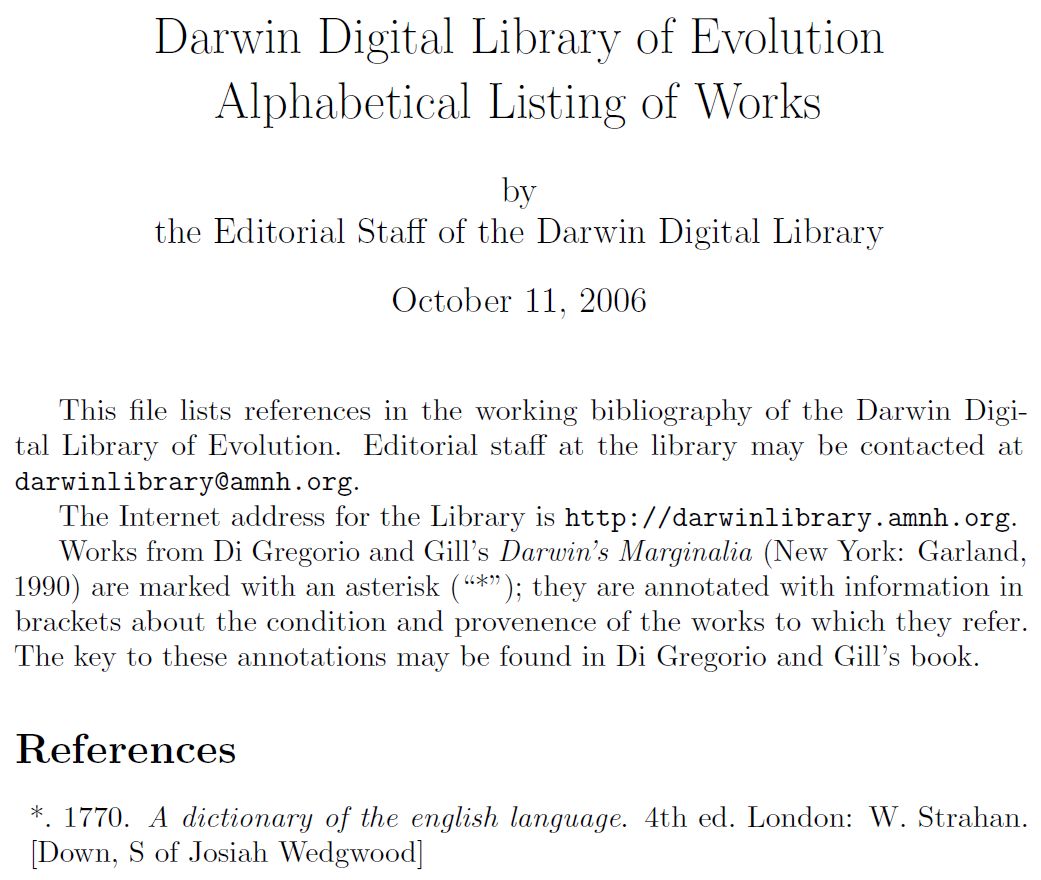
Now, Warren took an information provided by Charles Darwin's Library (at the website of the Biodiversity Heritage Library, BHL) as stating that Darwin owned that book before he even embarked on the Beagle Voyage. (In fact, Warren refers to the American Museum of Natural History, but that link does not exist anymore and the AMNH now relays you to the BHL's Charles Darwin Library.) This would be unproblematic, if the key to annotations had traveled along with the alphabetical list, but it hasn't. Page 84 of this list states:
 The crucial part, here, is that in square brackets: "Down, pre-B, ED." Unfortunately, the Charles Darwin Library or BHL does not give any information as to the meaning of these abbreviations (annotations). While SCRIBD still has a relic of the original list collated by the staff of the AMNH, this only tells us that the key to the annotations can be found in the book Charles Darwin's Marginalia edited by Di Gregorio & Gill (1990, Garland, New York).

Thankfully, Greg Priest (@greg_m_priest) tweeted the key to the symbols and the page with the entry of Wells's Two Essays.

"ED" seems to be missing from the key to symbols and Warren (2017) simply ignored it. He took the annotation to mean "book located at Down House, Kent" and "book owned prior to Beagle voyage but not known on board," as the key to symbols states for the meaning of "Down" and "pre-B."
However, Warren went further than that. He claimed that Charles Darwin bought the book while in Cambridge and owned it ever since, studiously avoiding the question what that "ED" at the end of the annotation might mean. In my opinion, it hints at one of the many Erasmus Darwin's rather than our Charles. That is, even if Di Gregorio's annotation was correct, it would not mean that Charles Darwin had bought the book before his Beagle voyage and owned it ever since.
However, the information of Di Gregorio, the BHL and AMNH is probably wrong anyway.
The first record
H. W. Rutherford (1908. Catalogue of the library of Charles Darwin now in the Botany School, Cambridge. Compiled by H. W. Rutherford, of the University Library; with an Introduction by Francis Darwin. Cambridge: Cambridge University Press) was the first at Cambridge University, who collated a list of the books that actually did enter their collection of Charles Darwin's books in 1908, and Francis Darwin wrote the introduction to that catalogue.
The first thing to notice is in Francis Darwin's Introduction:
The first record by H. W. Rutherford (1908) clearly contradicts Di Gregorio's annotation "Down, pre-B, ED," which has first been adopted by the AMNH and then by the the Biodiversity Heritage Library. While this annotation suggests Down House as the location of the book, the asterisk of Rutherford and the introductory statements by Francis Darwin state that Francis added this book to the collection, which has since been called the Darwin Library. That is, it was not from Down House or, anyway, not from Down House while Charles Darwin still roamed it.
Maybe it came down to Francis Darwin from Erasmus Darwin (either one). Maybe Francis stored it with some other books of his in Down for a while, before they went to Cambridge. Maybe the collator of the BHL's list made some mistake. Whatever the explanation of the screwed-up information at the BHL, it can surely not be taken as proof that Charles Darwin owned Well's Two Essays long before he even went on the Beagle voyage.
John S. Warren (2017. Darwin's missing links. History of European Ideas 43(8): 929-1001) claims that Charles Darwin bought William Charles Wells's (1818, Tow Essays: One upon single vision with two eyes; the other on dew. ...) before he even embarked on the voyage of the HMS Beagle. Charles Darwin read Herschel's Premier Discourse at Cambridge, who praised Wells's Essay on Dew as a role model for anybody attempting to do science. Warren promptly concludes:
Darwin required no prompting; he quickly acquired a copy ofWells’ ‘Essay on Dew’.259 The copy in Darwin’s library in Down House is identified in the Darwin Digital Library of Evolution, Bibliography and the ‘Key to Annotations’ as ‘Pre-B’ and ‘Down’: it was in Darwin’s private library pre-Beagle voyage, later located at Down House; that is, since the Beagle sailed in December 1831, the paper was acquired no later than 1831 (Appendix 1).260Whatever the historical significance of Wells's Essay on Dew (1814. Article IV.—An Essay on Dew, and several Appearances connected with it. The Quarterly Review; London Vol. 12(23): 90-99) the significance for the history of biology of the later published Two Essays lies in neither of the two essays, but in an appended "account of a female of the white race, part of whose skin resembles that of a negro ..." This last account contains an anticipation of natural selection as a means of adaptation of races to their different conditions. That is, Wells did not go as far as to suggest the origin of new species through natural selection, but he got pretty close.
259 Wells, Two Essays.
260 American Museum of Natural History (AMNH), 2005. http://darwinlibrary.amnh.org. Accessed January 25 and September 27, 2009. See also Appendix 1.
Appendix 1
The Darwin Library and DDLE are currently accessible on the AMNH website through the following links, as at 13th January, 2017: Darwin Manuscript Project (DMP) Website (darwinlibrary.amnh.org). To go straight to the William C Wells reference, the current URL is (http://www.biodiversitylibrary.org/docs/DarwinsLibraryBibliography.pdf) (Publications in EvoLit.bib p. 23). Excerpt from AMNH, 2005. ‘Darwin Digital Library of Evolution’ (darwinlibrary.amnh.org): web-page listing for the relevant section of the alphabetical letter ‘W’, showing William Charles Wells’ ‘Two Essays’ in Darwin’s private library, with immediately adjacent names. Wells’ book was acquired by Darwin before the end of 1831. The entry for Wells, 1818 is annotated, ‘*’ (the identifier for Darwin’s private library), ‘Pre-B’ (pre-Beagle voyage, but not known on board), and ‘Down’ (Darwin’s library, later located at Down House, Kent): see the Darwin Digital Library of Evolution, ‘Key to annotations’.
Screwed records
Now, Warren took an information provided by Charles Darwin's Library (at the website of the Biodiversity Heritage Library, BHL) as stating that Darwin owned that book before he even embarked on the Beagle Voyage. (In fact, Warren refers to the American Museum of Natural History, but that link does not exist anymore and the AMNH now relays you to the BHL's Charles Darwin Library.) This would be unproblematic, if the key to annotations had traveled along with the alphabetical list, but it hasn't. Page 84 of this list states:

Thankfully, Greg Priest (@greg_m_priest) tweeted the key to the symbols and the page with the entry of Wells's Two Essays.
 |
| Di Gregorio (ed.) 1990. Charles Darwin's Marginalia: Key to symbols |

"ED" seems to be missing from the key to symbols and Warren (2017) simply ignored it. He took the annotation to mean "book located at Down House, Kent" and "book owned prior to Beagle voyage but not known on board," as the key to symbols states for the meaning of "Down" and "pre-B."
However, Warren went further than that. He claimed that Charles Darwin bought the book while in Cambridge and owned it ever since, studiously avoiding the question what that "ED" at the end of the annotation might mean. In my opinion, it hints at one of the many Erasmus Darwin's rather than our Charles. That is, even if Di Gregorio's annotation was correct, it would not mean that Charles Darwin had bought the book before his Beagle voyage and owned it ever since.
However, the information of Di Gregorio, the BHL and AMNH is probably wrong anyway.
The first record
H. W. Rutherford (1908. Catalogue of the library of Charles Darwin now in the Botany School, Cambridge. Compiled by H. W. Rutherford, of the University Library; with an Introduction by Francis Darwin. Cambridge: Cambridge University Press) was the first at Cambridge University, who collated a list of the books that actually did enter their collection of Charles Darwin's books in 1908, and Francis Darwin wrote the introduction to that catalogue.
The first thing to notice is in Francis Darwin's Introduction:
THE library of Charles Darwin has now found a permanent home in his own University, and it is perhaps appropriate that it should be in the Botany School, since it was a Cambridge professor of Botany who, more than any one man, determined his career as a naturalist.
The collection is not identical with that at Down. Thus the books he wrote and some few others from Down are in my own possession. There are also a few books of mine which, for the sake of convenience, are kept in the Darwin library: these are marked with an asterisk in the catalogue. (Rutherford 1908, p. vii, emphasis added) ##[The books from Francis Darwin's private possession have probably been integrated into the collection by now.] Next thing to notice is the explanation of the abbreviations:
* Books thus marked were not in the Library at Down. ... (Rutherford 1908, p. xiv, emphasis added)And, finally, there is the entry for W. C. Wells:
*Wells (William Charles). Two Essays: one upon single vision with two eyes; the other on Dew: &c. 8vo. London, 1818. 24 (Rutherford 1908, p. 89)Conclusion
The first record by H. W. Rutherford (1908) clearly contradicts Di Gregorio's annotation "Down, pre-B, ED," which has first been adopted by the AMNH and then by the the Biodiversity Heritage Library. While this annotation suggests Down House as the location of the book, the asterisk of Rutherford and the introductory statements by Francis Darwin state that Francis added this book to the collection, which has since been called the Darwin Library. That is, it was not from Down House or, anyway, not from Down House while Charles Darwin still roamed it.
Maybe it came down to Francis Darwin from Erasmus Darwin (either one). Maybe Francis stored it with some other books of his in Down for a while, before they went to Cambridge. Maybe the collator of the BHL's list made some mistake. Whatever the explanation of the screwed-up information at the BHL, it can surely not be taken as proof that Charles Darwin owned Well's Two Essays long before he even went on the Beagle voyage.
Tuesday, 15 November 2016
The real decimal error that transmogrified into the spinach-iron-decimal-error myth
[Click here to get all posts in this series.]
The wrong old narrative
A decimal separator misplaced in the 1870s caused the false reputation of spinach for being the vegetable that was richest in iron. Though still highly popular, this narrative is wrong (see here and here). The new narrative can be stated most simply as follows.
The wrong new narrative
The decimal error is a myth, it never occurred. The false reputation of spinach was due to unreliable methods or poor experimentation. That is, errors were inherent in experimental methods, not data handling or a typo (see here). Moreover, Arnold E. Bender and Terence Hamblin were, according to this judgmental new narrative, promulgating pure and utter nonsense based on no true decimal error whatsoever, when they popularized the old narrative. This new narrative is combined with stuff about Popeye and peddled as a hero story about busting a myth about a myth (or "supermyth"). It seems to be highly popular for this reason, but it is also wrong, because a real decimal error did occur and it can explain why the eminent researchers, Arnold E. Bender and Terence J. Hamblin, mixed things up and, inadvertently, created the spinach-iron-decimal-error myth.The important difference between the new narrative and the one to follow is that the latter can explain Bender's and Hamblin's blunder, where the above only returns a verdict verging on insult.
The narrative that explains instead of returning verdicts
Throughout this series of reconstructing the data handling of the primary research literature, I found that the relevant research was full of data handling and data transformation errors, but none of these errors was as simple as misplacing a decimal separator (see here). Neither Mike Sutton's original sleuthing, nor my in depth analysis and reconstructions of the historic data handling and transformations ever found a displaced decimal separator that could explain why an eminent researcher such as Arnold E. Bender should have come up with that myth.
Surprisingly, I now found a real decimal error that can, indeed, explain how Bender's memory fused it with other peculiarities in the research record and, inadvertently, caused the myth in the 1970s. A simple decimal-point error did occur in an article published in—wait for it—Science 90, no. 2347, pp. 596-597 (1939). But the research reported there was about the iron content of dried peas and beans instead of spinach.* So how can it be the mythical error recurring in the urban legend about spinach & iron?
-----
* The full reference is: Aschman, Leah, Mary Speirs & Dorothy Maddox (1939) The availability of iron in dried peas and beans. Science 90, 596-597.
-----
The original decimal error
Let's first take a look at the error itself. Aschman et al. (1939) report the results of an experiment that was pretty similar to the much older experiments by Bunge (1892), for example. They rendered baby rats anaemic by feeding them on milk only (mammalian milk is poor in iron). Then they fed the anaemic rats dried peas and beans, did the proper controls and measured the recovery of the rats. Along the way, they also measured the iron content of the dried products and gave the values as follows:

Anybody with a sharp eye will spot the decimal-point error in the value given for butter beans at the end. And that is what the staff of the Nutrient Section of the Bureau of Home Economics did, when they published abstracts in the Journal of Home Economics 32, no. 7, p. 481:
 As you can see, however, this correction of a decimal point error concerning the iron content of butter beans follows directly on an abstract concerning the contents of oxalic acid in vegetables including spinach. Now, one big topic in the debate about the usefulness or uselessness of spinach as a dietary source of iron was oxalic acid, because it binds the iron and thus inhibits the absorption of it by the consumer.
The first and second claim of a misplaced decimal separator
In his inaugural lecture, Arnold E. Bender (1972, The wider Knowledge of Nutrition, Queen Elisabeth College) attributes the discovery of the decimal error explanation for the exaggerated iron content of spinach to the work of a professor Schupan (see here for an account of the sleuthing up of this first claim that a decimal error occurred in relation to the iron-content of spinach).
A lot of this passage is enigmatic or wrong. First, that Professor den Hartog never seems to have published anything himself on the issue. Some C. den Hartog (1971. Nutrition of infants and children. Royal Society of Health Journal 91(3): 111-114) from the Agricultural University in Wageningen, The Netherlands, however, was much into the issue of nutrition, iron deficiency and all that writing: "Neither breast milk nor cow's milk can obviate the need, early in life, for supplements to meet vitamin C, vitamin D and iron requirements" (den Hartog 1971, p. 111, see also p. 114). He has probably been the correspondent of Bender.
Second, Dr. Emil Wolff had no title of nobility, when he published his research in 1871 or 1880; the "Von" in "Von Dr. Emil Wolff" on the title-page must be translated as: "By Dr. Emil Wolff." The fact that Emil Wolff did get knighted towards the end of his life does not change his publishing as a regular guy (same with Justus Liebig, Johann Wolfgang Goethe and many other Germans who are often falsely cited as if knighted).
Third, Wolff's publications contained no misplaced decimal point relating to spinach and iron content (see here and here). In fact, spinach does not even feature as exceptionally rich in iron content in his publications (lettuce and asparagus should have become famous instead of spinach, if it was up to Wolff's data). The one thing that could be called a decimal error occurred in Wolff's later Aschen-Analysen of 1880 and concerned all chemical compounds in all analyzed vegetables (see here). That is, in transferring data from his 1871 Aschen-Analysen, a heading of a whole table said "in 100 parts" instead of "in 1000 parts." Fourth, the guy studying the iron content of vegetables with the α-α'-dipyridyl method was W.C. Sherman not Schupan. Fifth, the discrepancy of the findings of Sherman and colleagues was indeed down to the difference in methods and not to misplaced decimal point (see here).
Later, Bender (1977) released the decimal-point-error legend upon a wider public through a letter to The Spectator.
Looking, again, at the above image of the Journal of Home Economics (1940, vol. 32, no. 7, p. 481), we can reconstruct Bender's or den Hartog's faulty and mixed up memory as follows (as den Hartog remains an elusive figure in this legend, I will treat Bender's and Hartog's memory as one). He probably remembered the occurrence of a real decimal error concerning the iron-content of some vegetable, but did not remember correctly that it was made by Ashman et al. (1939. Science 90, 596-597) in relation to butter beans.
Why did Bender's/Hartog's memory fuse this real decimal error from 1939 to spinach, the name of Schupan and the year 1937? The link to spinach is obvious, if we remember that oxalic acid was a big issue in relation to the iron content of spinach (and other vegetables), because it binds iron and that way renders it unavailable to animals consuming spinach. As the abstract preceding the one with the decimal error was exactly about this issue and mentioned spinach as being high in oxalic acid, the fusing of the decimal error concerning iron content in butter beans to oxalic acid in spinach becomes intelligible. This leaves two remaining questions concerning Bender's faulty memory:
1. Who was Schupan?
2. Why the year 1937?
Who was Schupan?
I was able to trace "Werner Schuphan" (mind the h after the p) instead of Schupan. While he did publish on all sorts of vegetables including spinach, the following publication from 1940 shows that he can hardly have debunked the myth of spinach's exceptional iron richness in 1937:
Why the year 1937?
One article published by Schuphan in 1937 (Untersuchungen über wichtige Qualitätsfehler des Knollenseleries bei gleichzeitiger Berücksichtigung der Veränderung wertgebender Stoffgruppen durch die Düngung. Bodenkunde und Pflanzenernährung 2, issue 5-6, pp. 255-304) dealt with quality issues in celeriac including the so-called Eisenfleckigkeit (iron blotchiness) of tubers. He therein debunked the belief that celery tubers turn brown at the cut surface, because of the oxidation of iron and claimed that the colouring is due to resins and essential oils instead. That is, he debunked the idea that the oxidation of iron at the air is the cause of the celeriac getting brown, where it is cut.
The last question remaining is: Why did Bender think (misremember) that the decimal error occurred in the 1870s?
Why place the decimal error in the 1870s?
Schuphan (1937, p. 258) does cite H.W. Dahlen (1874. Beiträge zur chemischen Kenntnis der Gemüsepflanzen. Landwirtschaftliche Jahrbücher 3: 723-751) as follows: "Dahlen (5) findet z. B. in der Asche von knollensellerie einen Gehalt von 1,41% Fe2O3." ["Dahlen (citation no. 5), for example, finds the a content of 1.41% Fe2O3 in celeriac."]**
As a matter of fact, Dahlen's publication consisted of two parts, part A being published at pp. 320-336 of the journal, Landwirtschaftliche Jahrbücher 3, and part B at pp. 723-751. In neither of the parts does Dahlen drop a single word on iron content. He only measured the contents of water, ash, nitrogen, fat, sugar, starch, raw fiber, sulfur, phosphor, ammonia.
That is, Schuphan's citation of Dahlen (1874) as authority on the iron content of celeriac is false. Moreever, the erratum at the very end of Dahlen's two-part publication mentions an error of a decimal dimension:
-----
** Another article from Schuphan in 1937 (Der gegenwärtige Qualitätsbegriff bei Gemüsen und die Notwendigkeit seiner Erweiterung auf chemisch erfaßbare Wertmerkmale. Der Forschungsdienst 3: 290-303) discussed the general discrepancy between criteria for the marketability of vegetables (e.g., size, form, colour, solidity) and nutrient quality (e.g., contents in essential oils, proteins, sugar, vitamin c). Most of his examples are taken from his own and others' research on celery. He mentions aside, the effect of P-manure on contents of vitamin c, phosphoric acid and lezithin in spinach, but iron is no issue at all.
-----
Conclusion
This is probably the explanation for Bender's/Hartog's faulty memory and his inadvertent causing of a mythical debunking of a decimal error that did occur, but not in the 1870s, not in relation to spinach and not by Werner Schuphan. Arnold Bender fused the real decimal error concerning iron centent in butter beans with the oxalic acid content and hence low availability of iron in spinach; he further fused the debunking of an allegedly high iron content in celeriac as the cause of brown blotches at its cutting edges with a faulty citation by Schuphan of Dahlen (1874) and Dahlen's typo of a decimal order of magnitude with all this. And he thus came up with a false story about a decimal separator concerning the iron content of spinach having been displaced in the 1870s, and this having been debunked by Schuphan in 1937.
While this is the profane solution to a myth about a myth about the iron content of spinach, everybody is now fascinated about the further myth peddled by Mike Sutton, that no decimal error ever occurred, that no researcher ever existed that would fit to Bender's wrongly spelled "Schupan," and that Bender's memory is anyway pure fantasy and has no roots in anything that really ever happened.
The wrong old narrative
A decimal separator misplaced in the 1870s caused the false reputation of spinach for being the vegetable that was richest in iron. Though still highly popular, this narrative is wrong (see here and here). The new narrative can be stated most simply as follows.
The wrong new narrative
The decimal error is a myth, it never occurred. The false reputation of spinach was due to unreliable methods or poor experimentation. That is, errors were inherent in experimental methods, not data handling or a typo (see here). Moreover, Arnold E. Bender and Terence Hamblin were, according to this judgmental new narrative, promulgating pure and utter nonsense based on no true decimal error whatsoever, when they popularized the old narrative. This new narrative is combined with stuff about Popeye and peddled as a hero story about busting a myth about a myth (or "supermyth"). It seems to be highly popular for this reason, but it is also wrong, because a real decimal error did occur and it can explain why the eminent researchers, Arnold E. Bender and Terence J. Hamblin, mixed things up and, inadvertently, created the spinach-iron-decimal-error myth.The important difference between the new narrative and the one to follow is that the latter can explain Bender's and Hamblin's blunder, where the above only returns a verdict verging on insult.
The narrative that explains instead of returning verdicts
Throughout this series of reconstructing the data handling of the primary research literature, I found that the relevant research was full of data handling and data transformation errors, but none of these errors was as simple as misplacing a decimal separator (see here). Neither Mike Sutton's original sleuthing, nor my in depth analysis and reconstructions of the historic data handling and transformations ever found a displaced decimal separator that could explain why an eminent researcher such as Arnold E. Bender should have come up with that myth.
Surprisingly, I now found a real decimal error that can, indeed, explain how Bender's memory fused it with other peculiarities in the research record and, inadvertently, caused the myth in the 1970s. A simple decimal-point error did occur in an article published in—wait for it—Science 90, no. 2347, pp. 596-597 (1939). But the research reported there was about the iron content of dried peas and beans instead of spinach.* So how can it be the mythical error recurring in the urban legend about spinach & iron?
-----
* The full reference is: Aschman, Leah, Mary Speirs & Dorothy Maddox (1939) The availability of iron in dried peas and beans. Science 90, 596-597.
-----
The original decimal error
Let's first take a look at the error itself. Aschman et al. (1939) report the results of an experiment that was pretty similar to the much older experiments by Bunge (1892), for example. They rendered baby rats anaemic by feeding them on milk only (mammalian milk is poor in iron). Then they fed the anaemic rats dried peas and beans, did the proper controls and measured the recovery of the rats. Along the way, they also measured the iron content of the dried products and gave the values as follows:

Anybody with a sharp eye will spot the decimal-point error in the value given for butter beans at the end. And that is what the staff of the Nutrient Section of the Bureau of Home Economics did, when they published abstracts in the Journal of Home Economics 32, no. 7, p. 481:
The first and second claim of a misplaced decimal separator
In his inaugural lecture, Arnold E. Bender (1972, The wider Knowledge of Nutrition, Queen Elisabeth College) attributes the discovery of the decimal error explanation for the exaggerated iron content of spinach to the work of a professor Schupan (see here for an account of the sleuthing up of this first claim that a decimal error occurred in relation to the iron-content of spinach).
"One common belief, that spinach is good for you, appears to be due to experimental error since the belief predates Hollywood nutrition films based on the muscular development of the film star Popeye. I am indebted to Professor den Hartog of Holland for tracing the possible origin of this belief. It appears to date soon after 1870 when Dr. E. von Wolff published food analyses showing spinach to be exceptionally rich in iron, a figure that was repeated in many generations of textbooks; it was in the Handbook of Food Sciences (Handbuch der Ernährungslehre) by von Noorden and Saloman [sic] in 1920. In 1937 Professor Schupan analysed spinach for its iron content with α-α'-dipyridyl and found the figure to be one tenth of that reported by von Wolff – the fame of spinach may well have grown from a misplaced decimal point." (Bender 1972, p. 11)
 |
| C. den Hartog (1971) |
Second, Dr. Emil Wolff had no title of nobility, when he published his research in 1871 or 1880; the "Von" in "Von Dr. Emil Wolff" on the title-page must be translated as: "By Dr. Emil Wolff." The fact that Emil Wolff did get knighted towards the end of his life does not change his publishing as a regular guy (same with Justus Liebig, Johann Wolfgang Goethe and many other Germans who are often falsely cited as if knighted).
Third, Wolff's publications contained no misplaced decimal point relating to spinach and iron content (see here and here). In fact, spinach does not even feature as exceptionally rich in iron content in his publications (lettuce and asparagus should have become famous instead of spinach, if it was up to Wolff's data). The one thing that could be called a decimal error occurred in Wolff's later Aschen-Analysen of 1880 and concerned all chemical compounds in all analyzed vegetables (see here). That is, in transferring data from his 1871 Aschen-Analysen, a heading of a whole table said "in 100 parts" instead of "in 1000 parts." Fourth, the guy studying the iron content of vegetables with the α-α'-dipyridyl method was W.C. Sherman not Schupan. Fifth, the discrepancy of the findings of Sherman and colleagues was indeed down to the difference in methods and not to misplaced decimal point (see here).
Later, Bender (1977) released the decimal-point-error legend upon a wider public through a letter to The Spectator.
The fusion of the real decimal error with the spinach-iron issue"Sir: In a recent article (18 June) spinach is given undeserved nutritional eminence, although, since the facts have never been widely publicised, the author can be excused.For a hundred years or more spinach has been (and clearly still is) renowned for its high content of iron compared with that of other vegetables, but to the joy of those who dislike the stuff this is quite untrue. In 1870 Dr E. von Wolff published the analyses of a number of foods, including spinach which was shown to be exceptionally rich in iron. The figures were repeated in succeeding generations of textbooks—after all one does not always verify the findings of others including the 'Handbook of Food Sciences' (Handbuch der Ernährungslehre) by von Noorden and Saloman in 1920.In 1937 Professor Schupan eventually repeated the analysis of spinach and found that it contained no more iron than did any other leafy vegetable, only one-tenth of the amount previously reported. The fame of spinach appears to have been based on a misplaced decimal point."Professor Arnold Bender, The Spectator (18 July 1977, p. 18)
Looking, again, at the above image of the Journal of Home Economics (1940, vol. 32, no. 7, p. 481), we can reconstruct Bender's or den Hartog's faulty and mixed up memory as follows (as den Hartog remains an elusive figure in this legend, I will treat Bender's and Hartog's memory as one). He probably remembered the occurrence of a real decimal error concerning the iron-content of some vegetable, but did not remember correctly that it was made by Ashman et al. (1939. Science 90, 596-597) in relation to butter beans.
Why did Bender's/Hartog's memory fuse this real decimal error from 1939 to spinach, the name of Schupan and the year 1937? The link to spinach is obvious, if we remember that oxalic acid was a big issue in relation to the iron content of spinach (and other vegetables), because it binds iron and that way renders it unavailable to animals consuming spinach. As the abstract preceding the one with the decimal error was exactly about this issue and mentioned spinach as being high in oxalic acid, the fusing of the decimal error concerning iron content in butter beans to oxalic acid in spinach becomes intelligible. This leaves two remaining questions concerning Bender's faulty memory:
1. Who was Schupan?
2. Why the year 1937?
Who was Schupan?
I was able to trace "Werner Schuphan" (mind the h after the p) instead of Schupan. While he did publish on all sorts of vegetables including spinach, the following publication from 1940 shows that he can hardly have debunked the myth of spinach's exceptional iron richness in 1937:
Spinat zeichnet sich – wie wir sehen – besonders durch hohe Gehalte an Carotin, Chlorophyll, Eisen und Reineiweiß und Vitamin C aus." (Schuphan, W. 1940. Über den Einfluss der Chlorid- und Sulfatdüngung auf Ertrag, Marktgängigkeit und biologischen Wert verschiedener Gemüse unter Berücksichtigung edaphischer und klimatischer Faktoren. Bodenkunde und Pflanzenernährung 19(5-6): 265-315)As the above quote reiterates the idea that spinach is richer in iron than other vegetables, it is unlikely that he had some years before claimed the opposite.
"Spinach distinguishes itself – as we see – especially through high contents of carotin, chlorophyll, iron and pure protein and vitamin c." [my translation]
Why the year 1937?
One article published by Schuphan in 1937 (Untersuchungen über wichtige Qualitätsfehler des Knollenseleries bei gleichzeitiger Berücksichtigung der Veränderung wertgebender Stoffgruppen durch die Düngung. Bodenkunde und Pflanzenernährung 2, issue 5-6, pp. 255-304) dealt with quality issues in celeriac including the so-called Eisenfleckigkeit (iron blotchiness) of tubers. He therein debunked the belief that celery tubers turn brown at the cut surface, because of the oxidation of iron and claimed that the colouring is due to resins and essential oils instead. That is, he debunked the idea that the oxidation of iron at the air is the cause of the celeriac getting brown, where it is cut.
The last question remaining is: Why did Bender think (misremember) that the decimal error occurred in the 1870s?
Why place the decimal error in the 1870s?
Schuphan (1937, p. 258) does cite H.W. Dahlen (1874. Beiträge zur chemischen Kenntnis der Gemüsepflanzen. Landwirtschaftliche Jahrbücher 3: 723-751) as follows: "Dahlen (5) findet z. B. in der Asche von knollensellerie einen Gehalt von 1,41% Fe2O3." ["Dahlen (citation no. 5), for example, finds the a content of 1.41% Fe2O3 in celeriac."]**
As a matter of fact, Dahlen's publication consisted of two parts, part A being published at pp. 320-336 of the journal, Landwirtschaftliche Jahrbücher 3, and part B at pp. 723-751. In neither of the parts does Dahlen drop a single word on iron content. He only measured the contents of water, ash, nitrogen, fat, sugar, starch, raw fiber, sulfur, phosphor, ammonia.
That is, Schuphan's citation of Dahlen (1874) as authority on the iron content of celeriac is false. Moreever, the erratum at the very end of Dahlen's two-part publication mentions an error of a decimal dimension:
"Druckfehlerberichtigung. In Heft III. Seite 336 letzte Zeile der Tabelle muß es heißen statt 3.244 Stickstoff 0.244 pCt. Stickstoff." ["Erratum. In issue no. III, page 336, last row of the table it must read, instead of 3.244 nitrogen, 0.244 percent nitrogen."]Hence, there is at least an erroneous citation by Schuphan (1937) to Dahlen (1874), as well as a typo by Dahlen involving a decimal order of magnitude.
-----
** Another article from Schuphan in 1937 (Der gegenwärtige Qualitätsbegriff bei Gemüsen und die Notwendigkeit seiner Erweiterung auf chemisch erfaßbare Wertmerkmale. Der Forschungsdienst 3: 290-303) discussed the general discrepancy between criteria for the marketability of vegetables (e.g., size, form, colour, solidity) and nutrient quality (e.g., contents in essential oils, proteins, sugar, vitamin c). Most of his examples are taken from his own and others' research on celery. He mentions aside, the effect of P-manure on contents of vitamin c, phosphoric acid and lezithin in spinach, but iron is no issue at all.
-----
Conclusion
This is probably the explanation for Bender's/Hartog's faulty memory and his inadvertent causing of a mythical debunking of a decimal error that did occur, but not in the 1870s, not in relation to spinach and not by Werner Schuphan. Arnold Bender fused the real decimal error concerning iron centent in butter beans with the oxalic acid content and hence low availability of iron in spinach; he further fused the debunking of an allegedly high iron content in celeriac as the cause of brown blotches at its cutting edges with a faulty citation by Schuphan of Dahlen (1874) and Dahlen's typo of a decimal order of magnitude with all this. And he thus came up with a false story about a decimal separator concerning the iron content of spinach having been displaced in the 1870s, and this having been debunked by Schuphan in 1937.
While this is the profane solution to a myth about a myth about the iron content of spinach, everybody is now fascinated about the further myth peddled by Mike Sutton, that no decimal error ever occurred, that no researcher ever existed that would fit to Bender's wrongly spelled "Schupan," and that Bender's memory is anyway pure fantasy and has no roots in anything that really ever happened.
Wednesday, 6 July 2016
Did Darwin plagiarize Matthew? Part 7: Debunking Sutton's own appendix
[A post on another misreading of Matthew (1831) on the part of Sutton (2014) can be found here.]
Sutton (2014. Nullius in Verba. Darwin's greatest secret. Epub by Thinker Media) claims that Patrick (1831. On Naval Timber and Arboriculture) has written on species transformation through natural selection not just in an appendix, but also throughout the main text of his book. In retrospect, some passages scattered throughout the book do indeed seem to have been inspired by the idea of natural selection or survival of the fittest. This does not necessarily mean, however, that these passages transported the idea of species transformation through natural selection for the contemporary reader.
 Sutton compiled an appendix himself. Part one of this reproduces passages from "the text directly relevant to Matthew's hypothesis, which was included in the main body of his book." That is, all the passages in part one of Sutton's appendix are from the main text of Matthew's book and are meant, by Sutton, to prove that Matthew did not confine his speculation about natural selection as a cause of species transformation to his (Matthew's) appendix.
Below follows this part one of Sutton's appendix (highlighted in red) with additional context from Matthew (1831) that serves to clarify the meaning (highlighted in green) and comments concerning the relevance of these quotes to readers contemporary of Matthew (plain).
To long to read? Summary: None of the 17 passages that Sutton quotes from the main body of the book suggest that species transform through natural selection. The prelude of one passage contains a footnote that points to an end-note in Matthew's appendix that states the principle of natural selection clearly, but not as a mechanism of species transformation. Many passages say something about varieties, artificial selection, competitive exclusion, survival of the fittest or even natural selection, but none in connection with species transformation. That is, On Naval Timber and Arboriculture is no book on the origin or transformation of species. The only place, where species transformation is mentioned in some odd combination with natural selection (circumstance-suiting law) and catastrophes is in the addendum (p. 381- 388), which was a late attachment to the end of the appendix of end-notes (A - F), but is usually cited as though it was an integral part of the appendix Note F.
[Three facts show that this is a misunderstanding on the part of the people who cite the addendum as if it belonged to Note F. First, the theme of note F is alien to that of the evolutionary addendum. Note F is about the geology of the North Sea, changing sea levels, erosion on the adjacent carse, where Matthew lived, and deposition in the sea etc., whereas the addendum discusses the possible origins of species (admixture and hybridization, spontaneous generation, creation, or adaptation to free niches after catastrophes). Second, the addendum is separated from note F by a double horizontal line at page 381. Third, the addendum has its own entry at the contents page (xvi) as "Accommodation of organized life to circumstance, by diverging ramifications," and this entry is aligned equal (not indented) to the appendix's Notes A-F.]
NAVIGATION is of the first importance to the improvement and perfecting of the species, in spreading, by emigration the superior varieties of man…
Page 1" [in Matthew 1831]
This racist statement of Matthew is about competitive exclusion, indeed, but it says nothing about the mechanism causing some varieties of man (presumably the British and Scottish) to be superior to others. It could as well have come about through special creation or Lamarckian use-inheritance. The passage continues as follows:
"..., and diffusing the arts and sciences over the world; in promoting industry, by facilitating transfer of commodity through innumerable channels from where it is not, to here it is required; and in bearing the products of those most fertile but unwholesome portions of the earth, to others more congenial to the existence of the varieties of man susceptible of high improvement"
The contemporary reader will not, from this passage, have gotten a whiff of the idea of natural selection being the cause for the alleged existence of superior and inferior varieties of man, if Matthew thought that was their raison d'être in the first place. Instead, the whole passage chimes rather well with the widespread Victorian improvement philosophy. And that is what contemporary readers will have read out of it together with their contemporary racism and British snobbism, if they held any. That Sutton sees this first sentence of the book of Matthew (1831) as a fanfare trumpeting the idea of natural selection from the roof tops is due to his retrospective bias (Whiggishness).
"…an overflowing population, chained, from the state of society, to incessant toil, the scope of their mental energies narrowed to a few objects from the division of labour, all tending to that mechanical order and tameness incompatible with liberty; thus, perhaps, equally in danger of deteriorating and sinking into caste both classes yielding to the natural law of restricted adaptation to condition…[228]
Page 3" [in Matthew 1831]
Endnote [228] in Sutton (2014) says: "Here Matthew draws sociopolitical conclusions about humans that we know about domesticated species. Namely, that varieties become weaker when not moderated by natural selection."
This natural law of restricted adaptation meant physiological adaptation (accommodation) not evolution through natural selection (see also below, where Sutton mistakes a quote from Steuart given by Matthew as the original words of Matthew). Quoting the preceding and following statements of the above shows that Matthew actually promoted war as a wholesome form of educating young people to become heroic and chivalrous.
"When we consider the tendency of luxurious peace, the effeminacy thence following in upon many of our wealthier population,—when we view, on the one hand, an entailed aristocracy*, whose founders had been gradually been thrown uppermost in more stirring times, the boldest and the wisest, but whose progeny, "in a calm world" entailed to listless satiety, have little left of hope or fear to awaken in them the dormant energies of their ancestors, or even to preserve these energies from entirely sinking; and, on the other hand, an overflowing population, chained, from the state of society, to incessant toil, the scope of their mental energies narrowed to a few objects from the division of labour, all tending to that mechanical order and tameness incompatible with liberty; thus, perhaps, equally in danger of deteriorating and sinking into caste both classes yielding to the natural law of restricted adaptation to condition:—when we reflect on this, the conclusion is irresistibly forced upon us, that the periodical return of war is indispensable to the heroic chivalrus character and love of freedom which we have so long maintained, and which (Britain being the first in name and power in the family of nations) must be so influential on the morale of the civilized world." Matthew (1831, pp. 2-3)
This war mongering can only have told the contemporary readers that peace and satiety leads to bad habits, manners and morals, if they believed it. The only chance through which a reader could have gotten a whiff of the idea of natural selection from this passage was by following the asterisk to the footnote (saying "See App. B") and the footnote to the end-note B in the appendix of Matthew (1831). Only there, then, could he find a statement of the survival of the fittest that has nothing to do with the idea of war as a way of disciplining lazy of listless people. But even that would not necessarily have meant anything new to the contemporary reader, because natural selection was a generally held to keep the species fixed and that is exactly what Matthew (1831, p. 364) describes in his end-note B.
"There are several valuable varieties of apple trees of acute branch angle, which do not throw up the bark of the breeks; this either occasions the branches to split down when loaded with fruit, or if they escape this for a few years, the confined bark becomes putrid and produces canker which generally ruins the tree. We have remedied this by a little attention in assisting the rising of the bark with the knife. Nature must not be charged with the malformation of these varieties; at least had she formed them, as soon as she saw her error she would have blotted out her work.
Pages 9 and 10 (Footnote)" [in Matthew 1831]
The contemporary reader could as well have taken the capitalized term Nature, here, to mean god or any other way in which a poor design could have gotten rid of. This passage carries no notion of natural selection with it. (By the way, it is a footnote to a section of Matthew's book called Directions for Training Plank Timber. This section is a mere recipe for pruning trees and it is the section that has been redacted, cut to shape, and reprinted in the Chambers's Edinburgh Journal. Sutton, up to form, construes an abstruse case from this recipe for pruning claiming that Robert Chambers must have read and understood and communicated Matthew's book including the idea of natural selection (see here).
"We have never yet found one individual apple plant, raised from seed, to be the counterpart of another; but differing even in every part and habit, in bud, leaf, flower, fruit, seed, bark, wood, root; in luxuriance of growth; in hardihood; in being suited for different soils and climates, some thriving in the very moist, others only in the dry; in the disposition of the branches, erect, pendulous, horizontal; in earliness and comparative earliness of leaf, of flower of fruit.'
We hope the above remarks will not be lost on those who have the management of the sowing, planting and thinning of woods, and that they will always have selection in view. Although numerous varieties are derived from the seed of one tree, yet if that tree be of a good breed, the chances are greatly in favour of this progeny being also good.
Page 67" [in Matthew 1831]
This statement is about variety and artificial selection. If, by implication, a contemporary reader also got a whiff of natural selection from it, there is still no need for species transformation being a result of that. Again, this passage does not transport the idea of species transformation through natural selection.
"Our common larch like almost every other kind of tree consists of numberless varieties, which differ considerably in quickness of growth, ultimate size, and value of timber. This subject has been much neglected. We are, however, on the eve of great improvements in arboriculture; the qualities and habits of varieties are just beginning to be studied. It is also found that the uniformity in each kind of wild growing plants called species may be broken down by art or culture and that when once a breach is made, there is almost no limit to disorder, the mele that ensues being nearly incapable of reduction.
Page 76" [in Matthew 1831]
This is actually a footnote at page 76. While it is about variety and artificial selection, again, Matthew does not propose species transformation as a result, but the braking down of species boundaries and a veritable (probably Lamarckian) mess. Lamarck thought that species were not real and that gaps between species only existed, because the many intermediate species still remained to be discovered.
"The consequences are now being developed of our deplorable ignorance of, or inattention to, one of the most evident traits of natural history, that vegetables as well as animals are generally liable to an almost unlimited diversification, regulated by climate, soil, nourishment, and new commixture of already formed varieties. In those with which man is most intimate, and where his agency in throwing them from their natural locality and dispositions has brought out this power of diversification in stronger shades, it has been forced upon his notice, as in man himself in the dog, horse, cow, sheep, poultry.- in the apple, Pear, plum, gooseberry, potato, pea, which sport in infinite varieties, differing considerably in size, colour, taste, firmness of texture, period of growth, almost in every recognisable quality. In all these kinds man is influential in preventing deterioration, by careful selection of the largest or most valuable as breeders; but in timber trees the opposite course has been pursued. The large growing varieties being so long of coming to produce seed, that many plantations are cut down before they reach this maturity, the small growing and weakly varieties, known by early and extreme seeding, have been continually selected as reproductive stock, from the ease and conveniency with which their seed could be procured; and the husks of several kinds of these invariably kiln dried, in order that the seeds might be the more easily extracted! May we then wonder that our plantations are occupied by a sickly short lived puny race, incapable of supporting existence in situations where their own kind had formerly flourished - particularly evinced in the genus Pinus more particularly in the species Scots fir; so much inferior to those of Nature's own rearing, where only the stronger, more hardy soil, suited varieties can struggle forward to maturity and reproduction?
We say that the rural economist should pay as much regard to the breed or particular variety of his forest trees, as he does to that of his live stock of horses, cows, and sheep. That nurserymen should attest the variety of their timber plants, sowing no seeds but those gathered from the largest, most healthy, and luxuriant growing trees, abstaining from the seed of the prematurely productive, and also from that of the very aged and over mature; as they, from animal analogy, may be expected to give an infirm progeny, subject to premature decay.
Pages 106-108" [in Matthew 1831]
This passage is about variety, poor selection regimes of nurserymen and natural selection. But there is again no hint, for contemporary readers, at species transformation being the result of natural selection, only degeneration of cultivated plants being a result of human selection.
"When woods are planted of various kinds of timber, the stronger, larger growing kinds will sometimes acquire room by overwhelming the smaller: but when the forest is of one kind of tree, and too close, all suffer nearly alike, and follow each other fast in decay, as their various strength of constitution gives way; unless, from some negligence or defect in planting, a portion of the plants have come away quickly, and the others hung back sickly for several years, so that the former might master the latter: or when some strong growing variety overtops its congeners. In the natural forest of America, when a clearance by any means is effected, the young seedlings, generally all of one kind, spring up so numerous, that, choaking each other, they all die together in a few years. This close springing up and dying is sometimes repeated several times over; different kinds of trees rising in succession, till the seeds in the soil be so reduced as to throw up plants so far asunder as to afford better opportunity for the larger growing varieties to develop their strength; and, overpowering the less, thus acquire spread of branches commensurate to the height, and thence strength of constitution sufficient to bear them forward to large trees.
Pages 153-154" [in Matthew 1831]
This is about competition and the generally detrimental effects of too close a stand of trees. Differential selection may only occur after sufficient thinning. Species transformation is, again, not proposed to be a result of this process.
"Indeed the difference of quality in timber depends chiefly on the infinite varieties existing in what is called Species, though soil and climate have no doubt considerable influence, both in forming the variety, and in modifying it while growing. Of varieties those which have the thinnest bark under equal exposure have the hardest wood.
Page 202" [in Matthew 1831]
Here, Matthew simply asserts the variability of species. Neither natural selection nor species transformation are mentioned.
" “ In like manner, in all the other relations, we see Nature especially accommodating the character of each individual plant, to the exigencies of its particular situation. In the interior of woods, the wind can exert a far less mechanical effect on individual trees; and therefore, while they axe positively determined to push upwards towards the light, they are negatively permitted to do, so by the removal of any necessity to thicken their trunks, for the sake of greater strength, and to contract the height of them, in order to afford the blast a shorter lever against the roots. But, with trees in an open situation, all this is widely different. There they are freely exposed to the wind, and the large expansion of their branches, gives every advantage to the violence of the storm. Nature accordingly, bestows greater proportional thickness, and less proportional elevation on trees, which are isolated, or nearly so; while their system of root, which, by necessity, is correlatively proportional to their system of top, affords likewise heavier ballast, and a stronger anchorage, in order to counteract the greater spread of sail, displayed in the wider expansion of the branches. Every individual tree is thus a beautiful system of qualities specially relative to the place which it holds in creation of provisions admirably accommodated to the peculiar circumstances of its case.
Pages 261- 263" [in Matthew 1831]
Matthew was in the habit of quoting very long passages of the authors he wanted to criticize and rubbish. Moreover, Matthew spliced these quoted, that is, he picked nits to quote and left the cherries to sell them as his own ideas. In particular, Matthew (1831, pp. 254-264) contains a very long quote of Henry Steuart (1828. The Planter's Guide, pp. 76-191). Looking at the page numbers alone, already tells us that Matthew has spliced Steuart heavily, here, condensing into ten pages what is spread over 115 pages in the original.
Anyway, Sutton re-quoted a passage of this quote of Steuart by Matthew as though it came directly from Matthew. The true location of the above passage is page 260 of Matthew (1831). That means, it is not from Matthew but is a quote of Steuart. To normal readers, this should be immediately obvious from the quotation marks in front of the first word that Sutton chose to quote ("In like manner,...).
Ironically, after Matthew ended this long quote from Steuart, he (Matthew) continued, from page 264 onward, to refute what he has just quoted. That is, Sutton quotes as wisdom of Matthew, what Matthew only quoted in order to dismiss.
What is even worse, the whole of Steuart's treatise on transplanting trees has nothing to do with adaptation in the evolutionary sense. He (Steuart) speaks a lot of the "plastic powers of plants" (e.g., Steuart 1828, p. 85) and the "peculiar adaptations to the circumstances" (p. 87), but this all relates to the physiological adaptation (accommodation) of individual trees to their environmental circumstances.
"Gardeners certainly experience the branches and roots of crab apple to be harder than the varieties with thicker bark, larger more downy leaves, and larger fruit. The largest growing apple varieties, however, are not the above mentioned mild varieties, but those which have a pretty close approximation to the crab. We have taken slips from some of the very largest of our pear trees, and having placed them close to the ground on young stocks, have found they threw out spines and rectangular branching similar to crabs. Those most dissimilar to the crab have thick annual shoots, without any lateral rectangular branching, and very thick bark; they have been gradually bred to this condition by repeated sowing, always choosing the seed of those partaking most of these qualities for resowing, their disposition to vary to mildness being at the same time influenced in some measure by culture and abundant moist nourishment: but these mild varieties; although they throw out a strong annual shoot while young, seldom or never reach to any considerable size of tree, unless they are nourished by crab roots, their own roots being soft and fleshy, and incapable of foraging at much depth or distance. Their branches and twigs as they get old are also very soft and friable, covered with a thick bark, but the timber of the stem is very little inferior in hardness to crab timber.
We ask if even the fact of these unnaturally tender varieties (obtained by long continued selection, probably assisted by culture, soil and climate, and which, without the cherishing of man, would soon disappear), being of rather more porous texture of wood goes any length to prove our author's assertion? We have paid some attention to the fibre of the genus Pyrus, and find that the Siberian crabs have by far the smallest vessels. Having grafted the large Fulwood upon the smallest Red Siberian Crab, or Cherry-apple, the new wood layers above the junction swelled to triple the thickness of those below. By ingrafting other kinds upon other stocks we have found the reverse to take place n[o] doubt owing to those with largest vessels swelling the most, there being the same number of vessels above and below the junction, each corresponding, or being a continuation of the other.* But this small Siberian crab, when ingrafted upon a common crab, grew fully as quickly during several years as the Fulwood under the same circumstances; and the timber though of much finer texture, scarcely exceeded the other in hardness. Sir Henry tells us, that the oak is less durable in Italy and Spain than in England. We tell Sir Henry, that the redwood pitch pine from Georgia and the Floridas, on the confines of the torrid zone, is more durable than the red wood pine from Archangel, on the confines of the frigid zone. But does this fact regarding the oak of the south of Europe prove any thing regarding the oak of England,- that it will always be deteriorated by culture for several years after planting, or that the quality may not suffer as much from slowness of growth as from fastness, or from the climate being too cold as from being too warm?
[Footnote at page 285:] The fineness of vessel or fibre of the Siberian crab may be induced by the arid warm air the continued radiation of heat and light upon the portion above ground and the coldness of the ground around the roots during the short summer in Siberia where the air and surface of the ground is warm and vegetation progressive while the ground remains frozen at a small depth Like all varieties of plants habituated to colder climate the Siberian crab developes its leaves under less heat than varieties of the same kind which have been habituated to milder We have not taken Sir Henry in the literal sense Timber is well known to decay sooner in a warm than in a cold country.
The reason why Highland Scots oak spokes are superior to English is because the latter are generally split from out the refuse of the timber cut for naval purposes principally the branches and tops of large trees whereas those from the Highlands of Scotland are from the root cuts of copse. We believe most carpenters of Scotland are aware of this. The oak from the Highlands of Scotland is however for the most part of excellent quality growing generally on dry gravel and rock not on cold moist clayey soils. The hardest we have ever seen was from a steep dry gravel bank of south exposure, in an open situation, much exposed to the western breeze. The Highland oak from these soils is generally of a greyish colour, and very dense; whereas that from moist soils is often reddish brown, and defective. Should Sir Henry weigh portions of oak from these soils in a pair of material, in place of mental scales, we think his conclusions would be somewhat different. The strongest hardest ash we have seen, was cut from a hard, dry, adhesive clay, of course a young tree.
Sir Henry, speaking of the Western Highlands and Islands of Scotland, states that "it is from a want of soil, and not of climate, that woods of any given extent cannot be got up in these unsheltered but romantic situations." Of many situations of these bleak districts, this must be admitted, but we cannot receive it as a general fact; and even where it holds true, the want of (proper) soil, or formation of peat is a consequence of the want of climate, although this may have reacted to increase the evil. There must have been a greater warmth of climate, at least in summer when the forests grew, which lie buried in the mosses of the northern part of Scotland, and of the Orkney and Shetland Islands, as some kinds of timber are found in situations, where such kinds by no circumstances of gradual shelter under the present climate could have grown. There are several indications of a greater warmth having been general throughout Britain, and even farther eastward, and that a slight refrigeration is still in progress. We instance the once numerous vineyards of England,- the vestiges of aration so numerous upon many of our hills, where it would now be considered fruitless to attempt raising grain…"
Pages 283-286" [in Matthew 1831]
This is Matthew criticizing Steuart. While there is a little bit about artificial selection in the first paragraph, the rest is about grafting, wood quality, and the proximate effects of climate and soil on the latter. This passage is neither about natural selection nor about species transformation. Sutton makes a lot of fuss, however, about the fact that Matthew and Darwin have both considered crab apple trees, as if anybody writing on crab apple or Golden Pippin after 1831 must have gotten his stuff from Matthew (for an example of still older literature dealing with these trees see here).
"In tall trees this greater deposition on the stem, in proportion to that on the roots, twigs, and leaves, some will think instinctive; some will refer it to an effort of nature to supply the necessary strength to enable the stem to resist the great strain of the winds upon the elevated top. If it take place to a greater extent than what arises from the greater elongation of the necessary vessels of communication, perhaps it is owing to the evaporation or stagnation of the sap on the tall exposed stem, and to the considerable motion or waving of the stem by wind promoting deposition, evincing one of the deep balancings of material cause and effect, or circumstantial regulation, which mocks the wisdom of the wise.
Page 301" [in Matthew 1831]
Here, Matthew is discussing Steuart's hypothesis that pruning will have the physiological effects that the tree will get taller and, therefore, put proportionally more weight on the stem than in the other organs, in order to withstand the larger strains from wind. It has absolutely nothing to do with natural selection or species transformation.
"Our author's next implied assumption, that a tree produces best timber in a soil and climate natural to it (we suppose by this is meant the soil and climate where the kind of tree is naturally found growing), is, we think, at least exceedingly hypothetical; and, judging from our facts, incorrect The natural soil and climate of a tree, is often very far from being the soil and climate most suited to its growth, and is only the situation where it has greater power of occupancy than any other plant whose germ is present. The pines do not cover the pine barrens of America, because they prefer such soil, or grow most luxuriant in such soil; they would thrive much better, that is, grow faster in the natural allotment of the oak and the walnut, and also mature to a better wood in this deeper richer soil. But the oak and the walnut banish them to inferior soil from greater power of occupancy in good soil, as the pines, in their turn, banish other plants from inferior sands—some to still more sterile location, by the same means of greater powers of occupancy in these sands. One cause considerably affecting the natural location of certain kinds of plants is, that only certain soils are suited to the preservation of certain seeds, throughout the winter or wet season. Thus many plants, different from those which naturally occupy the soil, would feel themselves at home, and would beat off intruders, were they once seated. We have had indubitable proof in this country, that Scots fir grown upon good deep loam, and strong till (what our author would call the natural soil of the oak), is of much better quality, and more resinous, than fir grown on poor sand (what he would call the natural soil of the Scots fir), although of more rapid growth on the loam than on the sand; and the best Scots fir we have ever seen, of equal age and quickness of growth, is growing upon Carse land (clayey alluvium).
Pages 302-303" [in Matthew 1831]
This passage is about competitive exclusion. While that is related to the struggle for survival and natural selection, many contemporary reader did not even understand the concept. This is 100% proven by Selby (1842), who cited this passage and went on to refuse Matthew's reasoning, because he did not understand this relativity: pines grow worse in poor soils and better in rich ones, oaks do the same, but they grow still better than pines in rich soils, whereas pines do not as bad as oaks in poor soils (see #18, here). Again, nothing about natural selection causing species transformation.
"Man's interference is useful in removing competitors, in giving it lateral room for extension, in training it skilfully to one leader and subordinate equality of feeders, should transplanting, early pruning up, or other cause, destroy the natural regular pyramidal disposition - not in pruning it up, thus reducing it to narrower compass, and destroying its balance to the locality.
The use of the infinite seedling varieties in the families of plants, even in those in a state of nature, differing in luxuriance of growth and local adaptation, seems to be to give one individual (the strongest best circumstance-suited) superiority over others of its kind around, that it may, by overtopping and smothering them, procure room for full extension, and thus affording, at the same time, a continual selection of the strongest, best circumstance-suited, for reproduction. Man's interference, by preventing this natural process of selection among plants, independent of the wider range of circumstances to which he introduces them, has increased the difference in varieties, particularly in the more domesticated kinds; and even in man himself, the greater uniformity, and more general vigour among savage tribes, is referrible to nearly similar selecting law - the weaker individual sinking under the ill treatment of the stronger, or under the common hardship.
As our author's premises thus appear neither self evident, nor supported by facts, it might seem unfair, at least it would be superfluous, to proceed to the consideration of his conclusions and corollaries.
Page 308" [in Matthew 1831]
This passage clearly states the idea of natural selection between variable seedlings. The "strongest best circumstance-suited" will over-top and smother the weaker and this "continual selection of the strongest" is a "natural process of selection" among plants. But, here again, there is no mention of species transformation. The contemporary reader will not have gotten anything new from this passage, for this mechanism (by any other name) was widely believed to keep the species fixed.
The last sentence is the closure of a very long ellipse, in which Matthew re-quoted Loudon from Steuart, and dismissed his premises. These premises of Loudon concerned pruning and other technical matters and had nothing to do with the above ejaculation of Matthew about natural selection (without species transformation).
"There is a deposition from the atmosphere of saline matter going on at the surface of the earth, either evaporated from the ocean, and falling with the rain and dews, or formed by gaseous combinations— most probably both. In countries where the quantity of rain is insufficient to wash this saline accumulation away into the ocean as fast as it is formed, it increases to such a degree as almost to prevent vegetation only a few of what are termed saline plants appearing. This saline accumulation in warm dry countries bears considerable analogy to tannin deposit in cold countries.
Page 325 (Footnote)" [in Matthew 1831]
This passage has no bearing on either natural selection or on species transformation.
"Sea salt, perhaps also nitre and other salts, will be serviceable in a moist country, or far from the sea, where the plants and water contain little saline matter, and probably pernicious in a dry climate, where the plants and water generally contain much saline matter.
Page 325" [in Matthew 1831]
Again, this passage has no bearing on either natural selection or on species transformation.
"And besides, we have found varieties of the same kind or species of tree some of them adapted to prosper in dry air and soil, and others in moist air and soil. Although the above causes prevent a positive limitation of certain kinds of trees to certain soils, yet there are some which have superior adaptation to moist soils and others to dry; some whose roots from their fibrous soft character, can only spread luxuriantly on light, soft, or mossy soils, and others, whose roots have power to permeate the stiffest and most obdurate. The above explanations will account for much of the incongruity which we find in authors regarding the adaptation of certain kinds of timber to certain soils.
Page 335"
This is about varieties of a species being adapted to different soils and this having caused confusion in the literature concerning the soil requirements of that species. There's no indication that the varieties arose through natural selection and none that this might eventually lead to speciation.
"The highest latitude to which a tree, or any other kind of plant, reproducing by seed, naturally extends, depending on the ripening of the seed, and also on the power of occupancy, is however different from that where it will grow, when ripe seeds are procured from the coldest place where they ripen, and all the competitors removed; and under the system of shelter belts, hardy pine nurses, and seeds from the nearest place where they ripen, we have no doubt that oaks may be extended to a colder situation than Nature herself would have placed them in. For the higher more bleak portion of the country, we would recommend acorns grown in Scotland, in preference to those imported from England. We have several times observed wheat, the seed of which had been imported from England, sustain blight and other injuries in a cold moist autumn when a portion of the same field, sown of Scots seed, at the same time as the other, and under the very same circumstances, was entirely free from injury."
Sutton gave no page number for the last quote, but it's from p. 356f. If ever there was an opaque passage... Matthew seems to suggest that the the ranges of tree species, like oak, could be extended by letting the seeds ripen in colder climates. Whether this would then be a physiological accommodation of the seeds to cold climate or a form of artificial selection depends on the actual (but unknown) processes leading to the result of cold hardier trees. Anyway, no species transformation through natural selection, again.
--- to be continued ---
Sutton (2014. Nullius in Verba. Darwin's greatest secret. Epub by Thinker Media) claims that Patrick (1831. On Naval Timber and Arboriculture) has written on species transformation through natural selection not just in an appendix, but also throughout the main text of his book. In retrospect, some passages scattered throughout the book do indeed seem to have been inspired by the idea of natural selection or survival of the fittest. This does not necessarily mean, however, that these passages transported the idea of species transformation through natural selection for the contemporary reader.
 Sutton compiled an appendix himself. Part one of this reproduces passages from "the text directly relevant to Matthew's hypothesis, which was included in the main body of his book." That is, all the passages in part one of Sutton's appendix are from the main text of Matthew's book and are meant, by Sutton, to prove that Matthew did not confine his speculation about natural selection as a cause of species transformation to his (Matthew's) appendix.
Below follows this part one of Sutton's appendix (highlighted in red) with additional context from Matthew (1831) that serves to clarify the meaning (highlighted in green) and comments concerning the relevance of these quotes to readers contemporary of Matthew (plain).
To long to read? Summary: None of the 17 passages that Sutton quotes from the main body of the book suggest that species transform through natural selection. The prelude of one passage contains a footnote that points to an end-note in Matthew's appendix that states the principle of natural selection clearly, but not as a mechanism of species transformation. Many passages say something about varieties, artificial selection, competitive exclusion, survival of the fittest or even natural selection, but none in connection with species transformation. That is, On Naval Timber and Arboriculture is no book on the origin or transformation of species. The only place, where species transformation is mentioned in some odd combination with natural selection (circumstance-suiting law) and catastrophes is in the addendum (p. 381- 388), which was a late attachment to the end of the appendix of end-notes (A - F), but is usually cited as though it was an integral part of the appendix Note F.
[Three facts show that this is a misunderstanding on the part of the people who cite the addendum as if it belonged to Note F. First, the theme of note F is alien to that of the evolutionary addendum. Note F is about the geology of the North Sea, changing sea levels, erosion on the adjacent carse, where Matthew lived, and deposition in the sea etc., whereas the addendum discusses the possible origins of species (admixture and hybridization, spontaneous generation, creation, or adaptation to free niches after catastrophes). Second, the addendum is separated from note F by a double horizontal line at page 381. Third, the addendum has its own entry at the contents page (xvi) as "Accommodation of organized life to circumstance, by diverging ramifications," and this entry is aligned equal (not indented) to the appendix's Notes A-F.]
"From the main body of the book [Matthew 1831]
NAVIGATION is of the first importance to the improvement and perfecting of the species, in spreading, by emigration the superior varieties of man…
Page 1" [in Matthew 1831]
This racist statement of Matthew is about competitive exclusion, indeed, but it says nothing about the mechanism causing some varieties of man (presumably the British and Scottish) to be superior to others. It could as well have come about through special creation or Lamarckian use-inheritance. The passage continues as follows:
"..., and diffusing the arts and sciences over the world; in promoting industry, by facilitating transfer of commodity through innumerable channels from where it is not, to here it is required; and in bearing the products of those most fertile but unwholesome portions of the earth, to others more congenial to the existence of the varieties of man susceptible of high improvement"
The contemporary reader will not, from this passage, have gotten a whiff of the idea of natural selection being the cause for the alleged existence of superior and inferior varieties of man, if Matthew thought that was their raison d'être in the first place. Instead, the whole passage chimes rather well with the widespread Victorian improvement philosophy. And that is what contemporary readers will have read out of it together with their contemporary racism and British snobbism, if they held any. That Sutton sees this first sentence of the book of Matthew (1831) as a fanfare trumpeting the idea of natural selection from the roof tops is due to his retrospective bias (Whiggishness).
"…an overflowing population, chained, from the state of society, to incessant toil, the scope of their mental energies narrowed to a few objects from the division of labour, all tending to that mechanical order and tameness incompatible with liberty; thus, perhaps, equally in danger of deteriorating and sinking into caste both classes yielding to the natural law of restricted adaptation to condition…[228]
Page 3" [in Matthew 1831]
Endnote [228] in Sutton (2014) says: "Here Matthew draws sociopolitical conclusions about humans that we know about domesticated species. Namely, that varieties become weaker when not moderated by natural selection."
This natural law of restricted adaptation meant physiological adaptation (accommodation) not evolution through natural selection (see also below, where Sutton mistakes a quote from Steuart given by Matthew as the original words of Matthew). Quoting the preceding and following statements of the above shows that Matthew actually promoted war as a wholesome form of educating young people to become heroic and chivalrous.
"When we consider the tendency of luxurious peace, the effeminacy thence following in upon many of our wealthier population,—when we view, on the one hand, an entailed aristocracy*, whose founders had been gradually been thrown uppermost in more stirring times, the boldest and the wisest, but whose progeny, "in a calm world" entailed to listless satiety, have little left of hope or fear to awaken in them the dormant energies of their ancestors, or even to preserve these energies from entirely sinking; and, on the other hand, an overflowing population, chained, from the state of society, to incessant toil, the scope of their mental energies narrowed to a few objects from the division of labour, all tending to that mechanical order and tameness incompatible with liberty; thus, perhaps, equally in danger of deteriorating and sinking into caste both classes yielding to the natural law of restricted adaptation to condition:—when we reflect on this, the conclusion is irresistibly forced upon us, that the periodical return of war is indispensable to the heroic chivalrus character and love of freedom which we have so long maintained, and which (Britain being the first in name and power in the family of nations) must be so influential on the morale of the civilized world." Matthew (1831, pp. 2-3)
This war mongering can only have told the contemporary readers that peace and satiety leads to bad habits, manners and morals, if they believed it. The only chance through which a reader could have gotten a whiff of the idea of natural selection from this passage was by following the asterisk to the footnote (saying "See App. B") and the footnote to the end-note B in the appendix of Matthew (1831). Only there, then, could he find a statement of the survival of the fittest that has nothing to do with the idea of war as a way of disciplining lazy of listless people. But even that would not necessarily have meant anything new to the contemporary reader, because natural selection was a generally held to keep the species fixed and that is exactly what Matthew (1831, p. 364) describes in his end-note B.
"There are several valuable varieties of apple trees of acute branch angle, which do not throw up the bark of the breeks; this either occasions the branches to split down when loaded with fruit, or if they escape this for a few years, the confined bark becomes putrid and produces canker which generally ruins the tree. We have remedied this by a little attention in assisting the rising of the bark with the knife. Nature must not be charged with the malformation of these varieties; at least had she formed them, as soon as she saw her error she would have blotted out her work.
Pages 9 and 10 (Footnote)" [in Matthew 1831]
The contemporary reader could as well have taken the capitalized term Nature, here, to mean god or any other way in which a poor design could have gotten rid of. This passage carries no notion of natural selection with it. (By the way, it is a footnote to a section of Matthew's book called Directions for Training Plank Timber. This section is a mere recipe for pruning trees and it is the section that has been redacted, cut to shape, and reprinted in the Chambers's Edinburgh Journal. Sutton, up to form, construes an abstruse case from this recipe for pruning claiming that Robert Chambers must have read and understood and communicated Matthew's book including the idea of natural selection (see here).
"We have never yet found one individual apple plant, raised from seed, to be the counterpart of another; but differing even in every part and habit, in bud, leaf, flower, fruit, seed, bark, wood, root; in luxuriance of growth; in hardihood; in being suited for different soils and climates, some thriving in the very moist, others only in the dry; in the disposition of the branches, erect, pendulous, horizontal; in earliness and comparative earliness of leaf, of flower of fruit.'
We hope the above remarks will not be lost on those who have the management of the sowing, planting and thinning of woods, and that they will always have selection in view. Although numerous varieties are derived from the seed of one tree, yet if that tree be of a good breed, the chances are greatly in favour of this progeny being also good.
Page 67" [in Matthew 1831]
This statement is about variety and artificial selection. If, by implication, a contemporary reader also got a whiff of natural selection from it, there is still no need for species transformation being a result of that. Again, this passage does not transport the idea of species transformation through natural selection.
"Our common larch like almost every other kind of tree consists of numberless varieties, which differ considerably in quickness of growth, ultimate size, and value of timber. This subject has been much neglected. We are, however, on the eve of great improvements in arboriculture; the qualities and habits of varieties are just beginning to be studied. It is also found that the uniformity in each kind of wild growing plants called species may be broken down by art or culture and that when once a breach is made, there is almost no limit to disorder, the mele that ensues being nearly incapable of reduction.
Page 76" [in Matthew 1831]
This is actually a footnote at page 76. While it is about variety and artificial selection, again, Matthew does not propose species transformation as a result, but the braking down of species boundaries and a veritable (probably Lamarckian) mess. Lamarck thought that species were not real and that gaps between species only existed, because the many intermediate species still remained to be discovered.
"The consequences are now being developed of our deplorable ignorance of, or inattention to, one of the most evident traits of natural history, that vegetables as well as animals are generally liable to an almost unlimited diversification, regulated by climate, soil, nourishment, and new commixture of already formed varieties. In those with which man is most intimate, and where his agency in throwing them from their natural locality and dispositions has brought out this power of diversification in stronger shades, it has been forced upon his notice, as in man himself in the dog, horse, cow, sheep, poultry.- in the apple, Pear, plum, gooseberry, potato, pea, which sport in infinite varieties, differing considerably in size, colour, taste, firmness of texture, period of growth, almost in every recognisable quality. In all these kinds man is influential in preventing deterioration, by careful selection of the largest or most valuable as breeders; but in timber trees the opposite course has been pursued. The large growing varieties being so long of coming to produce seed, that many plantations are cut down before they reach this maturity, the small growing and weakly varieties, known by early and extreme seeding, have been continually selected as reproductive stock, from the ease and conveniency with which their seed could be procured; and the husks of several kinds of these invariably kiln dried, in order that the seeds might be the more easily extracted! May we then wonder that our plantations are occupied by a sickly short lived puny race, incapable of supporting existence in situations where their own kind had formerly flourished - particularly evinced in the genus Pinus more particularly in the species Scots fir; so much inferior to those of Nature's own rearing, where only the stronger, more hardy soil, suited varieties can struggle forward to maturity and reproduction?
We say that the rural economist should pay as much regard to the breed or particular variety of his forest trees, as he does to that of his live stock of horses, cows, and sheep. That nurserymen should attest the variety of their timber plants, sowing no seeds but those gathered from the largest, most healthy, and luxuriant growing trees, abstaining from the seed of the prematurely productive, and also from that of the very aged and over mature; as they, from animal analogy, may be expected to give an infirm progeny, subject to premature decay.
Pages 106-108" [in Matthew 1831]
This passage is about variety, poor selection regimes of nurserymen and natural selection. But there is again no hint, for contemporary readers, at species transformation being the result of natural selection, only degeneration of cultivated plants being a result of human selection.
"When woods are planted of various kinds of timber, the stronger, larger growing kinds will sometimes acquire room by overwhelming the smaller: but when the forest is of one kind of tree, and too close, all suffer nearly alike, and follow each other fast in decay, as their various strength of constitution gives way; unless, from some negligence or defect in planting, a portion of the plants have come away quickly, and the others hung back sickly for several years, so that the former might master the latter: or when some strong growing variety overtops its congeners. In the natural forest of America, when a clearance by any means is effected, the young seedlings, generally all of one kind, spring up so numerous, that, choaking each other, they all die together in a few years. This close springing up and dying is sometimes repeated several times over; different kinds of trees rising in succession, till the seeds in the soil be so reduced as to throw up plants so far asunder as to afford better opportunity for the larger growing varieties to develop their strength; and, overpowering the less, thus acquire spread of branches commensurate to the height, and thence strength of constitution sufficient to bear them forward to large trees.
Pages 153-154" [in Matthew 1831]
This is about competition and the generally detrimental effects of too close a stand of trees. Differential selection may only occur after sufficient thinning. Species transformation is, again, not proposed to be a result of this process.
"Indeed the difference of quality in timber depends chiefly on the infinite varieties existing in what is called Species, though soil and climate have no doubt considerable influence, both in forming the variety, and in modifying it while growing. Of varieties those which have the thinnest bark under equal exposure have the hardest wood.
Page 202" [in Matthew 1831]
Here, Matthew simply asserts the variability of species. Neither natural selection nor species transformation are mentioned.
" “ In like manner, in all the other relations, we see Nature especially accommodating the character of each individual plant, to the exigencies of its particular situation. In the interior of woods, the wind can exert a far less mechanical effect on individual trees; and therefore, while they axe positively determined to push upwards towards the light, they are negatively permitted to do, so by the removal of any necessity to thicken their trunks, for the sake of greater strength, and to contract the height of them, in order to afford the blast a shorter lever against the roots. But, with trees in an open situation, all this is widely different. There they are freely exposed to the wind, and the large expansion of their branches, gives every advantage to the violence of the storm. Nature accordingly, bestows greater proportional thickness, and less proportional elevation on trees, which are isolated, or nearly so; while their system of root, which, by necessity, is correlatively proportional to their system of top, affords likewise heavier ballast, and a stronger anchorage, in order to counteract the greater spread of sail, displayed in the wider expansion of the branches. Every individual tree is thus a beautiful system of qualities specially relative to the place which it holds in creation of provisions admirably accommodated to the peculiar circumstances of its case.
Pages 261- 263" [in Matthew 1831]
Matthew was in the habit of quoting very long passages of the authors he wanted to criticize and rubbish. Moreover, Matthew spliced these quoted, that is, he picked nits to quote and left the cherries to sell them as his own ideas. In particular, Matthew (1831, pp. 254-264) contains a very long quote of Henry Steuart (1828. The Planter's Guide, pp. 76-191). Looking at the page numbers alone, already tells us that Matthew has spliced Steuart heavily, here, condensing into ten pages what is spread over 115 pages in the original.
Anyway, Sutton re-quoted a passage of this quote of Steuart by Matthew as though it came directly from Matthew. The true location of the above passage is page 260 of Matthew (1831). That means, it is not from Matthew but is a quote of Steuart. To normal readers, this should be immediately obvious from the quotation marks in front of the first word that Sutton chose to quote ("In like manner,...).
Ironically, after Matthew ended this long quote from Steuart, he (Matthew) continued, from page 264 onward, to refute what he has just quoted. That is, Sutton quotes as wisdom of Matthew, what Matthew only quoted in order to dismiss.
What is even worse, the whole of Steuart's treatise on transplanting trees has nothing to do with adaptation in the evolutionary sense. He (Steuart) speaks a lot of the "plastic powers of plants" (e.g., Steuart 1828, p. 85) and the "peculiar adaptations to the circumstances" (p. 87), but this all relates to the physiological adaptation (accommodation) of individual trees to their environmental circumstances.
"Gardeners certainly experience the branches and roots of crab apple to be harder than the varieties with thicker bark, larger more downy leaves, and larger fruit. The largest growing apple varieties, however, are not the above mentioned mild varieties, but those which have a pretty close approximation to the crab. We have taken slips from some of the very largest of our pear trees, and having placed them close to the ground on young stocks, have found they threw out spines and rectangular branching similar to crabs. Those most dissimilar to the crab have thick annual shoots, without any lateral rectangular branching, and very thick bark; they have been gradually bred to this condition by repeated sowing, always choosing the seed of those partaking most of these qualities for resowing, their disposition to vary to mildness being at the same time influenced in some measure by culture and abundant moist nourishment: but these mild varieties; although they throw out a strong annual shoot while young, seldom or never reach to any considerable size of tree, unless they are nourished by crab roots, their own roots being soft and fleshy, and incapable of foraging at much depth or distance. Their branches and twigs as they get old are also very soft and friable, covered with a thick bark, but the timber of the stem is very little inferior in hardness to crab timber.
We ask if even the fact of these unnaturally tender varieties (obtained by long continued selection, probably assisted by culture, soil and climate, and which, without the cherishing of man, would soon disappear), being of rather more porous texture of wood goes any length to prove our author's assertion? We have paid some attention to the fibre of the genus Pyrus, and find that the Siberian crabs have by far the smallest vessels. Having grafted the large Fulwood upon the smallest Red Siberian Crab, or Cherry-apple, the new wood layers above the junction swelled to triple the thickness of those below. By ingrafting other kinds upon other stocks we have found the reverse to take place n[o] doubt owing to those with largest vessels swelling the most, there being the same number of vessels above and below the junction, each corresponding, or being a continuation of the other.* But this small Siberian crab, when ingrafted upon a common crab, grew fully as quickly during several years as the Fulwood under the same circumstances; and the timber though of much finer texture, scarcely exceeded the other in hardness. Sir Henry tells us, that the oak is less durable in Italy and Spain than in England. We tell Sir Henry, that the redwood pitch pine from Georgia and the Floridas, on the confines of the torrid zone, is more durable than the red wood pine from Archangel, on the confines of the frigid zone. But does this fact regarding the oak of the south of Europe prove any thing regarding the oak of England,- that it will always be deteriorated by culture for several years after planting, or that the quality may not suffer as much from slowness of growth as from fastness, or from the climate being too cold as from being too warm?
[Footnote at page 285:] The fineness of vessel or fibre of the Siberian crab may be induced by the arid warm air the continued radiation of heat and light upon the portion above ground and the coldness of the ground around the roots during the short summer in Siberia where the air and surface of the ground is warm and vegetation progressive while the ground remains frozen at a small depth Like all varieties of plants habituated to colder climate the Siberian crab developes its leaves under less heat than varieties of the same kind which have been habituated to milder We have not taken Sir Henry in the literal sense Timber is well known to decay sooner in a warm than in a cold country.
The reason why Highland Scots oak spokes are superior to English is because the latter are generally split from out the refuse of the timber cut for naval purposes principally the branches and tops of large trees whereas those from the Highlands of Scotland are from the root cuts of copse. We believe most carpenters of Scotland are aware of this. The oak from the Highlands of Scotland is however for the most part of excellent quality growing generally on dry gravel and rock not on cold moist clayey soils. The hardest we have ever seen was from a steep dry gravel bank of south exposure, in an open situation, much exposed to the western breeze. The Highland oak from these soils is generally of a greyish colour, and very dense; whereas that from moist soils is often reddish brown, and defective. Should Sir Henry weigh portions of oak from these soils in a pair of material, in place of mental scales, we think his conclusions would be somewhat different. The strongest hardest ash we have seen, was cut from a hard, dry, adhesive clay, of course a young tree.
Sir Henry, speaking of the Western Highlands and Islands of Scotland, states that "it is from a want of soil, and not of climate, that woods of any given extent cannot be got up in these unsheltered but romantic situations." Of many situations of these bleak districts, this must be admitted, but we cannot receive it as a general fact; and even where it holds true, the want of (proper) soil, or formation of peat is a consequence of the want of climate, although this may have reacted to increase the evil. There must have been a greater warmth of climate, at least in summer when the forests grew, which lie buried in the mosses of the northern part of Scotland, and of the Orkney and Shetland Islands, as some kinds of timber are found in situations, where such kinds by no circumstances of gradual shelter under the present climate could have grown. There are several indications of a greater warmth having been general throughout Britain, and even farther eastward, and that a slight refrigeration is still in progress. We instance the once numerous vineyards of England,- the vestiges of aration so numerous upon many of our hills, where it would now be considered fruitless to attempt raising grain…"
Pages 283-286" [in Matthew 1831]
This is Matthew criticizing Steuart. While there is a little bit about artificial selection in the first paragraph, the rest is about grafting, wood quality, and the proximate effects of climate and soil on the latter. This passage is neither about natural selection nor about species transformation. Sutton makes a lot of fuss, however, about the fact that Matthew and Darwin have both considered crab apple trees, as if anybody writing on crab apple or Golden Pippin after 1831 must have gotten his stuff from Matthew (for an example of still older literature dealing with these trees see here).
"In tall trees this greater deposition on the stem, in proportion to that on the roots, twigs, and leaves, some will think instinctive; some will refer it to an effort of nature to supply the necessary strength to enable the stem to resist the great strain of the winds upon the elevated top. If it take place to a greater extent than what arises from the greater elongation of the necessary vessels of communication, perhaps it is owing to the evaporation or stagnation of the sap on the tall exposed stem, and to the considerable motion or waving of the stem by wind promoting deposition, evincing one of the deep balancings of material cause and effect, or circumstantial regulation, which mocks the wisdom of the wise.
Page 301" [in Matthew 1831]
Here, Matthew is discussing Steuart's hypothesis that pruning will have the physiological effects that the tree will get taller and, therefore, put proportionally more weight on the stem than in the other organs, in order to withstand the larger strains from wind. It has absolutely nothing to do with natural selection or species transformation.
"Our author's next implied assumption, that a tree produces best timber in a soil and climate natural to it (we suppose by this is meant the soil and climate where the kind of tree is naturally found growing), is, we think, at least exceedingly hypothetical; and, judging from our facts, incorrect The natural soil and climate of a tree, is often very far from being the soil and climate most suited to its growth, and is only the situation where it has greater power of occupancy than any other plant whose germ is present. The pines do not cover the pine barrens of America, because they prefer such soil, or grow most luxuriant in such soil; they would thrive much better, that is, grow faster in the natural allotment of the oak and the walnut, and also mature to a better wood in this deeper richer soil. But the oak and the walnut banish them to inferior soil from greater power of occupancy in good soil, as the pines, in their turn, banish other plants from inferior sands—some to still more sterile location, by the same means of greater powers of occupancy in these sands. One cause considerably affecting the natural location of certain kinds of plants is, that only certain soils are suited to the preservation of certain seeds, throughout the winter or wet season. Thus many plants, different from those which naturally occupy the soil, would feel themselves at home, and would beat off intruders, were they once seated. We have had indubitable proof in this country, that Scots fir grown upon good deep loam, and strong till (what our author would call the natural soil of the oak), is of much better quality, and more resinous, than fir grown on poor sand (what he would call the natural soil of the Scots fir), although of more rapid growth on the loam than on the sand; and the best Scots fir we have ever seen, of equal age and quickness of growth, is growing upon Carse land (clayey alluvium).
Pages 302-303" [in Matthew 1831]
This passage is about competitive exclusion. While that is related to the struggle for survival and natural selection, many contemporary reader did not even understand the concept. This is 100% proven by Selby (1842), who cited this passage and went on to refuse Matthew's reasoning, because he did not understand this relativity: pines grow worse in poor soils and better in rich ones, oaks do the same, but they grow still better than pines in rich soils, whereas pines do not as bad as oaks in poor soils (see #18, here). Again, nothing about natural selection causing species transformation.
"Man's interference is useful in removing competitors, in giving it lateral room for extension, in training it skilfully to one leader and subordinate equality of feeders, should transplanting, early pruning up, or other cause, destroy the natural regular pyramidal disposition - not in pruning it up, thus reducing it to narrower compass, and destroying its balance to the locality.
The use of the infinite seedling varieties in the families of plants, even in those in a state of nature, differing in luxuriance of growth and local adaptation, seems to be to give one individual (the strongest best circumstance-suited) superiority over others of its kind around, that it may, by overtopping and smothering them, procure room for full extension, and thus affording, at the same time, a continual selection of the strongest, best circumstance-suited, for reproduction. Man's interference, by preventing this natural process of selection among plants, independent of the wider range of circumstances to which he introduces them, has increased the difference in varieties, particularly in the more domesticated kinds; and even in man himself, the greater uniformity, and more general vigour among savage tribes, is referrible to nearly similar selecting law - the weaker individual sinking under the ill treatment of the stronger, or under the common hardship.
As our author's premises thus appear neither self evident, nor supported by facts, it might seem unfair, at least it would be superfluous, to proceed to the consideration of his conclusions and corollaries.
Page 308" [in Matthew 1831]
This passage clearly states the idea of natural selection between variable seedlings. The "strongest best circumstance-suited" will over-top and smother the weaker and this "continual selection of the strongest" is a "natural process of selection" among plants. But, here again, there is no mention of species transformation. The contemporary reader will not have gotten anything new from this passage, for this mechanism (by any other name) was widely believed to keep the species fixed.
The last sentence is the closure of a very long ellipse, in which Matthew re-quoted Loudon from Steuart, and dismissed his premises. These premises of Loudon concerned pruning and other technical matters and had nothing to do with the above ejaculation of Matthew about natural selection (without species transformation).
"There is a deposition from the atmosphere of saline matter going on at the surface of the earth, either evaporated from the ocean, and falling with the rain and dews, or formed by gaseous combinations— most probably both. In countries where the quantity of rain is insufficient to wash this saline accumulation away into the ocean as fast as it is formed, it increases to such a degree as almost to prevent vegetation only a few of what are termed saline plants appearing. This saline accumulation in warm dry countries bears considerable analogy to tannin deposit in cold countries.
Page 325 (Footnote)" [in Matthew 1831]
This passage has no bearing on either natural selection or on species transformation.
"Sea salt, perhaps also nitre and other salts, will be serviceable in a moist country, or far from the sea, where the plants and water contain little saline matter, and probably pernicious in a dry climate, where the plants and water generally contain much saline matter.
Page 325" [in Matthew 1831]
Again, this passage has no bearing on either natural selection or on species transformation.
"And besides, we have found varieties of the same kind or species of tree some of them adapted to prosper in dry air and soil, and others in moist air and soil. Although the above causes prevent a positive limitation of certain kinds of trees to certain soils, yet there are some which have superior adaptation to moist soils and others to dry; some whose roots from their fibrous soft character, can only spread luxuriantly on light, soft, or mossy soils, and others, whose roots have power to permeate the stiffest and most obdurate. The above explanations will account for much of the incongruity which we find in authors regarding the adaptation of certain kinds of timber to certain soils.
Page 335"
This is about varieties of a species being adapted to different soils and this having caused confusion in the literature concerning the soil requirements of that species. There's no indication that the varieties arose through natural selection and none that this might eventually lead to speciation.
"The highest latitude to which a tree, or any other kind of plant, reproducing by seed, naturally extends, depending on the ripening of the seed, and also on the power of occupancy, is however different from that where it will grow, when ripe seeds are procured from the coldest place where they ripen, and all the competitors removed; and under the system of shelter belts, hardy pine nurses, and seeds from the nearest place where they ripen, we have no doubt that oaks may be extended to a colder situation than Nature herself would have placed them in. For the higher more bleak portion of the country, we would recommend acorns grown in Scotland, in preference to those imported from England. We have several times observed wheat, the seed of which had been imported from England, sustain blight and other injuries in a cold moist autumn when a portion of the same field, sown of Scots seed, at the same time as the other, and under the very same circumstances, was entirely free from injury."
Sutton gave no page number for the last quote, but it's from p. 356f. If ever there was an opaque passage... Matthew seems to suggest that the the ranges of tree species, like oak, could be extended by letting the seeds ripen in colder climates. Whether this would then be a physiological accommodation of the seeds to cold climate or a form of artificial selection depends on the actual (but unknown) processes leading to the result of cold hardier trees. Anyway, no species transformation through natural selection, again.
--- to be continued ---
Sunday, 5 June 2016
Did Darwin plagiarize Matthew? Part 6: Debunking claims about Matthew's and Darwin's letters to the Gardeners' Chronicle
[The following is a logic play. The question whether or not Darwin did read Matthew's book before 1859, as plagiarism-theorists claim, cannot be answered in either way without reading a dead man's mind.]
Here are two historical and controversially interpreted statements:
1. In a letter claiming priority for the idea that natural selection could transform species, Patrick Matthew (1860. Nature's Law of Selection. Gardeners’ Chronicle and Agricultural Gazette, April 7, pp. 312-313) also mentioned, where his book has been reviewed, for example:
2. In response, Darwin (1860. Natural Selection. Gardeners’ Chronicle and Agricultural Gazette, April 21, pp. 362-363) readily admitted Matthew’s priority and excused his ignorance of it by:
Many futile debates can result from this as, for example, the one where the contestants take their different opinions about the question whether Loudon was a naturalist or not as divergent points of departure and then argue about the question whether Darwin did or did not lie, here. Another would be derivative, but still futile, where the contestants argue about the contemporary meaning of the term naturalist in Darwin’s days and whether that would include or exclude Loudon.
These debates are futile, because the first question that needs to be answered, before the above questions can even be fruitfully addressed, is: what valid conclusion can be drawn from the above gives statements? This is different from asking whether Loudon was a naturalist or what that term meant. It is even different from asking whether Darwin did regard Loudon as a naturalist. If the last sentence seems contradictory, remember that we are only asking what logically valid conclusion the above given statements allow us to draw, without external evidence. It's a matter of logic and not of science or history. We are not inquiring into the historical truth about Loudon or Darwin's opinion of him, but only into the logic frame within which any such historic inquiry must fall.
[This is just playing with logic serving to show that those who claim they have proven Darwin to be a liar cannot even apply this simple logic properly. The question, whether or not Darwin did read Matthew's book before 1859, cannot now be ascertained anymore.]
As we can neither ask Darwin nor read his mind, the only way to draw a valid conclusion from the above is to apply logic. The logic that must be applied, here, is the one of syllogisms. A syllogism does not depend on external evidence about the correctness or falsity of the statements that are being assumed (the premises). A syllogism only assure that the conclusion will be valid, if the premises are true. Let’s start with a simple example.
Step 1
First, replace that awful word premise by statement. Second, change the numerals and verbs to fit the historic statements by Matthew and Darwin:
Step 2
Now, replace the letters with words as follows:
“L” by “Loudon”
“knows M” by “had reviewed Mr. Matthew’s views” or by “had heard of Mr. Matthew’s views”
“N” by “is a naturalist”
That yields:
Still, conclusion 1 remains the logically consistent one.
Step 3
Rephrase the last syllogism a little more, in order to fit it more closely to the historical statements of Matthew and Darwin. This time, change:
“Statement 1” into “Matthew” and replace “Mr. Matthew’s” by “my” in statement 1
“Statement 2” into “Darwin”
“Conclusion 1” and “Conclusion 2” into “Darwin thought that”
This yields:
The only alternative
The only possibility in which the valid conclusion would be that Darwin lied, would require further evidence, that is, a letter by Darwin or a notebook entry or anything showing that Darwin did consider Loudon a naturalist:
Conclusion
Some plagiarism theorists take the historic statements by Matthew and Darwin from the beginning of this post as incriminating evidence that 100% prove Darwin to be a liar. Putting it mildly, that is poor logic. Without external evidence about what Darwin considered Loudon to be, the parsimonious conclusion remains that he did not include Loudon among the naturalists. He surely was an improver—a park, garden and landscape designer or architect, a botanist, and an encyclopaedist.
But one cannot simply assume that Darwin did regard Loudon as a naturalist, like Alexander Humboldt, de Candolle or Charles Lyell, then find the above quoted statement of Darwin in contradiction to one's own assumption and, therefore, conclude that Darwin must have lied. That is not just poor logic, but even poorer history.
That said, I again disclaim to draw myself any rash conclusion concerning the question whether Darwin regarded Loudon as a naturalist. This question is open to historic inquiry. But to simply grab the first two statements at hand, charge them with one's own biased assumptions and then claim them to be 100% proof of Darwin's lying and plagiarism is not a historical inquiry.
Here are two historical and controversially interpreted statements:
1. In a letter claiming priority for the idea that natural selection could transform species, Patrick Matthew (1860. Nature's Law of Selection. Gardeners’ Chronicle and Agricultural Gazette, April 7, pp. 312-313) also mentioned, where his book has been reviewed, for example:
“reviewed in […] the “Gardeners’ Magazine,” by Loudon”
2. In response, Darwin (1860. Natural Selection. Gardeners’ Chronicle and Agricultural Gazette, April 21, pp. 362-363) readily admitted Matthew’s priority and excused his ignorance of it by:
“neither I, nor apparently any other naturalist, had heard of Mr. Matthew’s views”
Many futile debates can result from this as, for example, the one where the contestants take their different opinions about the question whether Loudon was a naturalist or not as divergent points of departure and then argue about the question whether Darwin did or did not lie, here. Another would be derivative, but still futile, where the contestants argue about the contemporary meaning of the term naturalist in Darwin’s days and whether that would include or exclude Loudon.
These debates are futile, because the first question that needs to be answered, before the above questions can even be fruitfully addressed, is: what valid conclusion can be drawn from the above gives statements? This is different from asking whether Loudon was a naturalist or what that term meant. It is even different from asking whether Darwin did regard Loudon as a naturalist. If the last sentence seems contradictory, remember that we are only asking what logically valid conclusion the above given statements allow us to draw, without external evidence. It's a matter of logic and not of science or history. We are not inquiring into the historical truth about Loudon or Darwin's opinion of him, but only into the logic frame within which any such historic inquiry must fall.
[This is just playing with logic serving to show that those who claim they have proven Darwin to be a liar cannot even apply this simple logic properly. The question, whether or not Darwin did read Matthew's book before 1859, cannot now be ascertained anymore.]
As we can neither ask Darwin nor read his mind, the only way to draw a valid conclusion from the above is to apply logic. The logic that must be applied, here, is the one of syllogisms. A syllogism does not depend on external evidence about the correctness or falsity of the statements that are being assumed (the premises). A syllogism only assure that the conclusion will be valid, if the premises are true. Let’s start with a simple example.
Premise 1: Every L is an M.Of course, conclusion 1 is correct. An L is no N. The semblance of this syllogism with the above given historical statements by Matthew and Darwin can now be increased, step-wise.
Premise 2: No N is an M.
Question: If the above premises were true, which conclusion would be valid?
Conclusion 1: An L is no N.
Conclusion 2: An L is an N.
Step 1
First, replace that awful word premise by statement. Second, change the numerals and verbs to fit the historic statements by Matthew and Darwin:
Statement 1: L knows M.Of course, conclusion 1 remains the logically valid answer!
Statement 2: No N knows M.
Question: Given the above statements, which conclusion will be valid/consistent/logical?
Conclusion 1: L is no N.
Conclusion 2: L is an N.
Step 2
Now, replace the letters with words as follows:
“L” by “Loudon”
“knows M” by “had reviewed Mr. Matthew’s views” or by “had heard of Mr. Matthew’s views”
“N” by “is a naturalist”
That yields:
Statement 1: L knows M. → Loudon had reviewed Mr. Matthew’s views.
Statement 2: No N knows M. → No naturalist had heard of Mr. Matthew’s views.
Question: Which conclusion is correct?
Conclusion 1: L is no N. → Loudon is no naturalist.
Conclusion 2: L is an N. → Loudon is a naturalist.
Still, conclusion 1 remains the logically consistent one.
Step 3
Rephrase the last syllogism a little more, in order to fit it more closely to the historical statements of Matthew and Darwin. This time, change:
“Statement 1” into “Matthew” and replace “Mr. Matthew’s” by “my” in statement 1
“Statement 2” into “Darwin”
“Conclusion 1” and “Conclusion 2” into “Darwin thought that”
This yields:
Matthew: Loudon had reviewed my views.Again, given the above historic statements on their own, the valid conclusion remains that Darwin considered Loudon to be no naturalist.
Darwin: (apparently) no naturalist had heard of Mr. Matthew’s views.
Question: Which of the following conclusion is valid?
Darwin thought that Loudon was no naturalist.
Darwin thought that Loudon was a naturalist.
The only alternative
The only possibility in which the valid conclusion would be that Darwin lied, would require further evidence, that is, a letter by Darwin or a notebook entry or anything showing that Darwin did consider Loudon a naturalist:
Matthew: Loudon had reviewed my views.
Darwin 1: calls Loudon a naturalist in a letter or note or anything.
Darwin 2: (apparently) no naturalist had heard of Mr. Matthew’s views.
Question: Which of the following conclusion is valid?This evidence needed for the second premise (Darwin 1) to be true, however, is lacking. The Darwin Correspondence Project lists a letter, where Darwin writes to Jenyns (14 or 21 August 1846):
Darwin thought that Loudon was no naturalist.
Darwin thought that Loudon was a naturalist and lied.
"In such foreign periodicals, as I have seen, there are no such papers, as White, or Waterton; or some few other naturalists in Loudon’s & Charlesworth’s Journal, would have written, & a great loss it has always appeared to me."Unfortunately, this is useless as external evidence on the question whether Darwin included Loudon among the naturalists. Loudon may have been like a commercial editor of some high profile for-profit journal run by professional publishers, or he may have been like one of the many editors of less journalistic and more scientific journals, an established scientist himself who had taken the chore of conducting the journal in question. As that journal was the Magazine of Natural History, and Journal of Zoology, Botany, Mineralogy, Geology and Meteorology, again, Loudon may also have held that post due to his status as a botanist rather than a naturalist.
Conclusion
Some plagiarism theorists take the historic statements by Matthew and Darwin from the beginning of this post as incriminating evidence that 100% prove Darwin to be a liar. Putting it mildly, that is poor logic. Without external evidence about what Darwin considered Loudon to be, the parsimonious conclusion remains that he did not include Loudon among the naturalists. He surely was an improver—a park, garden and landscape designer or architect, a botanist, and an encyclopaedist.
But one cannot simply assume that Darwin did regard Loudon as a naturalist, like Alexander Humboldt, de Candolle or Charles Lyell, then find the above quoted statement of Darwin in contradiction to one's own assumption and, therefore, conclude that Darwin must have lied. That is not just poor logic, but even poorer history.
That said, I again disclaim to draw myself any rash conclusion concerning the question whether Darwin regarded Loudon as a naturalist. This question is open to historic inquiry. But to simply grab the first two statements at hand, charge them with one's own biased assumptions and then claim them to be 100% proof of Darwin's lying and plagiarism is not a historical inquiry.
Wednesday, 1 June 2016
Maupertuis (1751) on natural selection
[See also this post for predecessors stating the principle of natural selection (though not in combination with species transformation)].
Pierre Louis Moreau de Maupertuis (1751. Essay de Cosmologie) stated the idea of natural selection or the survival of the fittest early and sub-headed his essay: "Which examines the evidence for God's existence from the Wonders of Nature." That is, it is an early example of the old combination of natural selection with fixed species:
The fact that the principle of natural selection was understood at that early time shows that Darwin, Wallace or Matthew, for that matter, did not 'discover' the mechanism of natural selection from scratch, as if it fell from heaven and into their heads. They rather combined an old mechanism with the opposite of what it was previously believed to do. In the new combination, it suddenly made species transform, where previously it kept them fixed.
While this was an extremely important new idea (new combination of old ideas) that made many people see evolution going on where, before, they had seen creation, it is a very small step in retrospect. In retrospect, one could deny that anything new had been proposed by these pioneers,by simply pointing out that both parts of the new combination have been old. A particularly egregious example of this frame of mind cane be found here.
Pierre Louis Moreau de Maupertuis (1751. Essay de Cosmologie) stated the idea of natural selection or the survival of the fittest early and sub-headed his essay: "Which examines the evidence for God's existence from the Wonders of Nature." That is, it is an early example of the old combination of natural selection with fixed species:
“Mais ne pourroit-on pas dire, que dans la combinaison fortuite des productions de la Nature, comme il n'y avoit que celles où se trouvoient certains rapports de convenance, qui pussent subsister, il n'est pas merveilleux que cette convenance se trouve dans toutes les eípèces qui actuellement existent? Le hazard, diroit-on, avoit produit une multitude innombrable d'Individus; un petit nombre se trouvoit construit de manière que les parties de l Animal pou voient íàtisfaire à ses besoins; dans un autre infiniment plus grand, il n'y avoit ni convenance, ni ordre: tous ces derniers ont péri: des Animaux sans bouche ne pouvoient pas vivre, d'autres qui manquoient d'organes pour la génération ne pouvoient pas se perpétuer: les seuls qui sòient restés sont ceux où se trouvoient l'ordre & la convenance & ces espèces, que nous voyons aujourd'hui, ne sont que la plus petite partie de ce qu'un destin aveugle avoit produit.” (Maupertius 1751. Essay de Cosmologie, p. 24-26)This passage is often, falsely, attributed to Maupertuis' earlier publication Venus Physique. Its reproduction is then, typically, deviant (e.g., starting with "Ne pourrait-on" instead of "Mais ne pourroit-on") and cited without giving page numbers. Anyway, the above passage roughly translates:
“Could one not say that, in the fortuitous combinations of the productions of nature, none but those that found themselves in certain relations of appropriateness could subsist, is it not wonderful that this appropriateness is present in all the species that are currently in existence? Chance, one would say, produced an innumerable multitude of individuals; a small number found themselves constructed in such a manner that the parts of the animal were able to satisfy its needs; in another infinitely greater number, there was neither appropriateness nor order: all of these latter have perished. Animals lacking a mouth could not live; others lacking reproductive organs could not perpetuate themselves: the species we see today are but the smallest part of what blind destiny has produced.”Some internet sources translate "convenace" with "fitness" instead of "appropriateness," in order to make the semblance clearer.
The fact that the principle of natural selection was understood at that early time shows that Darwin, Wallace or Matthew, for that matter, did not 'discover' the mechanism of natural selection from scratch, as if it fell from heaven and into their heads. They rather combined an old mechanism with the opposite of what it was previously believed to do. In the new combination, it suddenly made species transform, where previously it kept them fixed.
While this was an extremely important new idea (new combination of old ideas) that made many people see evolution going on where, before, they had seen creation, it is a very small step in retrospect. In retrospect, one could deny that anything new had been proposed by these pioneers,by simply pointing out that both parts of the new combination have been old. A particularly egregious example of this frame of mind cane be found here.
Friday, 20 May 2016
Did Darwin plagiarize Matthew? Part 4: Debunking claims about citing Matthew (1831)
For all the relevant posts on Patrick Matthew go here. and for all the posts refuting tall claims of Mike Sutton go here. If you are interested in my publication Compariing the respective Transmutation Mechanisms of Patrick Matthew, Charles Darwin and Alfred Wallace, follow this link. It should get you straight past the paywall.
-------------------------------------------------------------------------------------------------------------
Mike Suttonis was a reader in criminology at Nottingham Trent University who has used google, in order to track down the provenience of certain quotes that are often attributed wrongly. He now thinks he has sufficient evidence to conclude that both Charles Darwin and Alfred Wallace plagiarized Patrick Matthew (1831. On Naval Timber and Arboriculture) and stole Matthew's idea of evolution through natural selection from it.
One part of his exercise was to find sources that cited Matthew's book and collect them in a list (Sutton 2014, Nullius in Verba, ThinkerMedia, chapter 4, List 1). This list is reproduced below. The sources mentioned in this list did indeed cite Matthew (1831). However, Sutton takes these rather trivial facts as his point of departure for a wild gallop over mere assumptions, jumping to his preferred conclusion that, beyond a reasonable doubt, Darwin and Wallace plagiarized Matthew.
Given that Matthew's book treats a miscellany of topics, the mere citation of it does not necessarily mean that the idea of natural selection transforming species has thereby been transported. This would require the following: (1.) those who cited Matthew (1831) also read him from A to Z; (2.) they also understood him from A to Z; (3.) they specifically understood his idea that natural selection could transform species; and (4.) they communicated this specific idea. Only those readers, who did not just take Matthew (1831) to be a book on the practical maters of tree planting, training, pruning, etc. and did also receive his idea concerning species transmutation through natural selection, could also have passed that idea on somehow.
It is therefore pertinent to check whether the sources that did cite Matthew (1831) fulfill these requirements. The following reproduces list 1 of Sutton (2014, chapter 4) with comments added, where these assumptions are evidently false. (Too long to read? Scroll to end.)
List 1
1 - Edinburgh publisher Adam Black
2 - London publisher Longman, Rees, Orme, Brown and Green (1831)
3 - The Farmer's Journal — Currently unknown reviewer (1831)
4 - The Perthshire Courier — Currently unknown reviewer (1831)
5 - The Elgin Courier — Currently unknown reviewer (1831)
The first five items on the list are not from five different historical records but from one advertisement of Matthew's publishers in Edinburgh (Adam Black) and London (Longman and Co.). This advertisement also reprinted praise from other sources as is nowadays very common for blurbs.
1+2 - Concerning the above requirements, the publisher's probably read or had let someone read the book form A to Z. But the writer of this advertisement of the publishers had definitely not understood Matthew's idea that natural selection might transform species. On the contrary, he wrote as if Matthew's book was yet another installment of the ruling paradigm that natural selection kept the species fixed and immutable (see also here):
"In embracing the Philosophy of Plants, the interesting subject of Species and Variety is considered,—the principle of the natural location of vegetables is distinctly shewn,—the principle also which in the untouched wild "keeps unsteady nature to her law," inducing conformity in species, and preventing deterioration of the breed, is explained,—and the causes of the variation and deterioration of cultivated forest-trees pointed out."
This disconfirms list items 1 and 2 as not fulfillingg requirements (2.), (3.) and (4.). They did not understand Matthew's idea about natural selection and species transmutation and communicated the opposite idea.
3 - The snippet reprinted from the Farmer's Journal, recommended Matthew's book as a practical study to landed proprietors:
" 'In recommending this work to landed proprietors, we shall, therefore, only remark, that is displays an intelligent and cultivated mind, and an evident practical study of the subject.'—Farmer's Journal."
Mike Weale ferreted out the original to this snippet (see here) and commented:
"The reviewer is complimentary regarding Matthew’s “intelligent and cultivated mind”, and his practical knowledge, but is critical of Matthew’s view on free trade. In particular, the reviewer thinks that if the import duty on foreign timber were dropped, then domestic production of timber would not be able to compete with Norway. The reviewer notes that the Appendix contains “some singular inquiries and reflections on “Instinct or habit of breed,” and the effects of change of place and climate on the dispositions and habits of mankind”, but the reviewer does not directly refer to Matthew’s views on either natural selection or evolution."
In other words, it does not fulfill requirement (4.). List item 3 disconfirmed!
4 - The snippet of the Pertshire Courier is a completely empty phrase:
" 'We consider "Naval Timber" to be an extraordinary book, containing much amusement, much instruction, and a tolerable sprinkling of eccentricity.'—Pertshire Courier."
This piece is just useless for any conclusion concerning requirements (1.-4.) above. List item 4 disconfirmed!
5 - This item is a snippet of which Sutton claims that it "specifically drew attention to Matthew's discovery of the natural process of selection on species" (see here). That is, Sutton claims that this item does not just support any of his assumptions but assumption (4.) in particular.
" 'This work contains a great variety of interesting information. We have perused, with much interest and gratification, the speculations therein contained, in reference to the moral and physical constitutions of the human race.'—Elgin Courier."
While this piece supports the assumption that the author read Matthew's book from A to Z, because there are passages in the appendixes dealing with moral or physical constitution of humans (ht, Mike Weale), it remains Suttons secret, how a hint at speculations about the moral and physical constitution of the human race is supposed to specifically draw attention to the idea that natural selection transforms species. That is, this source fulfills requirement (1.), but not (4.). List item 5 disconfirmed!
6 - The Country Times — Currently unknown reviewer (1831)
This is from another advert of the same publishers being placed in the advertising section of the Edinburgh Literary Journal (1831, Vol. 5, pp. 46, ht Mike Weale and his Patrick Matthew Project) saying:
"This work is evidently the production of sound practical knowledge."
Again, this is an almost empty phrase. If it hinted at anything, then at the practical side (tree pruning, sowing, trenching training, etc.) of Matthew's book. List item 6 disconfirmed!
7 - The United Service Journal and Naval and Military Magazine (1831) — unknown reviewer
This is another of the sources for which Sutton claims that it "specifically drew attention to Matthew's discovery of the natural process of selection on species" (see here). The anonymous review of the United Service Journal and Naval and military Magazine (1831, part II, p. 457) wrote:
"In thus testifying our hearty approbation of the author, it is strictly in his capacity of a forest-ranger, where he is original, bold, and evidently experienced in all the arcana of the parentage, birth, and education of trees. But we disclaim participation in his ruminations on the law of Nature, or on the outrages committed upon reason and justice by our burthens of hereditary nobility, entailed property, and insane enactments."
This fulfills requirement (1.), that the author read Matthew's book entirely and did get to the passages dealing with natural selection and the species question. But it does not show that he also understood it (requirements (2.-3.) questionable). Even if he did, he disclaimed participation in the ruminations on the law of nature as well as in Matthew's political rants against hereditary nobility, entailed property etc. Nevertheless, even a disclaim could theoretically draw the attention to the thing being disclaimed. But "ruminations on the law of Nature" could mean anything. It remains Sutton's secret, again, how this unspecific disclaim is supposed to specifically draw the attention to the idea that natural selection could transform species. This review does not fulfill requirement (4.). List item 7 disconfirmed!
8 - The Edinburgh Literary Journal — unknown reviewer (1831)
This is the third source (Edinburgh Literary Journal No. 138, Saturday, July 2, 1831: pp. 1-4) for which Sutton claims that it "specifically drew attention to Matthew's discovery of the natural process of selection on species." It is indeed a very entertaining review, a very well crafted grilling, which you might consider spending some time reading. One passage simply reprints the whole preface of Matthew (1831), in order to show the reader what a prick Matthew was.
"We have always considered it as a fortunate circumstance, when an author has the talent of delineating his own character, and especially in the front of his book, which saves a reviewer much trouble. We shall, therefore, give Mr Matthew's Preface entire, as it is short, and conveys a tolerable taste of his style and genius.—
'It may be thought presumptuous in a person who has never had the curiosity to peruse the British classic authors on planting and timber,—Evelyn, Hanbury, Marshall, Miller, Pontey,—to make experiment of the public sufferance. The author does not, however think any apology necessary; as, if the public lose time unprofitably over his pages, he considers the blame attachable to them, not to him. A writer does not obtrude as a speaker does, but merely places his thoughts within reach.
As the subject, notwithstanding its great importance, might be felt, per se, dry and insipid by the general reader, accustomed to the luxuries of modern literature, the author has not scrupled to mix with it such collateral matter as he thought might serve to correct the aridity. The very great interest of the question regarding species, variety, habit, has perhaps led him a little too wide.' [...]" (p. 1)
The highlighted sentence is not from the author, but from the preface of Matthew being reprinted. Moreover, contemporary readers could not necessarily have told, from this sentence, that the book said anything about natural selection transforming species, varieties or habits. Back then, many books dealing with natural history said something about species, varieties and habits. But if natural selection or an equivalent thereof was mentioned in connection with the species problem, then as a force keeping the species fixed and preventing their transmutation.
Sutton thinks the contemporary readers must have understood: "the question regarding species, variety, habit," as a hint of Matthew at his idea that natural selection plays a role in transforming species, because he does understand it thus now. The ruling paradigm, however, saw natural selection and species transmutation as mutually exclusive. Therefore, contemporary readers may well have gathered the opposite from this 'hint.'
In the remainder of the review the author attempts to summarize each part of Matthew's book, but he never gets to the last part:
"Mr Matthew's work is divided into five parts. The 1st is on the structure of sea vessels; the 2nd on British forest trees, suited to naval purposes; the 3rd on miscellaneous matter, connected with naval timber; and the 4th contains notices of recent authors, who treat of arboriculture. In the first part, which is very short, we find an idea given of a ship's hull and timbers [...]" (p. 2)
I could go on quoting the whole review, but it never gets to say anything on the fifth part, which happens to be the appendix containing, among other matters, the details of his idea of natural selection as a species transforming force. Given the disgust with Matthew's book, which the author of this review displays throughout, it seems unlikely that he had the stamina to read the appendix after finishing the main text. It is unlikely that he read and/or understood the passages dealing with natural selection. This source does not fulfill requirements (1.-4.). List item 8 disconfirmed!
9 - The Metropolitan — unknown reviewer (1831)
This review in The Metropolitan (October 1831, p. 44) reads:
"This is a sensible and clever practical work. The writer seems to understand his subject, and has called the attention of the public to our woods and forests, and to the great staple from which our navy is to be supplied with the means of existence. After treating of planks and timbers, Mr. M. notices British forest-trees suited for naval purposes, and then follows miscellaneous matter relating to naval timber. We find in Part IV. a judicious notice, or rather notices, of the authors, who treat of arboriculture, who have lately appeared before the public; on these there are very just comments. We had no notion that a heavy duty was laid on all timber for ship-building that conies from abroad. The removal of this duty, and that on hemp, would give our ship-owners a superiority over all foreign vessels in the carrying trade. The Americans alone could compete with us. Yet, living as we do by the ocean, and on the ocean, so impolitic is our taxation, that the materials for building our vessels are so taxed in timber and hemp alone as to make them cost 10l. per register ton, instead of six, for which they might be had. Let Lord Althorp think of this. Every timber grower will read Mr. Matthew's work to advantage. It is earnestly and rationally written."
The author clearly missed the passages that have been inspired by the idea of natural selection. If we generously grant assumption (1.), however, and assume that the author did read the book from A to Z, then he still did not even mention the fact that Matthew also speculates about natural history, the species question, species transmutation and all that. Requirement (4.) is therefore not fulfilled. List item 9 disconfirmed!
10 - John Claudius Loudon (1832)
This anonymous review has probably been written by Loudon (Gardener's Magazine and Register of Rural and Domestic Improvements 8: 702-3). It is the fourth source which, it is claimed, "specifically drew attention to Matthew's discovery of the natural process of selection on species" (see also here). Loudon clearly shows that he did read and understand the appendix on natural selection and species transmutation.
"An appendix of 29 pages concludes the book, and receives some parenthetical evolutions of certain extraneous points which the author struck upon in prosecuting the thesis of his book. This may be truly termed, in a double sense, an extraordinary part of the book. One of the subjects discussed in this appendix is the puzzling one, of the origin of species and varieties; and if the author has hereon originated no original views (and of this we are far from certain), he has certainly exhibited his own in an original manner."
The preceding passages of the review show that Loudon has also read and understood the other parts of the book. Hence assumptions (1.) - (3.) are supported. Whether Loudon accepted it or understood the full implications, I cannot tell. Nor whether a contemporary reader would have taken this passage as meaning that this is just another installment of the ruling paradigm that natural selection and species transmutation exclude each other or not. It may nevertheless have aroused the attention of some contemporary reader to this specific book because he was interested in this specific topic. Therefore this is the only source to which fulfills requirement (4.). The only confirmed item! I should mention, however, that Loudon never again referred to this aspect of Matthew's book in any of his later citations of Matthew, which all exclusively related to practical matters of tree planting, training, pruning, etc.
11 - Robert Chambers (1832)
This is from the Chambers's Edinburgh Journal (Saturday, March 24, 1883, p 63). It occurred in that journal's 'Column for Country Gentlemen' and was not actually a review of the book, but rather an excerpt from the books pages 8-14, as Mike Weale pointed out a the Patrick Matthew Project. It's a recipe for training plank timber:
"ON THE TRAINING OF PLANK TIMBER.
Divide all branches into leaders and feeders—leaders, being the main or superior shoots which tend to become stems—feeders the inferior branches. Should more than one leader appear from the time of planting the tree till it attain the required height of the plank, shorten all but the most promising one down to the condition of feeders, making the section immediately above a twig, preferring one which takes a lateral or horizontal direction. Cut off, close by the trunk, all shoots which rise at a very acute angle with the main stem. These nearly perpendicular branches generally originate from improper pruning, springing out where a large branch has been cut away. Reserve all splintered, twisted, or diseased branches. Do not cut away any of the lower branches (feeders) till they become sickly or dead. By pruning these prematurely, you destroy the fine balance of nature, and throw too much vigour into the top, which, in consequence, puts forth a number of leaders. After the tree has acquired a sufficient height of bole for plank, say from 20 to 60 feet, it will then be proper, in order to have timber as clean as possible, and regularly flexible, to top off all the branches on the stem as far as the required height. We consider the spring as the least dangerous time for pruning. The perfection of naval forest economy would consist in superadding a top, of which every branch is a valuable bend or knee. In pruning and educating for plank timber, the whole art consists in training the tree as much as possible, and with as little loss of branch as possible, to one leader and numerous feeders, and to the regular cone figure which the pine tribe naturally assumes. This can be best and most easily performed by timely attention, checking every over-luxuriant, overshadowing branch and wayward shoot on its first appearance ; so that none of the feeders which spring forth at first may be smothered till they in turn become lowermost; and by the influence of rather close plantation, which of itself will perform in a natural manner all that we have been teaching by art, and will perform it well. This closeness must, however, be very guardedly employed, and timeously prevented from proceeding too far, otherwise the complete ruin of the forest by premature decay or winds, may ensue, especially when it consists of pines. Of course all kinds of pines require no other attention than this (well-timed thinning), and to have their sickly moss-covered under-branches swept clean down.—Matthew on Naval Timber,"
Sutton makes a lot of this excerpt claiming that it must have been written by Robert Chambers, who later published the book The Vestiges of Natural History of Creation. Stating that this book influenced both Darwin and Wallace, he jumps to the conclusion that R. Chambers must have known about Matthew's idea on natural selection and species transmutation and, therefore, must have communicated it to Darwin:
"My original discovery that Robert Chambers, a great influence on Charles Darwin and Alfred Wallace, read Patrick Matthew's prior-published hypothesis of natural selection (because he cited it in 1832) represents just one of many bombshell's in the history of biology that explode prior Darwinist myths." (See here)
On the contrary, if the above recipe for pruning had been written by Robert Chambers rather than his brother, it would only have shown that he had read the pages 8-14 of Matthew's book, which were exclusively about the best method of pruning. Combine this with the fact that the later published Vestiges of Creation does not mention or hint at the idea of natural selection even once, and these facts are good evidence for the opposite conclusion. That is, Robert Chambers either did not read or he did not understand or he did not accept the idea that natural selection could lead to species transformation. That makes it very unlikely that he received this idea from Matthew (1831) even if he did read that book. Anyway, the source itself as quoted above does not fulfill requirements (1.-4.). List item 11 disconfirmed!
12 - John Murray II (1833)
13 - John Murray III (1833) personally or by association, via the same publishing house as John
Murray II
A journal of the John Murray publishing house, The Quarterly Review (1833, vol. 49: pp. 125-135), published an article on three books that somehow had a common theme of navy concerns:
"1. On Naval Timber and Arboriculture; with Critical Notes. By Patrick Matthew. 8vo. London. 1830.
2. Practical Remarks on Building and Equipping Ships of War. By A. W. Schomberg, Esq., Rear Admiral of the Blue. 8vo. London. 1832.
3. Calculations relating to the Equipment of Ships. By John Edye. 4to. London. 1833."
It was not a review and all it gave to Matthew was short shrift concerning what he had written on dry rot:
"THE author of the first of these works introduces one of the most important branches of his subject in these terms:—
'We greatly wonder that something efficacious has not been done by our Navy Board in regard to Dry Rot; and consider that a rot-prevention-officer or wood-physician should be appointed to each vessel of war, from the time her first timber is laid down, to be made accountable if rot to any extent should ever occur; and that this officer should be regularly bred to his profession. Perhaps it might be as well to endow several professors' chairs at the universities, to follow out and lecture on this science.'
We do not know of what wood Mr. Matthew would recommend these chairs to be formed ; but although a Mercury may be made ex quovis ligno, we do not think any skill will ever convert him
either into a Rot-prevention officer or a Wood-physician. His discovery, in short, is neither more nor less than the old prescription, to rub naval timbers with lime: and after a variety of long sentences and solemn calculations, he is himself obliged to close the chapter with a simple statement, which at one touch decomposes his whole doctrine, as effectually as ever a rot-doctor's prepared plank was converted into the semblance of wet leather by a three months’ sojourn in the 'fungus pit' at Woolwich :—
'It is necessary,’ he candidly says, 'to mention, that though lime, when timber is so dry as to be liable to corruption by insects or dry rot, is, by destroying life and increasing the dryness, preventive of this corruption—yet lime, in contact with timber for a considerable time in moist air, from its great attraction for water, draws so much moisture from the air as to become wet mortar or pulp, which, moistening the timber, promotes its decay by the moist rot.’—p. 162.
Mr. Matthew is, we do not doubt, a skilful planter; and, though his ‘Critical Notes’ are pert nonsense, his book, on the whole, is not a bad one;—but it will be evident, before we conclude this
paper, that he has never had even a glimpse of the rationale of what is called dry rot in timber. In the mean time let it be observed, that, in point of fact, all rot, whether in animal or vegetable substances, in whatever dust or snuff it may end, does and must begin with moisture."
That's it. None of the other topics dealt with by Matthew was even mentioned. The author then drifts off to publications he deems better and abler, for example, by a Mr. Knowles, a Mr. Kyan, or in the Encyclopaedia Britannica. That is, this source fulfills not one of the requirements (1. - 4.). List items 12 and 13 disconfirmed!
Nevertheless, Sutton tries to charge this source with particular importance by asserting that it means that none other than the publishers John Murray II and III, Darwin's publishers, were in the know of Matthew's idea concerning natural selection: "even Darwin's publisher was fully aware of Matthew's distinctive phrase and hypothesis of the natural process of selection" (Sutton 2014, chapter 4). Apart from the pseudo-replication trying to make two sources out of one, this is pert nonsense. The author is most likely Sir Walter Scott, who is known to have been a contributor to The Quarterly Review. If the Murrays read their journal, they will have gotten no whiff of natural selection from it.
14 - Edmund Murphy (1834)
Edmund Murphy reviewed a book in The Irish Farmer's and Gardeners Magazine (1834, vol. 1, no. 4, pp: 201-204). Alas, it was not the book by Patrick Matthew but one by Stephen Ballard: 'A Treatise on the Nature of Trees, and the Pruning of Timber Trees, shewing the impossibility of encreasing [sic] the quantity, or improving the quality of timber by pruning.' In this review of Ballard's treatise against pruning, Murphy mentions Matthew but once in passing:
"Even amongst those whose treatment of timber trees appears to have been the most judicious, including, of course, persons of high scientific acquirements, a certain application of the pruning knife has ever been deemed of advantage, and has been recommended in every treatise on the management of timber from Evelin's "Discourse of Forest Trees," to Matthew's Book on " Naval Timber and Arboriculture." It remained to Mr. Ballard to broach the principle that "it is utterly impossible by pruning to increase the quantity or improve the quality, or even (page 57) the shape of any tree."
Again, this source fulfills none of the requirements (1.) to (4.). List item 14 disconfirmed!
15 - Gavin Cree (1841)
This refers to a reprint (Cree, G. 1841. On Pruning Forest Trees. The Gardeners Magazine, Vol 3. pp. 440-444) of this article (Cree, G. 1832. On Pruning Forest Trees. The Quarterly Journal of Agriculture 3: pp. 477-481). This is a response to an earlier article by Matthew attacking Gavin Cree's published advice concerning tree pruning. It is entirely an 'academic' cat fight about the pros and cons of pruning trees and has nothing to do with other ideas of Matthew. It is not even worth quoting from it. List item 15 disconfirmed!
16 - John William Carleton[26] (1841)
In the end-note [26] Sutton wrote:
"Cited NTA [Sutton's acronym for Matthew (1831)] within a review as part of quoted text by Selby (1842). Carleton probably never read the book, but we cannot be sure."
Alas, it is not even a review of Selby (see here). Carleton begins his article by explaining why he is, in principle, unwilling to review a part of a work that comes in several parts. Therefore, he does not review it. In order to give his readers an idea of the literary quality of Selby's book, however, he reprints an excerpt. This excerpt happens to contain a passage wherein Selby cited Matthew:
The Wych Elm we consider, from its habit and growth, to be less calculated for mixed plantations than almost any other tree with which we are acquainted, not even excepting the ash, particularly where the oak, a tree that cannot bear close interference, is intended to form the principal or ultimate crop, for, in addition to the rapid growth we have noticed during its early years, although upon soil in which it may never ultimately arrive at any respectable size, it has what Matthew, in his treatise upon naval timber, calls 'a peculiar, fan-like, sloping-to-one-side spread of branch,' giving it at all ages a wide-spreading head, which, rising above its slower growing neighbours, not only lashes them with severity, but deprives them of their due share of light and air, and soon suffocates or reduces them to a weak, unhealthy state, from which, extermination of their enemy by the free use of the axe is the only chance of recovering them."
List item 16 disconfirmed!
17 - Cuthbert William Johnson (1842)
This was an excerpt from Johnson's Farmer's Encyclopaedia, which was about to be competed at the time, published in the The Farmer's Magazine (1842, January to June. Vol. 5 pp. 364-368). Johnson just writes on how to plant a tree, whether to simply dig a hole and put the seedling it, whetehr to manure it, trench it, what to do on sandy soils, what to do on peat soils etc. etc. The second last paragraph is just a throw away sentence citing all sorts of authors that have said anything on the issue of tree planting:
"See also on the introduction of certain new forest trees in Scotland (Tram. High. Soc. vol. v.
p. 121); "Reports relative to Plantations" (Ibid, p. 155J ; by Mr. Thomson (Ibid. vol. vi. p. 287);
"On Economy in Planting;" "On the Larch Plantations of the Dunkreld and Athol Estates" (Ibid. vol. iil. p. 165); "On preparing large Trees intended to lie transplanted,'' by Mr. Macnab (Ibid. p. 283) ; '• On pruning Forest-trees," by Mr. Cree (Ibid. vol. iii. p. 59 and 447, and by Mr. Matthew, p. 300)."
This source does not fulfill any of the requirements (1.) - (4.). List item 17 disconfirmed!
18 - Prideaux John Selby (Selby 1842)
Selby (1842. A history of British forest-trees) cites Matthew (1831) on about 25 pages, but only one of these citations is not about technical matters such as timber quality for human purposes, pruning, trenching, planting, treating seeds etc. This citation is at page 391 and it actually rejects Matthew's idea about greater power of occupancy:
"The soil upon which most if the Abietae prevail, is usually of a dry and cool quality; thus, the débris of granitic and other primitive rocks, and barren sandy districts, are very commonly occupied by Pine and fir forests, sometimes of enormous extent; the thick and close manner in which they grow, and the dense shade they produce, effectually preventing the vegetation of other species. Matthew, however, in his able treatise on naval timber seems to think that its indigenous location in such districts arises not so much from preference of soils of the nature above-mentioned, as from its having more power of occupancy in such soils than any other plant of the country; and this opinion he endeavours to support by stating that the Pinus sylvestris, planted in a good or rich soil, attains larger dimensions and its best timber properties, and that it is only driven from this superior soil by the greater power of occupancy, and that it is only driven from this superior soil by the greater power of occupancy possessed by the oak and other deciduous trees, an opinion in which we cannot altogether acquiesce, as we see no reason why the fir, if it grows with such additional vigour in a richer soil, as Mr. Matthew asserts, should, at the same time, be unable to maintain a contest with the oak or other tree." (Selby 1842, p. 391)
Obviously, Selby did not understand the relativity of growth in a richer or poorer soil. That is if the pine does grow better in rich than in poor soil, but the oak grows still much better than the pine there, then the oak will oust the pine from the rich soil. If on the other hand, pine grows worse in poor than in rich soil, but still better than other trees, it will exclude the other trees from poor soil. In modern parlance, soil quality would be called a dimension of the ecological niche (/niːʃ/).
While it is obvious for us to see, in retrospective, that this insight about ecology (competitive exclusion) has been inspired by Matthew's thinking in terms of natural selection and competition between trees, his contemporaries did not have our retrospective vantage. Selby obviously failed to get Matthew's idea, here. If this proves anything, then that Selby did not receive (read or understand) Matthew's exposition of the idea of natural selection in the appendix. It surely shows that Selby read Matthew (1831) as a work on technical matters of tree planting, training etc., because 24 of 25 pages that cite Matthew, do so on technical matters.
That is, requirements (3.) and (4. ) are clearly not fulfilled. Even if Selby read the parts on natural selection and species transmutation, he clearly did not understand them, and he did not communicate them. List item 18 disconfirmed!
19 - The Penny Magazine of the Society for the Diffusion of Useful Knowledge (1838) (1842) — Anonymous article
Sutton gives this reference in the list at the end of the book: Anonymous 1838. "Economical uses of the willow." The Penny Magazine of the Society for the Diffusion of Useful Knowledge.
Firstly, this article is not in the 1838 volume of the Penny Magazine, but in the volume of 1842. This does not get clear, however, unless one scrolls through the whole thing that google has put online. The 1838 volume ends at page 508 and the 1842 volume commences with page 1. The article in question starts at page 434 and ends on page 436, but it can be read better following this link, because the scans are better than in the link given above and no volumes are concatenated.
Secondly, the anonymous author of this article does cite and quote Matthew (1831) directly, but only on a practical use of willows:
"Mr. Mathew [sic], in his 'Treatise on Naval Timber,' states, in reference to these properties of red-wood willow:—"Formerly, before the introduction of iron-hoops for cart-wheels, the external rim, or felloe, was made of willow; and when new, the cart or wain was drawn along a road covered with hard small gravel (and in preference, gravel somewhat angular); by which means the felloe shod itself with stone, and thus became capable of enduring the friction of the road for a long time, the toughness and elasticity of the willow retaining the gravel till the stone was worn away." (p. 435).
So, this source only shows that Matthew (1831) had something to say on a historical use of willow twigs for cart wheels. List item 19 disconfirmed!
20 - Publishers Cradock and Co. (1843)[27] in "British Forest Trees"
This is a guide (a book for laypeople who want to identify trees) called British forest trees. Page 49 cites Matthew as follows:
"The Crack Willow—Salix fragilis—has the leaves oval, lanceolate, serrated, and smooth, with toothed glandular foot stalks. The leaves are wider than the last-mentioned variety but it is in many respects similar : it grows till it is a tolerably tall tree, and its distinguishing appellation, Crack, is derived from the brittleness of its small branches, which, if struck sharply, break off at the year's shoot. Like the rest of its tribe, it is a quick grower : its leaves are very long, and of a shining green on each side ; and its foliage and appearance is altogether graceful. Its wood is of a pink or salmon colour, and it is sometimes called the redwood willow. There is great difference of opinion as to the value of its timber ; some, Sir E. J. Smith among them, have said that the wood is of little or no value ; while Mr. Mathews [sic], in a treatise on Naval Timber, describes it as possessing valuable properties, asserting that it has been long used as the timber of vessels in Scotland, and adds, "by reason of its lightness, pliancy, and toughness, it is the best without exception for the formation of small fast sailing war-vessels." "
Again, a citation that has nothing to do with natural selection or even natural history, List item 20 disconfirmed!
21 - Henry Stephens (1851)
Books.google gives you a false lead calling it volume 1 when it is volume 2.We are talking about: Henry Stephens (1851) The Book of the Farm. Vol. 2, p. 569:
"Hedgerow trees are strongly recommended, by all the old writers on agriculture, as being the best means of growing timber for the navy, and giving shelter to fields; and even a recent writer on timber seems to favour the plan of planting the oak in hedgerow, as if that tree could not be sufficiently gnarled for naval purposes, and rendered thick in the bark for tan, in other exposed situations where they could do no injury, rather than in thorn hedges.† † Matthew On Naval Timber, p. 359."
Again, this source does not fulfill any of the above assumption. List item 21 disconfirmed!
22 - John. P. Norton (1851) (Co-published with Stevens above)
Another pseudo-replication on Sutton's part? If the above Book of the Farm was co-published by Stephens with Norton, then it would be only one source. List item 22 disconfirmed!
23 - Levi Woodbury (1832) (1833) (1852)
In 1852, Wodbury's writings have been collected and republished. Among them a Report to the Secretary of the Navy from 1832., which had already been reprinted in 1833. Woodbury only mentions in passing, towards the end of that report, that Mathews [sic] had suggested that the crown should give up its royal forests to private management. That's all. In combination wit the thrice reprinted misspelling of Matthew's name, Woodbury might not even have read Matthew's book at all but only heard of it's suggestion concerning the royal forests from someone. The page he gave (82) corroborates this interpretation, for Matthew says nothing about the management of the royal forests at that page. List item 23 disconfirmed!
24 - William Jameson (1853)
Jameson (1853. Contributions to a history of the relation between climate and vegetation in various parts of the globe. Journal of the Horticultural Society of London 8: 273-314) wrote:
"This opinion regarding the value of sites where Pine trees are grown is not we are aware in accordance with those of many but we here give facts as exhibited in the Himalayahs Matthew in his treatise on naval timber states that the Pinus sylvestris if grown on good or rich soil attains rapidly large dimensions and its best timber properties." (p. 307)
Again, nothing on natural history or natural selection, just a throw away citation concerning soils and the growth of pines therein. List item 24 disconfirmed!
25 - Wyatt Papworth (1858)
Papworth (1858. Notes on the Assumed Use of Chestnut Timber in the Carpentry of Old Buildings. The Civil Engineer and Architects Journal 21: 293-296) wrote:
"While Matthews, in a much commended work on Naval Timber (1831), says, "There is one circumstance connected with this timber in this country, at least in Scotland, which must prevent its general use in ship plank, and be of material injury to it for ship timbers: this is that few trees of it of size are found without the timber being shaky or split, some to such a degree that the annual rings or concentric growths have separated from each other..... From the use of the Spanish chesnut in the Spanish navy, both in planking and timbering, and from the roofing beams and ornamental work of Westminster Hall being also of this wood, we should suppose it not so liable to this defect of rents in the timber in milder climates. It is, we should think, as capable of supporting weight when stretched as a beam as the oak. Having much less proportion of sap wood, and from the matured wood containing much less sap or moisture, we should suppose it not so liable to dry rot, or that more simple means or a shorter period would suffice for seasoning it, so as to be proof againt [sic] this evil." "
Finally, no requirement (1.) to (4.) met again. List item 25 disconfirmed!
Summary
From 25 sources that did cite Matthew (1831), Loudon (1832) is the only one standing a chance to have drawn the attention of anybody to the fact that Matthew's book also contained a new idea about the species problem.
The other parts in this series (6 parts so far) can be found under the label 'Patrick Matthew.'
-------------------------------------------------------------------------------------------------------------
Mike Sutton
One part of his exercise was to find sources that cited Matthew's book and collect them in a list (Sutton 2014, Nullius in Verba, ThinkerMedia, chapter 4, List 1). This list is reproduced below. The sources mentioned in this list did indeed cite Matthew (1831). However, Sutton takes these rather trivial facts as his point of departure for a wild gallop over mere assumptions, jumping to his preferred conclusion that, beyond a reasonable doubt, Darwin and Wallace plagiarized Matthew.
Given that Matthew's book treats a miscellany of topics, the mere citation of it does not necessarily mean that the idea of natural selection transforming species has thereby been transported. This would require the following: (1.) those who cited Matthew (1831) also read him from A to Z; (2.) they also understood him from A to Z; (3.) they specifically understood his idea that natural selection could transform species; and (4.) they communicated this specific idea. Only those readers, who did not just take Matthew (1831) to be a book on the practical maters of tree planting, training, pruning, etc. and did also receive his idea concerning species transmutation through natural selection, could also have passed that idea on somehow.
It is therefore pertinent to check whether the sources that did cite Matthew (1831) fulfill these requirements. The following reproduces list 1 of Sutton (2014, chapter 4) with comments added, where these assumptions are evidently false. (Too long to read? Scroll to end.)
List 1
1 - Edinburgh publisher Adam Black
2 - London publisher Longman, Rees, Orme, Brown and Green (1831)
3 - The Farmer's Journal — Currently unknown reviewer (1831)
4 - The Perthshire Courier — Currently unknown reviewer (1831)
5 - The Elgin Courier — Currently unknown reviewer (1831)
The first five items on the list are not from five different historical records but from one advertisement of Matthew's publishers in Edinburgh (Adam Black) and London (Longman and Co.). This advertisement also reprinted praise from other sources as is nowadays very common for blurbs.
1+2 - Concerning the above requirements, the publisher's probably read or had let someone read the book form A to Z. But the writer of this advertisement of the publishers had definitely not understood Matthew's idea that natural selection might transform species. On the contrary, he wrote as if Matthew's book was yet another installment of the ruling paradigm that natural selection kept the species fixed and immutable (see also here):
"In embracing the Philosophy of Plants, the interesting subject of Species and Variety is considered,—the principle of the natural location of vegetables is distinctly shewn,—the principle also which in the untouched wild "keeps unsteady nature to her law," inducing conformity in species, and preventing deterioration of the breed, is explained,—and the causes of the variation and deterioration of cultivated forest-trees pointed out."
This disconfirms list items 1 and 2 as not fulfillingg requirements (2.), (3.) and (4.). They did not understand Matthew's idea about natural selection and species transmutation and communicated the opposite idea.
3 - The snippet reprinted from the Farmer's Journal, recommended Matthew's book as a practical study to landed proprietors:
" 'In recommending this work to landed proprietors, we shall, therefore, only remark, that is displays an intelligent and cultivated mind, and an evident practical study of the subject.'—Farmer's Journal."
Mike Weale ferreted out the original to this snippet (see here) and commented:
"The reviewer is complimentary regarding Matthew’s “intelligent and cultivated mind”, and his practical knowledge, but is critical of Matthew’s view on free trade. In particular, the reviewer thinks that if the import duty on foreign timber were dropped, then domestic production of timber would not be able to compete with Norway. The reviewer notes that the Appendix contains “some singular inquiries and reflections on “Instinct or habit of breed,” and the effects of change of place and climate on the dispositions and habits of mankind”, but the reviewer does not directly refer to Matthew’s views on either natural selection or evolution."
In other words, it does not fulfill requirement (4.). List item 3 disconfirmed!
4 - The snippet of the Pertshire Courier is a completely empty phrase:
" 'We consider "Naval Timber" to be an extraordinary book, containing much amusement, much instruction, and a tolerable sprinkling of eccentricity.'—Pertshire Courier."
This piece is just useless for any conclusion concerning requirements (1.-4.) above. List item 4 disconfirmed!
5 - This item is a snippet of which Sutton claims that it "specifically drew attention to Matthew's discovery of the natural process of selection on species" (see here). That is, Sutton claims that this item does not just support any of his assumptions but assumption (4.) in particular.
" 'This work contains a great variety of interesting information. We have perused, with much interest and gratification, the speculations therein contained, in reference to the moral and physical constitutions of the human race.'—Elgin Courier."
While this piece supports the assumption that the author read Matthew's book from A to Z, because there are passages in the appendixes dealing with moral or physical constitution of humans (ht, Mike Weale), it remains Suttons secret, how a hint at speculations about the moral and physical constitution of the human race is supposed to specifically draw attention to the idea that natural selection transforms species. That is, this source fulfills requirement (1.), but not (4.). List item 5 disconfirmed!
6 - The Country Times — Currently unknown reviewer (1831)
This is from another advert of the same publishers being placed in the advertising section of the Edinburgh Literary Journal (1831, Vol. 5, pp. 46, ht Mike Weale and his Patrick Matthew Project) saying:
"This work is evidently the production of sound practical knowledge."
Again, this is an almost empty phrase. If it hinted at anything, then at the practical side (tree pruning, sowing, trenching training, etc.) of Matthew's book. List item 6 disconfirmed!
7 - The United Service Journal and Naval and Military Magazine (1831) — unknown reviewer
This is another of the sources for which Sutton claims that it "specifically drew attention to Matthew's discovery of the natural process of selection on species" (see here). The anonymous review of the United Service Journal and Naval and military Magazine (1831, part II, p. 457) wrote:
"In thus testifying our hearty approbation of the author, it is strictly in his capacity of a forest-ranger, where he is original, bold, and evidently experienced in all the arcana of the parentage, birth, and education of trees. But we disclaim participation in his ruminations on the law of Nature, or on the outrages committed upon reason and justice by our burthens of hereditary nobility, entailed property, and insane enactments."
This fulfills requirement (1.), that the author read Matthew's book entirely and did get to the passages dealing with natural selection and the species question. But it does not show that he also understood it (requirements (2.-3.) questionable). Even if he did, he disclaimed participation in the ruminations on the law of nature as well as in Matthew's political rants against hereditary nobility, entailed property etc. Nevertheless, even a disclaim could theoretically draw the attention to the thing being disclaimed. But "ruminations on the law of Nature" could mean anything. It remains Sutton's secret, again, how this unspecific disclaim is supposed to specifically draw the attention to the idea that natural selection could transform species. This review does not fulfill requirement (4.). List item 7 disconfirmed!
8 - The Edinburgh Literary Journal — unknown reviewer (1831)
This is the third source (Edinburgh Literary Journal No. 138, Saturday, July 2, 1831: pp. 1-4) for which Sutton claims that it "specifically drew attention to Matthew's discovery of the natural process of selection on species." It is indeed a very entertaining review, a very well crafted grilling, which you might consider spending some time reading. One passage simply reprints the whole preface of Matthew (1831), in order to show the reader what a prick Matthew was.
"We have always considered it as a fortunate circumstance, when an author has the talent of delineating his own character, and especially in the front of his book, which saves a reviewer much trouble. We shall, therefore, give Mr Matthew's Preface entire, as it is short, and conveys a tolerable taste of his style and genius.—
'It may be thought presumptuous in a person who has never had the curiosity to peruse the British classic authors on planting and timber,—Evelyn, Hanbury, Marshall, Miller, Pontey,—to make experiment of the public sufferance. The author does not, however think any apology necessary; as, if the public lose time unprofitably over his pages, he considers the blame attachable to them, not to him. A writer does not obtrude as a speaker does, but merely places his thoughts within reach.
As the subject, notwithstanding its great importance, might be felt, per se, dry and insipid by the general reader, accustomed to the luxuries of modern literature, the author has not scrupled to mix with it such collateral matter as he thought might serve to correct the aridity. The very great interest of the question regarding species, variety, habit, has perhaps led him a little too wide.' [...]" (p. 1)
The highlighted sentence is not from the author, but from the preface of Matthew being reprinted. Moreover, contemporary readers could not necessarily have told, from this sentence, that the book said anything about natural selection transforming species, varieties or habits. Back then, many books dealing with natural history said something about species, varieties and habits. But if natural selection or an equivalent thereof was mentioned in connection with the species problem, then as a force keeping the species fixed and preventing their transmutation.
Sutton thinks the contemporary readers must have understood: "the question regarding species, variety, habit," as a hint of Matthew at his idea that natural selection plays a role in transforming species, because he does understand it thus now. The ruling paradigm, however, saw natural selection and species transmutation as mutually exclusive. Therefore, contemporary readers may well have gathered the opposite from this 'hint.'
In the remainder of the review the author attempts to summarize each part of Matthew's book, but he never gets to the last part:
"Mr Matthew's work is divided into five parts. The 1st is on the structure of sea vessels; the 2nd on British forest trees, suited to naval purposes; the 3rd on miscellaneous matter, connected with naval timber; and the 4th contains notices of recent authors, who treat of arboriculture. In the first part, which is very short, we find an idea given of a ship's hull and timbers [...]" (p. 2)
I could go on quoting the whole review, but it never gets to say anything on the fifth part, which happens to be the appendix containing, among other matters, the details of his idea of natural selection as a species transforming force. Given the disgust with Matthew's book, which the author of this review displays throughout, it seems unlikely that he had the stamina to read the appendix after finishing the main text. It is unlikely that he read and/or understood the passages dealing with natural selection. This source does not fulfill requirements (1.-4.). List item 8 disconfirmed!
9 - The Metropolitan — unknown reviewer (1831)
This review in The Metropolitan (October 1831, p. 44) reads:
"This is a sensible and clever practical work. The writer seems to understand his subject, and has called the attention of the public to our woods and forests, and to the great staple from which our navy is to be supplied with the means of existence. After treating of planks and timbers, Mr. M. notices British forest-trees suited for naval purposes, and then follows miscellaneous matter relating to naval timber. We find in Part IV. a judicious notice, or rather notices, of the authors, who treat of arboriculture, who have lately appeared before the public; on these there are very just comments. We had no notion that a heavy duty was laid on all timber for ship-building that conies from abroad. The removal of this duty, and that on hemp, would give our ship-owners a superiority over all foreign vessels in the carrying trade. The Americans alone could compete with us. Yet, living as we do by the ocean, and on the ocean, so impolitic is our taxation, that the materials for building our vessels are so taxed in timber and hemp alone as to make them cost 10l. per register ton, instead of six, for which they might be had. Let Lord Althorp think of this. Every timber grower will read Mr. Matthew's work to advantage. It is earnestly and rationally written."
The author clearly missed the passages that have been inspired by the idea of natural selection. If we generously grant assumption (1.), however, and assume that the author did read the book from A to Z, then he still did not even mention the fact that Matthew also speculates about natural history, the species question, species transmutation and all that. Requirement (4.) is therefore not fulfilled. List item 9 disconfirmed!
10 - John Claudius Loudon (1832)
This anonymous review has probably been written by Loudon (Gardener's Magazine and Register of Rural and Domestic Improvements 8: 702-3). It is the fourth source which, it is claimed, "specifically drew attention to Matthew's discovery of the natural process of selection on species" (see also here). Loudon clearly shows that he did read and understand the appendix on natural selection and species transmutation.
"An appendix of 29 pages concludes the book, and receives some parenthetical evolutions of certain extraneous points which the author struck upon in prosecuting the thesis of his book. This may be truly termed, in a double sense, an extraordinary part of the book. One of the subjects discussed in this appendix is the puzzling one, of the origin of species and varieties; and if the author has hereon originated no original views (and of this we are far from certain), he has certainly exhibited his own in an original manner."
The preceding passages of the review show that Loudon has also read and understood the other parts of the book. Hence assumptions (1.) - (3.) are supported. Whether Loudon accepted it or understood the full implications, I cannot tell. Nor whether a contemporary reader would have taken this passage as meaning that this is just another installment of the ruling paradigm that natural selection and species transmutation exclude each other or not. It may nevertheless have aroused the attention of some contemporary reader to this specific book because he was interested in this specific topic. Therefore this is the only source to which fulfills requirement (4.). The only confirmed item! I should mention, however, that Loudon never again referred to this aspect of Matthew's book in any of his later citations of Matthew, which all exclusively related to practical matters of tree planting, training, pruning, etc.
11 - Robert Chambers (1832)
This is from the Chambers's Edinburgh Journal (Saturday, March 24, 1883, p 63). It occurred in that journal's 'Column for Country Gentlemen' and was not actually a review of the book, but rather an excerpt from the books pages 8-14, as Mike Weale pointed out a the Patrick Matthew Project. It's a recipe for training plank timber:
"ON THE TRAINING OF PLANK TIMBER.
Divide all branches into leaders and feeders—leaders, being the main or superior shoots which tend to become stems—feeders the inferior branches. Should more than one leader appear from the time of planting the tree till it attain the required height of the plank, shorten all but the most promising one down to the condition of feeders, making the section immediately above a twig, preferring one which takes a lateral or horizontal direction. Cut off, close by the trunk, all shoots which rise at a very acute angle with the main stem. These nearly perpendicular branches generally originate from improper pruning, springing out where a large branch has been cut away. Reserve all splintered, twisted, or diseased branches. Do not cut away any of the lower branches (feeders) till they become sickly or dead. By pruning these prematurely, you destroy the fine balance of nature, and throw too much vigour into the top, which, in consequence, puts forth a number of leaders. After the tree has acquired a sufficient height of bole for plank, say from 20 to 60 feet, it will then be proper, in order to have timber as clean as possible, and regularly flexible, to top off all the branches on the stem as far as the required height. We consider the spring as the least dangerous time for pruning. The perfection of naval forest economy would consist in superadding a top, of which every branch is a valuable bend or knee. In pruning and educating for plank timber, the whole art consists in training the tree as much as possible, and with as little loss of branch as possible, to one leader and numerous feeders, and to the regular cone figure which the pine tribe naturally assumes. This can be best and most easily performed by timely attention, checking every over-luxuriant, overshadowing branch and wayward shoot on its first appearance ; so that none of the feeders which spring forth at first may be smothered till they in turn become lowermost; and by the influence of rather close plantation, which of itself will perform in a natural manner all that we have been teaching by art, and will perform it well. This closeness must, however, be very guardedly employed, and timeously prevented from proceeding too far, otherwise the complete ruin of the forest by premature decay or winds, may ensue, especially when it consists of pines. Of course all kinds of pines require no other attention than this (well-timed thinning), and to have their sickly moss-covered under-branches swept clean down.—Matthew on Naval Timber,"
Sutton makes a lot of this excerpt claiming that it must have been written by Robert Chambers, who later published the book The Vestiges of Natural History of Creation. Stating that this book influenced both Darwin and Wallace, he jumps to the conclusion that R. Chambers must have known about Matthew's idea on natural selection and species transmutation and, therefore, must have communicated it to Darwin:
"My original discovery that Robert Chambers, a great influence on Charles Darwin and Alfred Wallace, read Patrick Matthew's prior-published hypothesis of natural selection (because he cited it in 1832) represents just one of many bombshell's in the history of biology that explode prior Darwinist myths." (See here)
On the contrary, if the above recipe for pruning had been written by Robert Chambers rather than his brother, it would only have shown that he had read the pages 8-14 of Matthew's book, which were exclusively about the best method of pruning. Combine this with the fact that the later published Vestiges of Creation does not mention or hint at the idea of natural selection even once, and these facts are good evidence for the opposite conclusion. That is, Robert Chambers either did not read or he did not understand or he did not accept the idea that natural selection could lead to species transformation. That makes it very unlikely that he received this idea from Matthew (1831) even if he did read that book. Anyway, the source itself as quoted above does not fulfill requirements (1.-4.). List item 11 disconfirmed!
12 - John Murray II (1833)
13 - John Murray III (1833) personally or by association, via the same publishing house as John
Murray II
A journal of the John Murray publishing house, The Quarterly Review (1833, vol. 49: pp. 125-135), published an article on three books that somehow had a common theme of navy concerns:
"1. On Naval Timber and Arboriculture; with Critical Notes. By Patrick Matthew. 8vo. London. 1830.
2. Practical Remarks on Building and Equipping Ships of War. By A. W. Schomberg, Esq., Rear Admiral of the Blue. 8vo. London. 1832.
3. Calculations relating to the Equipment of Ships. By John Edye. 4to. London. 1833."
It was not a review and all it gave to Matthew was short shrift concerning what he had written on dry rot:
"THE author of the first of these works introduces one of the most important branches of his subject in these terms:—
'We greatly wonder that something efficacious has not been done by our Navy Board in regard to Dry Rot; and consider that a rot-prevention-officer or wood-physician should be appointed to each vessel of war, from the time her first timber is laid down, to be made accountable if rot to any extent should ever occur; and that this officer should be regularly bred to his profession. Perhaps it might be as well to endow several professors' chairs at the universities, to follow out and lecture on this science.'
We do not know of what wood Mr. Matthew would recommend these chairs to be formed ; but although a Mercury may be made ex quovis ligno, we do not think any skill will ever convert him
either into a Rot-prevention officer or a Wood-physician. His discovery, in short, is neither more nor less than the old prescription, to rub naval timbers with lime: and after a variety of long sentences and solemn calculations, he is himself obliged to close the chapter with a simple statement, which at one touch decomposes his whole doctrine, as effectually as ever a rot-doctor's prepared plank was converted into the semblance of wet leather by a three months’ sojourn in the 'fungus pit' at Woolwich :—
'It is necessary,’ he candidly says, 'to mention, that though lime, when timber is so dry as to be liable to corruption by insects or dry rot, is, by destroying life and increasing the dryness, preventive of this corruption—yet lime, in contact with timber for a considerable time in moist air, from its great attraction for water, draws so much moisture from the air as to become wet mortar or pulp, which, moistening the timber, promotes its decay by the moist rot.’—p. 162.
Mr. Matthew is, we do not doubt, a skilful planter; and, though his ‘Critical Notes’ are pert nonsense, his book, on the whole, is not a bad one;—but it will be evident, before we conclude this
paper, that he has never had even a glimpse of the rationale of what is called dry rot in timber. In the mean time let it be observed, that, in point of fact, all rot, whether in animal or vegetable substances, in whatever dust or snuff it may end, does and must begin with moisture."
That's it. None of the other topics dealt with by Matthew was even mentioned. The author then drifts off to publications he deems better and abler, for example, by a Mr. Knowles, a Mr. Kyan, or in the Encyclopaedia Britannica. That is, this source fulfills not one of the requirements (1. - 4.). List items 12 and 13 disconfirmed!
Nevertheless, Sutton tries to charge this source with particular importance by asserting that it means that none other than the publishers John Murray II and III, Darwin's publishers, were in the know of Matthew's idea concerning natural selection: "even Darwin's publisher was fully aware of Matthew's distinctive phrase and hypothesis of the natural process of selection" (Sutton 2014, chapter 4). Apart from the pseudo-replication trying to make two sources out of one, this is pert nonsense. The author is most likely Sir Walter Scott, who is known to have been a contributor to The Quarterly Review. If the Murrays read their journal, they will have gotten no whiff of natural selection from it.
14 - Edmund Murphy (1834)
Edmund Murphy reviewed a book in The Irish Farmer's and Gardeners Magazine (1834, vol. 1, no. 4, pp: 201-204). Alas, it was not the book by Patrick Matthew but one by Stephen Ballard: 'A Treatise on the Nature of Trees, and the Pruning of Timber Trees, shewing the impossibility of encreasing [sic] the quantity, or improving the quality of timber by pruning.' In this review of Ballard's treatise against pruning, Murphy mentions Matthew but once in passing:
"Even amongst those whose treatment of timber trees appears to have been the most judicious, including, of course, persons of high scientific acquirements, a certain application of the pruning knife has ever been deemed of advantage, and has been recommended in every treatise on the management of timber from Evelin's "Discourse of Forest Trees," to Matthew's Book on " Naval Timber and Arboriculture." It remained to Mr. Ballard to broach the principle that "it is utterly impossible by pruning to increase the quantity or improve the quality, or even (page 57) the shape of any tree."
Again, this source fulfills none of the requirements (1.) to (4.). List item 14 disconfirmed!
15 - Gavin Cree (1841)
This refers to a reprint (Cree, G. 1841. On Pruning Forest Trees. The Gardeners Magazine, Vol 3. pp. 440-444) of this article (Cree, G. 1832. On Pruning Forest Trees. The Quarterly Journal of Agriculture 3: pp. 477-481). This is a response to an earlier article by Matthew attacking Gavin Cree's published advice concerning tree pruning. It is entirely an 'academic' cat fight about the pros and cons of pruning trees and has nothing to do with other ideas of Matthew. It is not even worth quoting from it. List item 15 disconfirmed!
16 - John William Carleton[26] (1841)
In the end-note [26] Sutton wrote:
"Cited NTA [Sutton's acronym for Matthew (1831)] within a review as part of quoted text by Selby (1842). Carleton probably never read the book, but we cannot be sure."
Alas, it is not even a review of Selby (see here). Carleton begins his article by explaining why he is, in principle, unwilling to review a part of a work that comes in several parts. Therefore, he does not review it. In order to give his readers an idea of the literary quality of Selby's book, however, he reprints an excerpt. This excerpt happens to contain a passage wherein Selby cited Matthew:
The Wych Elm we consider, from its habit and growth, to be less calculated for mixed plantations than almost any other tree with which we are acquainted, not even excepting the ash, particularly where the oak, a tree that cannot bear close interference, is intended to form the principal or ultimate crop, for, in addition to the rapid growth we have noticed during its early years, although upon soil in which it may never ultimately arrive at any respectable size, it has what Matthew, in his treatise upon naval timber, calls 'a peculiar, fan-like, sloping-to-one-side spread of branch,' giving it at all ages a wide-spreading head, which, rising above its slower growing neighbours, not only lashes them with severity, but deprives them of their due share of light and air, and soon suffocates or reduces them to a weak, unhealthy state, from which, extermination of their enemy by the free use of the axe is the only chance of recovering them."
List item 16 disconfirmed!
17 - Cuthbert William Johnson (1842)
This was an excerpt from Johnson's Farmer's Encyclopaedia, which was about to be competed at the time, published in the The Farmer's Magazine (1842, January to June. Vol. 5 pp. 364-368). Johnson just writes on how to plant a tree, whether to simply dig a hole and put the seedling it, whetehr to manure it, trench it, what to do on sandy soils, what to do on peat soils etc. etc. The second last paragraph is just a throw away sentence citing all sorts of authors that have said anything on the issue of tree planting:
"See also on the introduction of certain new forest trees in Scotland (Tram. High. Soc. vol. v.
p. 121); "Reports relative to Plantations" (Ibid, p. 155J ; by Mr. Thomson (Ibid. vol. vi. p. 287);
"On Economy in Planting;" "On the Larch Plantations of the Dunkreld and Athol Estates" (Ibid. vol. iil. p. 165); "On preparing large Trees intended to lie transplanted,'' by Mr. Macnab (Ibid. p. 283) ; '• On pruning Forest-trees," by Mr. Cree (Ibid. vol. iii. p. 59 and 447, and by Mr. Matthew, p. 300)."
This source does not fulfill any of the requirements (1.) - (4.). List item 17 disconfirmed!
18 - Prideaux John Selby (Selby 1842)
Selby (1842. A history of British forest-trees) cites Matthew (1831) on about 25 pages, but only one of these citations is not about technical matters such as timber quality for human purposes, pruning, trenching, planting, treating seeds etc. This citation is at page 391 and it actually rejects Matthew's idea about greater power of occupancy:
"The soil upon which most if the Abietae prevail, is usually of a dry and cool quality; thus, the débris of granitic and other primitive rocks, and barren sandy districts, are very commonly occupied by Pine and fir forests, sometimes of enormous extent; the thick and close manner in which they grow, and the dense shade they produce, effectually preventing the vegetation of other species. Matthew, however, in his able treatise on naval timber seems to think that its indigenous location in such districts arises not so much from preference of soils of the nature above-mentioned, as from its having more power of occupancy in such soils than any other plant of the country; and this opinion he endeavours to support by stating that the Pinus sylvestris, planted in a good or rich soil, attains larger dimensions and its best timber properties, and that it is only driven from this superior soil by the greater power of occupancy, and that it is only driven from this superior soil by the greater power of occupancy possessed by the oak and other deciduous trees, an opinion in which we cannot altogether acquiesce, as we see no reason why the fir, if it grows with such additional vigour in a richer soil, as Mr. Matthew asserts, should, at the same time, be unable to maintain a contest with the oak or other tree." (Selby 1842, p. 391)
Obviously, Selby did not understand the relativity of growth in a richer or poorer soil. That is if the pine does grow better in rich than in poor soil, but the oak grows still much better than the pine there, then the oak will oust the pine from the rich soil. If on the other hand, pine grows worse in poor than in rich soil, but still better than other trees, it will exclude the other trees from poor soil. In modern parlance, soil quality would be called a dimension of the ecological niche (/niːʃ/).
While it is obvious for us to see, in retrospective, that this insight about ecology (competitive exclusion) has been inspired by Matthew's thinking in terms of natural selection and competition between trees, his contemporaries did not have our retrospective vantage. Selby obviously failed to get Matthew's idea, here. If this proves anything, then that Selby did not receive (read or understand) Matthew's exposition of the idea of natural selection in the appendix. It surely shows that Selby read Matthew (1831) as a work on technical matters of tree planting, training etc., because 24 of 25 pages that cite Matthew, do so on technical matters.
That is, requirements (3.) and (4. ) are clearly not fulfilled. Even if Selby read the parts on natural selection and species transmutation, he clearly did not understand them, and he did not communicate them. List item 18 disconfirmed!
19 - The Penny Magazine of the Society for the Diffusion of Useful Knowledge (1838) (1842) — Anonymous article
Sutton gives this reference in the list at the end of the book: Anonymous 1838. "Economical uses of the willow." The Penny Magazine of the Society for the Diffusion of Useful Knowledge.
Firstly, this article is not in the 1838 volume of the Penny Magazine, but in the volume of 1842. This does not get clear, however, unless one scrolls through the whole thing that google has put online. The 1838 volume ends at page 508 and the 1842 volume commences with page 1. The article in question starts at page 434 and ends on page 436, but it can be read better following this link, because the scans are better than in the link given above and no volumes are concatenated.
Secondly, the anonymous author of this article does cite and quote Matthew (1831) directly, but only on a practical use of willows:
"Mr. Mathew [sic], in his 'Treatise on Naval Timber,' states, in reference to these properties of red-wood willow:—"Formerly, before the introduction of iron-hoops for cart-wheels, the external rim, or felloe, was made of willow; and when new, the cart or wain was drawn along a road covered with hard small gravel (and in preference, gravel somewhat angular); by which means the felloe shod itself with stone, and thus became capable of enduring the friction of the road for a long time, the toughness and elasticity of the willow retaining the gravel till the stone was worn away." (p. 435).
So, this source only shows that Matthew (1831) had something to say on a historical use of willow twigs for cart wheels. List item 19 disconfirmed!
20 - Publishers Cradock and Co. (1843)[27] in "British Forest Trees"
This is a guide (a book for laypeople who want to identify trees) called British forest trees. Page 49 cites Matthew as follows:
"The Crack Willow—Salix fragilis—has the leaves oval, lanceolate, serrated, and smooth, with toothed glandular foot stalks. The leaves are wider than the last-mentioned variety but it is in many respects similar : it grows till it is a tolerably tall tree, and its distinguishing appellation, Crack, is derived from the brittleness of its small branches, which, if struck sharply, break off at the year's shoot. Like the rest of its tribe, it is a quick grower : its leaves are very long, and of a shining green on each side ; and its foliage and appearance is altogether graceful. Its wood is of a pink or salmon colour, and it is sometimes called the redwood willow. There is great difference of opinion as to the value of its timber ; some, Sir E. J. Smith among them, have said that the wood is of little or no value ; while Mr. Mathews [sic], in a treatise on Naval Timber, describes it as possessing valuable properties, asserting that it has been long used as the timber of vessels in Scotland, and adds, "by reason of its lightness, pliancy, and toughness, it is the best without exception for the formation of small fast sailing war-vessels." "
Again, a citation that has nothing to do with natural selection or even natural history, List item 20 disconfirmed!
21 - Henry Stephens (1851)
Books.google gives you a false lead calling it volume 1 when it is volume 2.We are talking about: Henry Stephens (1851) The Book of the Farm. Vol. 2, p. 569:
"Hedgerow trees are strongly recommended, by all the old writers on agriculture, as being the best means of growing timber for the navy, and giving shelter to fields; and even a recent writer on timber seems to favour the plan of planting the oak in hedgerow, as if that tree could not be sufficiently gnarled for naval purposes, and rendered thick in the bark for tan, in other exposed situations where they could do no injury, rather than in thorn hedges.† † Matthew On Naval Timber, p. 359."
Again, this source does not fulfill any of the above assumption. List item 21 disconfirmed!
22 - John. P. Norton (1851) (Co-published with Stevens above)
Another pseudo-replication on Sutton's part? If the above Book of the Farm was co-published by Stephens with Norton, then it would be only one source. List item 22 disconfirmed!
23 - Levi Woodbury (1832) (1833) (1852)
In 1852, Wodbury's writings have been collected and republished. Among them a Report to the Secretary of the Navy from 1832., which had already been reprinted in 1833. Woodbury only mentions in passing, towards the end of that report, that Mathews [sic] had suggested that the crown should give up its royal forests to private management. That's all. In combination wit the thrice reprinted misspelling of Matthew's name, Woodbury might not even have read Matthew's book at all but only heard of it's suggestion concerning the royal forests from someone. The page he gave (82) corroborates this interpretation, for Matthew says nothing about the management of the royal forests at that page. List item 23 disconfirmed!
24 - William Jameson (1853)
Jameson (1853. Contributions to a history of the relation between climate and vegetation in various parts of the globe. Journal of the Horticultural Society of London 8: 273-314) wrote:
"This opinion regarding the value of sites where Pine trees are grown is not we are aware in accordance with those of many but we here give facts as exhibited in the Himalayahs Matthew in his treatise on naval timber states that the Pinus sylvestris if grown on good or rich soil attains rapidly large dimensions and its best timber properties." (p. 307)
Again, nothing on natural history or natural selection, just a throw away citation concerning soils and the growth of pines therein. List item 24 disconfirmed!
25 - Wyatt Papworth (1858)
Papworth (1858. Notes on the Assumed Use of Chestnut Timber in the Carpentry of Old Buildings. The Civil Engineer and Architects Journal 21: 293-296) wrote:
"While Matthews, in a much commended work on Naval Timber (1831), says, "There is one circumstance connected with this timber in this country, at least in Scotland, which must prevent its general use in ship plank, and be of material injury to it for ship timbers: this is that few trees of it of size are found without the timber being shaky or split, some to such a degree that the annual rings or concentric growths have separated from each other..... From the use of the Spanish chesnut in the Spanish navy, both in planking and timbering, and from the roofing beams and ornamental work of Westminster Hall being also of this wood, we should suppose it not so liable to this defect of rents in the timber in milder climates. It is, we should think, as capable of supporting weight when stretched as a beam as the oak. Having much less proportion of sap wood, and from the matured wood containing much less sap or moisture, we should suppose it not so liable to dry rot, or that more simple means or a shorter period would suffice for seasoning it, so as to be proof againt [sic] this evil." "
Finally, no requirement (1.) to (4.) met again. List item 25 disconfirmed!
Summary
From 25 sources that did cite Matthew (1831), Loudon (1832) is the only one standing a chance to have drawn the attention of anybody to the fact that Matthew's book also contained a new idea about the species problem.
The other parts in this series (6 parts so far) can be found under the label 'Patrick Matthew.'
Subscribe to:
Posts (Atom)