Abstract. This is neither a comic nor a piece of history or science. It is rather a meta-level comparison of two narrative formats—comic or graphic novel with historiography. The insights gained from this comparison are then applied to examples from the history of evolutionary theory, in order to show how the analogy can serve as a tool for visualizing particular narrative structures and functions.
Introduction
The explanatory role of narrative is a topical issue in philosophy and history of science (see Morgan and Wise 2017, and articles following in this special issue called Narrative in Science). In this quest, images are often used as analogies that can visualize narrative structures and their functions (e.g., Morgan 2017). John Lewis Gaddis, for example, begins his excellent book The Landscape of History with Caspar David Friedrich’s painting The Wanderer above a Sea of Fog (fig. 1). This summons up Gaddis’s own sense of what historical consciousness is all about. Historians focus their attention, from whatever vantage point they can find, on where they have been and turn their back on concerns of the present (Gaddis 2002, p. 2).
 |
Fig. 1.: The Wanderer above the Sea of Fog by Caspar David Friedrich (around 1817). Hamburger Kunsthalle, Hamburg, Germany (picture taken by Elke Waldorf).
|
Soon, however, Gaddis needs to exchange this gazebo retrospective with other illustrative allegories and metaphors for the historian’s perspective. An eagle-eye (remote sensing) view can see what is happening in the valleys of the metaphorical landscape but will miss the action going on under canopies or roofs. Participant or protagonist reports can provide the latter, but will be limited to their individual experiences (see section 3, below).
By chapter two, Gaddis’s metaphors are in disarray. A map is better than the eagle-eye view at conveying the idea that the landscape (history) is a representation that has been construed by someone. But he needs to depart from these static metaphors and to admit that historians can manipulate time, matter, and space in ways that neither a look-out, a map-reader, or a protagonist could. Historians can scale dimensions up and down by zooming in and out of situations. Zooming in, they can spy out particular events, like immaterial ghosts, without ever getting embroiled in the action (like time-travelers in movies). They can not only de-materialize themselves but also render the past scenery concrete or abstract. And they can retard and speed up the passage of time by jumping large swaths of time with a few sentences only to expand a crucial moment by treating it at a length that takes much longer to read or enact. That is, Gaddis needs to add allegories of dimension jumping, time traveling, and the like to the wanderer’s retrospective from a promontory.
This suggested to me that comics may provide a more versatile analogy for historiographic narratives, even though the proposition may seem preposterous at first. It will seem less so after understanding the comic as a narrative format rather than a genre. Most people think of the comic or graphic novel as a genre and do associate it with either funny animals (e.g., Donald Duck) or superheroes. However, this is far from gauging the diversity of comics. Some are (auto-)bio-graphic novels (e.g., Bechdel 2007 on her family life, father’s suicide, and homosexual coming out; Dewilde 2016 on his surviving the terror attack on the Parisian night club Bataclan and finding back into life thereafter), some are journalistic war-zone reportages (e.g. Sacco 2009) or documentaries (e.g., Mandel and Bouagga 2017 on the refugees’ Jungle of Calais) and many deal with science in an instructional, educational, or edutainment form. Narratives of any genre can be put into the format of a comic or graphic novel. The format has been analyzed by McCloud (1994), Eisner (2001), Jüngst (2010) and many other comic makers and experts. All agree that it is a sequential art requiring a succession of still images. Whereas the story of a comic or graphic novel can be translated into many different media (e.g., film, audio play, text), the format is limited to media that can feature sequences of still images whether on paper, walls, or in digital media.
The advantage of the comic over other narrative formats is that its structures and functions are rather obvious. They almost illustrate themselves. Therefore, the comic format is a good foil against which to compare narrative structures and functions in the history of science, which is a far more complex animal. Not each element, function, form of representation, or perspective in comics finds an analogon in the history of science but, in comparing these narrative formats, differences can be as informative as similarities.
1 The comic format
Comics and graphic novels will be obvious representations, even if they are documentary or biographic by genre. Therefore, the comic format has the advantage that nobody gets confused about the status of the narrative as a representation that has been constructed. This is not true for history writing, where their representational status needs emphasizing (Gaddis 2002).
Comics are montages of both words and images (Eisner 2000, 8) where visual regimes (like perspective, symmetry, or resolution) are integrated with narrative ones (like grammar, syntax, plot). This is also true for pieces of history or science. Admittedly, the graphic character of comics dominates over the textual, whereas the reverse is true for history or science. The comic format is, nevertheless, closer to the history of science than purely graphic formats, like art canvas. The analogy between the comic and historiographic format is already closer than with others, before their texts are even written and their images even drawn.
1.1 Typical elements and their narrative functions
Figure 2 shows a prototypic comic strip with the usual elements being labelled in red. These elements are panels, gutters, captions, balloons, soundwords, and speedlines. The panels are snapshots of the story. They illustrate the narrative. The panels are separated by gutters. While these seem to be empty spaces, the readers need to construct the narrative from the snapshots by actively filling the void of the gutters with the help of their imagination. The readers have their minds in the gutters. The captions are explanatory comments that provide context. Balloons contain direct speech or thoughts of the protagonists. Soundwords evoke sound and speedlines evoke motion in the imagination of the readers.
 |
Fig. 2: Typical elements of a comic (after Jüngst 2010, 14, red labels added).
|
1.2 Comparing the comic with the historiographic format
Comics and graphic novels lose their tension, when the information of the words simply duplicates that of the images. While this must be avoided in many genres put into the shape of a comic or graphic novel, such redundancy may be desired in educational or information comics. For example, in comics made for learning foreign languages images illustrate the meaning of words. Therefore, words and images represent the same things. Likewise, suspense is a desideratum in text-based thrillers and whodunits but not in scientific or historiographic writings.
The comic panels (snapshots of the story) are analogous to pieces of the historical record. In history of science, these can be publications, data sets, pieces of correspondences, etc. The work of constructing a story from these snapshots is not left to the readers but provided by the author. This work is necessary for several reasons. First, the pieces of the historical record usually do not readily suggest a narrative by mere juxtaposition. Second, the pieces of the historical record are not necessarily snapshots of only one narrative. Sometimes they are too detailed and need to be stripped down, in order to represent a snapshot in the proposed narrative. Sometimes they are too meager and need to be augmented, in order to do so. And generally, they are very heterogeneous in media type and content. Some are texts, some diagrams, some data sets, some images, some theories, some methods, some instruments, some abstract, some concrete. Mere juxtaposition does not suggest a narrative. For these reasons, historians fill the spaces (gutters) between their record pieces with a lot of text that relates one piece to the next. Historians have their minds in the gutters.
Balloons have their analogon in quotes and soundwords have a less direct analogon in metaphors and figurative speech. A soundword is an item of text that evokes a sound in the mind of the reader. Conversely, a metaphor or figure of speech is a piece of text that evokes an image in the mind of the reader. Historical narratives have no need for a special element evoking motion, like speedlines do in comics, because motion is simply described by words (e.g., ran, drove, speedily).
What would happen, if a history comic transformed into a history book? The context providing captions would increase to pages of text. The gutters would expand even wider and fill with text forming whole chapters. The panels would shrink and attain various forms ranging from vintage images to vintage pieces of text. Soundwords would turn into metaphors and allegories and often migrate into the gutters. Speedlines would be replaced by words of motion and balloons by quotes of relevance. Text would thus invade the panels. Whenever authors conceived of producing their own illustrations of a historic situation or process, however, images would also invade the gutters. That way, the graphic novel would turn into a book of history as was well-nigh prerequisite, if the process was to count as a transformation of the comic into the historiographic format.
1.3 A difference that sheds a light on a philosophical issue
One unresolved issue of the history and philosophy of science concerns the relation of narrative and, respectively, scientific data or historical records (Morgan and Wise 2017). Does the narrative make (construe) sense of of the data and records, or does it discover their meaning? At first sight, the comic-format analogy seems to support the position that the images (analogous to data and records) imply the narrative, whereas the dominance of text in historical publications seems to support the opposite. Assume, however, a person with a brain damage of its narrative faculties. That person would neither be able to read the story from the images of a comic, no matter how narrow or absent the gutters, nor would it be able to get the narrative from the text of a history, no matter how detailed in prose and relieved of esoteric data and vintage records. Likewise, the significance of scientific data or historical records may often remain obscure without a narrative, but the narrative will remain an irrelevant fancy without data and records. That is, the difference between the dominance of images in comics and text in histories can be used instructively.
2 Graphic regimes in comics
2.1 Duration in comics (manipulating the time)
The space-time analogy is an inherent feature of sequential art (Eisner 2000, 25; McCloud 1994, 100). The sense for the passage of time works by associating spatial with temporal distance. Excluding literary tricks like flashbacks and so on, the chronology of images establishes a sense of time passing by. The comic reader connects images as though they were snapshots of a process in time. Just how much time passes from panel to panel is not determined by an external chronometer that ticks away independently of the narrative. It can be anything from a split second to an aeon. Again, the sequential art is closer to text-based narratives, where sentences can bridge various amounts of time, than non-sequential arts.
2.2 Forms of representation (transforming the matter)
Comics can represent something in a concrete, abstract, or metaphorical form. The form of representation can switch from one panel to the next and different forms of representation can even be interlaced within one panel. Figure 3 shows a page from a science-comic featuring all three forms of representation. The top panel even interlaces concrete with abstract representations. By abstract I do not mean the abstraction of iconic from real images as in the middle panel (fig. 3, the figure of Barak Obama). Such icons still represent things that eyes could see in reality. The arrows in the top panel of figure 3, however, represent scientific conceptions that are not visible to the eye. Here, the arrow coming in from the sun represents electromagnetic waves in the range of visible light. The arrows that go out from the earth and bounce back from the outer atmosphere, however, represent a mixture of things: electromagnetic waves in the infrared range (that is, heat waves) are partly reflected back to earth, but their energy is also absorbed by molecules and converted into the kinetic energy of these molecules. As kinetic energy of molecules it can no longer escape into space. That the visual representation of the greenhouse effect is incomplete, however, is irrelevant to the current point that comics can visualize abstract concepts of science.
 |
Fig. 3: From The Great Transformation. The top panel interlaces concrete and abstract representations as well as tele- and macroscopic perspectives. The bottom panel is a metaphorical representation (after Hamann et al. 2014, 19, red explanations added).
|
2.3 Perspectives (jumping the dimensions of scale)
Comics jump dimensions of scale easily. For example, one panel may show a remote (telescopic) perspective on a situation and the next a macro-, micro- or even submicroscopic perspective. While this jumping of dimensions of scale usually occurs between panels, the different perspectives can also be interlaced within one panel. As already seen in the previous section, the top panel of figure 3 interlaces an abstract representation of the greenhouse effect with a concrete, though iconic, representation of Hans Joachim Schellnhuber. But is also interlaces a telescopic with a macroscopic perspective. Such jumps between and interlacing of perspectives also occurs in other forms of narrative. They are even necessary in order to overcome a rock-paper-scissors like dilemma of single perspectives in historiography (see following section 3).
3 A rock-paper-scissors dilemma of single perspectives
3.1 The gazebo retrospective
Gaddis (2002) opened his book with a gazebo perspective and suggested that it could represent the perspective of historians focusing on the past and firmly turning their back on present concerns. However, it may as well represent a limited perspective, where the author has an elevated point of view but does not see the goings-on in the valleys of the landscape. Abridged accounts, as can often be found in educational rather than historical or scientific publications, lead from a presumed past to a fancied present by connecting the landmarks of a research history in a straight line. They do not check whether the nether regions of that history support the straight narrative. Take the online lesson Key Events in the History of Biological Study by Meredith Mikell (2018) at the online learning platform Study.com. It states:
“Around the same time, British naturalist Charles Darwin proposed his theory of evolution by natural selection in his work, On The Origin of Species, following his famous voyage on the HMS Beagle to the Galapagos Islands. He was not the first or only scientist to suggest evolution as the cause of biodiversity; Alfred Wallace had independently also proposed that evolution occurs as descent with modification. The theories of Darwin and Wallace were highly controversial at the time, but establishing the concept of evolution is considered to be the single most important contribution to the study of biology. These concepts were furthered by the works of Gregor Mendel on inheritance, for which he was considered the father of genetics.” (Mikell 2018)
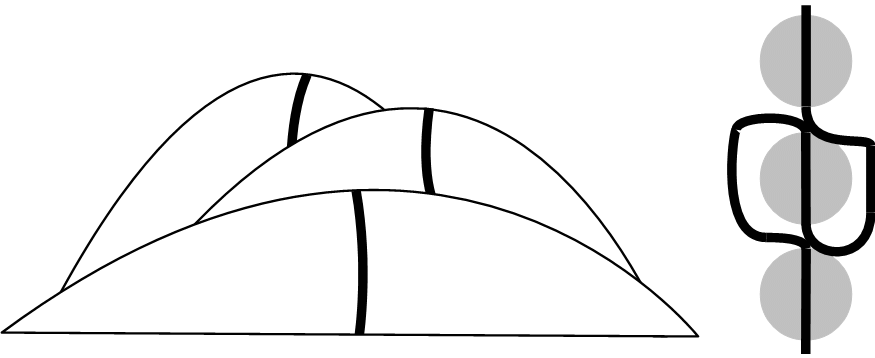
The next paragraph jumps to the molecular structure of DNA and credits Rosalind Franklin with the discovery of the double helix rather than James Watson and Francis Crick. Leaving the factual errors aside, this is an abridgement connecting landmark publications in a straight line without any regard of the contorted historical paths in between. Figure 4 (left) illustrates this, by allegory, with a path that seems to pass over three hilltops in a roughly straight line. One problem with the abridged gazebo account of Mikell (2018) is that the Mendelians turned against the Darwinians and proposed mutation as the ultimate source of variation instead of Darwin’s conditions of existence or Weismann’s sexual reproduction (Stoltzfus and Cable 2014). From an eagle-eye perspective (fig. 4, right), the street turns out to be curvy and loop back on itself at times.
 |
Fig. 4: Path over hills. Left: gazebo perspective. Right: Map-reader's view. Circles represent hills.
|
3.2 Remote perspectives
The eagle-eye perspective has its own shortcomings. In our landscape analogy, the eagle does not see what goes on under canopies and roofs. The peers of a field might seem to move coherently into the same direction, when a closer surveillance would record significant disagreements among them. Unless such disagreements boil over into overt controversies, they often get glossed over in statements made from an eagle-eye perspective, in order to give an overview or introduce to the general topic. It is a small step from there to historical oblivion.
For example, such amicable disagreements were important for the advance of theory on the evolutionary significance of sexual reproduction in the 1970s. Here is the context. In the late 1960s, evolutionary biologists took a U-turn that transformed sexual reproduction from the default mode of reproduction into an anomaly and, conversely, turned asexual reproduction into the expected but anomalously rare default mode. Weismann (1889, chap. 5) had rejected the conditions of existence as the ultimate source of heritable variation. Since he needed such a source of heritable variation, lest natural selection grind to a halt, he seized sexual reproduction as that source instead. Fisher (1930) and Muller (1932) in turn replaced it by mutation as the ultimate source of heritable variation, but they kept sexual reproduction as a mode of speeding up the population-wide process of adaptation. This implied a benefit of sex for groups, like populations or species, which got explicitly rejected in the late 1960s. Without this group benefit of sex, however, the ubiquity of sexual reproduction among animals and plants turned into an anomaly.
The pioneers George Williams, John Maynard Smith, and Bill Hamilton were not mental triplings. They disagreed on fundamental issues like the cost of sexual reproduction or the relevance of parasites for its evolutionary maintenance. In particular, Williams (1975) conceived the cost of sex as the cost of reducing the relatedness, r, of parents to their offspring from 1 to 0.5, whereas Maynard Smith (1978) conceived it as the cost of males that contribute nothing (except sperm) to reproduction. Williams’s cost occurs in all sexual reproduction, whereas Maynard Smith’s is absent from species where gametes are of equal size or both parents care equally for the offspring.
Likewise, Hamilton’s model assumptions disagreed with Williams’s. Hamilton modeled the differential effect of pathogens and parasites, that can quickly adapt to overcome their host’s defences, on asexual mutants in species with otherwise obligate sexual reproduction (e.g., Hamilton et al. 1990). Williams (2000) challenged the applicability of these red-queen models to organisms with a complex life-cycle of the strawberry-coral type. They produce (philopatric) offspring that stays close to its parents (and its parents’ pathogens and parasites) as well as dispersing offspring that gets away from the parents. However, the philopatric offspring is clonal and the dispersing offspring recombinant. If fast adapting parasites were the selective pressure keeping sexual reproduction beneficial, organisms with this life-cycle should do the opposite (see Dagg 2016; 2017 for details on these disagreements).
Accounts of such amicable but important disagreements are more likely to be gotten from the reports of participants (e.g., Trivers 2010; 2015, 195) or, vicariously, through preserved pieces of correspondence (see Dagg 2016), biographical notices, etc. Lumping these pioneers together on issues they disagreed about is unhelpful historically though not necessarily in other respects:
“It is important to realize that the ‘cost of sex’ [meaning Maynard Smith’s cost of males] and the ‘cost of meiosis’ [meaning Williams’s cost of reducing relatedness] are not different concepts.” (Bell 1982, 63)
“George Williams, whose evolutionary ideas have always seemed convergent like those of a twin or older brother from whom I was parted at birth.” (Hamilton 1996, 354)
“Anisogamy leads to a cost of sex, whether the gamete types are produced by the same individual (hermaphroditism) or by different reproductive morphs (males and females) of the same population (Maynard Smith 1971a, 1978; Williams 1975; Bell 1982).” (Jokela et al. 2009, S43)
The first quote is factually wrong, the second states a sentiment rather than a fact, and the third is a simplification lumping three scholars together (in parenthesis).
3.3 The protagonist’s or participant’s report
Gaddis (2002, 4) mentions early on that the participants in a story usually lack an expanded horizon beyond their immediate experience, unless they can find some lookout point. This leads us back to the need of a gazebo and to a rock-paper-scissors like dilemma in historiography. Each perspective has its advantages over the antecedent and its disadvantage over the subsequent.
The participant’s account of Robert Trivers (2010; 2015, 195), for example, relates how George Williams challenged one of Bill Hamilton’s theories during a memorial session for the deceased Hamilton.
“George got up and said, “I wish Bill were here today, because I have a bone to pick with him.” He then proceeded to pick that bone for the entire talk. It had to do with the evolution of sex and patterns of evidence that George had pointed out years ago that contradicted (so George said) aspects of Bill’s parasite approach. I thought it was wonderful. There were those who said that his talk was inappropriate, and why didn’t he just tell stories. But I thought it was perfect for the occasion. Both vintage George Williams – no wasted motion with that organism! – and a tribute to the enduring importance of Bill’s ideas.” (Trivers 2015, 195)
This account leaves the reader clueless as to what the disagreement of Williams with Hamilton was actually about. It lacks some lookout point from which to see the antecedent theories of Hamilton (red-queen model) and Williams (strawberry-coral model) as well. Fortunately, Williams (2000) managed to put his challenge on record (see previous section) in what seems to have been one of his last attempts at doing science before he drifted off into Alzheimer’s. Unfortunately, it has been utterly ignored—possibly—because it occurred in an obituary rather than a regular scientific article.
In conclusion, one perspective is not sufficient for historiography. Therefore, the comic format seems to be a better analogy for what is required.
4 Applying the analogy to examples
4.1 The Song of the Dodo
David Quammen’s The Song of the Dodo (Quammen 2012) belongs to the genre of popular science writing. And its concerns are not purely historical but also the environmental crisis and species extinction. But it contains enough history of science and literary craftsmanship to illustrate some narrative analoga to the comic format.
Quammen (2012, chap. 1) begins with describing the cutting of a Persian carpet into pieces as a
metaphor for habitat fragmentation, unraveling of ecosystems, and species extinction. The comic-format analogon to metaphor is a soundword like:
Chapter 2 opens with cases of species and sub-species that used to live on particular islands, like Madagascar, Bali, or Lombok, but are now extinct (Quammen 2012, 17f). These concrete examples are narrated from a map-reader’s perspective. These mementos of the environmental crisis serve to fetch readers with contemporary environmental concerns where they stand and lead them on to a history of science journey. That journey begins with a gazebo retrospective (p. 18f) that enumerates some landmarks of island biogeography: Charles Darwin’s
Origin of Species, Alfred Wallace’s
Island Life, Joseph Hooker’s publications on the botany of New Zealand, and
The Theory of Island Biogeography (MacArthur and Edward Wilson 1967). Quammen does not molest his readers with this abstract theory itself, but they do get a hunch that such a theory exists.
Quammen (2012, 19f) continues with some biographic information about Alfred Wallace and Charles Darwin. Before the biography style can put lay-readers off, however, he launches into full participation by interlacing the story of Wallace’s journey in the Malay Archipelago with accounts of his own journey on the tracks of Wallace. By this clever move, Quammen is able to tell the stations of Wallace’s journey from the participant’s perspective. Pieces of Wallace’s historical record get sprinkled into the personal experiences of Quammen or vice verse.
Thus, before he even launched the story of Alfred Wallace in the Malay Archipelago, Quammen has run an impressive gamut of narrative ploys. He has jumped perspectives from map-reader’s view over gazebo retrospective to participant’s report. He has varied his forms of representation from metaphoric to concrete and even left a hint at the existence of an abstract theory. And he has interlaced the past with the present.
4.2 Dispelling the Darkness
While John van Wyhe’s Dispelling the Darkness (2013) also deals with Alfred Wallace, it is an entirely different animal from Quammen’s Dodo. Whye begins his narrative with an account of how Alfred Wallace conceived his idea of species transmutation through natural selection while suffering a fit of tropical fever on the island Ternate. That is, he begins with a biographic protagonist’s perspective. His chapter 8, however, can serve to illustrate the narrative analogon of zooming in from a telescopic to a macroscopic scale and simultaneously retarding the passage of time to slow-motion. In this chapter, Wyhe addresses the plagiarism-claim that Wallace’s famous Ternate essay, which galvanised Darwin into writing up his theory, must have reached Darwin earlier than the latter admitted. For this, Wyhe manipulates the dimensions of scale and time.
The chapter begins with describing the island of Ternate (featuring several vintage maps), continues with describing Wallace’s house (featuring a floor map of Wallace’s house and a photography of a similar house). Wyhe reviews previous theories about these happenings (gazebo retrospective), before he zooms in to human life-size and decelerates, in order to dissect the happenings of February 1858. He takes on the hat of a ship-company’s clerk, who details the time-tables of departures and arrivals, as well as the hat of an archivist, who matches Wallace’s notebook entries with these time-tables.
It is not my job, here, to judge the correctness of Wyhe’s conclusions. His chapter stands exemplary for many scholars who have studied the time-tables of potential ships for the Ternate essay in minute detail. In the current context, it illustrates the narrative strategies of jumping dimensions of scale and manipulating the passage of time in history of science writings.
5 Conclusion
I started by suggesting that the comic format is a particularly versatile analogy for historiography. Limiting the use of analogy in history to this one would, nevertheless, constrain authors unduly. If one wished to enrich one’s prose with a diverse oeuvre of metaphors, figures of speech, paintings etc. such a constraint would indeed be gagging. I do not propose to limit the use of analogy in historiography but, figuratively, try to open a new window to fruitful analogizing. I have no other aim, here, or conclusion. A long quote from The Landscape of History indicates that John Lewis Gaddis would have appreciated the use of such a versatile analogy and the fresh air that the young sequential art would have brought to historiographical considerations.
“I fear that this chapter has staggered, even more than the others, under the weight of the metaphors I’ve inflicted on it […]. I make no apologies for metaphors, however, mixed or otherwise. […] For it seems to me that empathy – whether with respect to the past, the present, or the future – absolutely requires them. If we’re to be open to impressions, which is what I’ve argued empathy means, we’ve also got to be comparative. And that, in turn, is just another way of saying that something is “like” something else. […] If metaphors help us think – if, to use yet a final one, they can open windows and let in fresh air – then we have every reason to rely on them, and to do so unashamedly. We need all the help we can get.” (Gaddis 2002, 128)
If the comic analogy is a solution to a problem that John Gaddis never had, then that will be due to the fact that he is an accomplished history writer. The above sections showed, nevertheless, that differences in the comic and historiographic format can be used instructively (section 1.3) and that similarities can be used to to gauge the narrative craftsmanship of a history writer (section 4). This analogy may well turn out to be a useful lamp for seeing structures and functions in historiographic narratives via comparing them with the graphic techniques of comics. If the comic analogy helps any student to decipher or compose a history of science, this article will have served its purpose.
References
Bechdel, Alison. 2006. Fun Home: A Family Tragicomic. Boston: Houghton Mifflin Harcourt.
Bell, Graham. 1982. The Masterpiece of Nature: The Evolution and Genetics of Sexuality. Berkeley and Los Angeles: University of California Press.
Dagg, Joachim L. 2017. How Counterfactuals of Red-Queen Theory Shed Light on Science and Its Historiography.
Studies in History and Philosophy of Biological and Biomedical Sciences 64, 53–64.
https://doi.org/10.1016/j.shpsc.2017.06.001.
Dewilde, Fred. 2016. Mon Bataclan : Vivre encore. Paris: Lemieux Editeur.
Eisner, Will. 2000. Comics & Sequential Art. Expanded Ed. Paramus, NJ: North Light Books.
Fisher, Sir Ronald Aylmer. 1930. The Genetical Theory of Natural Selection. Oxford: The Clarendon Press.
Gaddis, John Lewis. 2002. The Landscape of History: How Historians Map the Past. Oxford: Oxford University Press.
Hamann, Alexandra, Claudia Zea-Schmidt, and Reinhold Leinfelder. 2014. The Great Transformation. Climate – Can We Beat the Heat? Comic. Berlin: Wissenschaftlicher Beirat der Bundesregierung Globale Umweltveränderungen.
Hamilton, W. D. 1996. Narrow Roads of Gene Land. Volume 1. Oxford: Oxford University Press.
Hamilton, W. D., R. Axelrod, and R. Tanese. 1990. Sexual Reproduction as an Adaptation to Resist Parasites (a Review). Proceedings of the National Academy of Sciences, 87.9, 3566–73.
Jokela, Jukka, Mark F. Dybdahl, and Curtis M. Lively. 2009. The maintenance of sex, clonal dynamics, and host-parasite coevolution in a mixed population of sexual and asexual snails.
The American Naturalist,
174(S1), S43-S53.
https://doi.org/10.1086/599080.
Jüngst, Heike Elisabeth. 2010. Information Comics: Knowledge Transfer in a Popular Format. Peter Lang.
MacArthur, Robert H., and Edward O. Wilson. 1967. The Theory of Island Biogeography. Princeton, NJ: Princeton University Press.
Mandel, Lisa, and Yasmine Bouagga. 2017. Les nouvelles de la jungle (de Calais). Turnai, BE: Casterman.
Maynard Smith, John. 1978. The Evolution of Sex. Cambridge: Cambridge University Press.
McCloud, Scott. 1994. Understanding Comics: The Invisible Art. Reprint. New York: William Morrow Paperbacks.
Morgan, Mary S., and M. Norton Wise. 2017. Narrative Science and Narrative Knowing. Introduction to Special Issue on Narrative Science.
Studies in History and Philosophy of Science, 62, 1–5.
https://doi.org/10.1016/j.shpsa.2017.03.005.
Quammen, David. 2012. The Song Of The Dodo: Island Biogeography in an Age of Extinctions. Random House.
Sacco, Joe. 2009. Footnotes in Gaza. New York: Metropolitan Books.
Trivers, Robert. 2015. Wild Life. New Brunswick, NJ: Biosocial Research Publications.
Weismann, August. 1889.
Essays Upon Heredity and Kindred Biological Problems. Edited by E. B. Poulton, S. Schönland, and A. E. Shipley. Oxford: The Clarendon Press.
Williams, George Christopher. 1975. Sex and Evolution. Princeton, NJ: Princeton University Press.
Wyhe, John van. 2013. Dispelling The Darkness: Voyage In The Malay Archipelago And The Discovery Of Evolution By Wallace And Darwin. World Scientific.